
The Six Sense Bases
Cha āyatanāniSix doors of experience — eye, ear, nose, tongue, body and mind. Everything that enters your life comes throug…


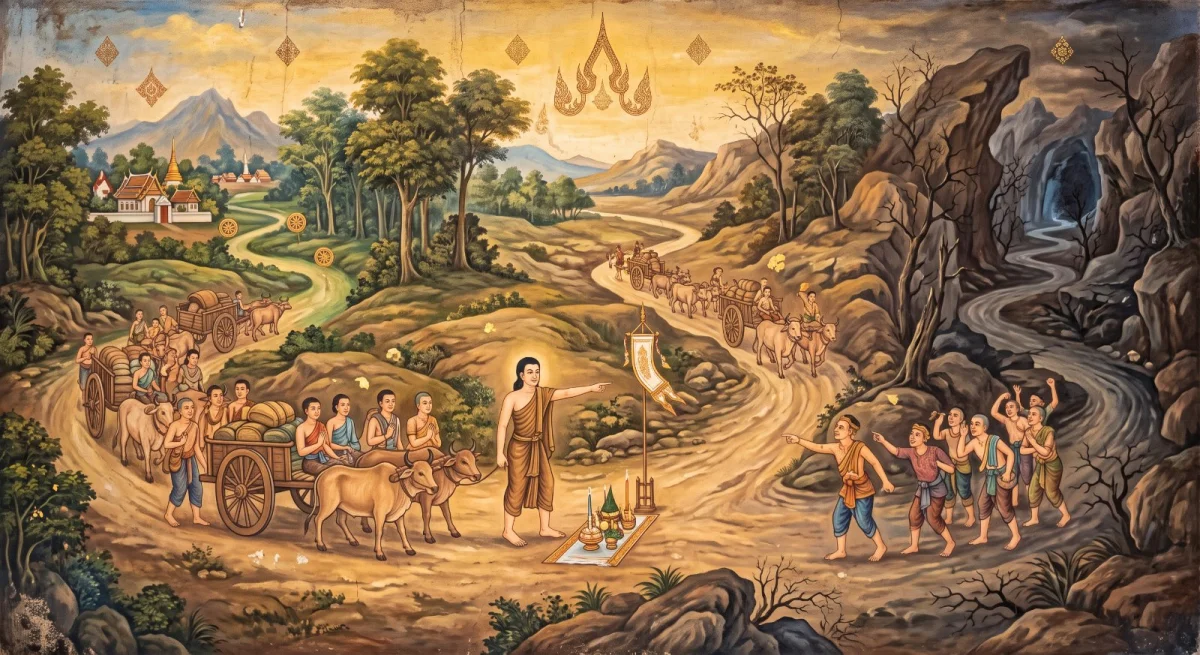
Apaṇṇakajātakaṃ
The first Jātaka in the Tipiṭaka. Its verse teaches that the wise should hold to what is sure, not to the way of guessers. The commentary tells of two caravans crossing a desert: the one that believed a deception and poured away its water perished, while the one that reasoned carefully came through safely.
In the Apaṇṇaka Jātaka of the Book of Ones (Ekanipāta) of the Jātaka, Khuddaka Nikāya, the Tipiṭaka text is a single verse: some state one position as sure, reasoners (takkika) state a second; the wise, knowing this, should take hold of what is sure. The Thai translation's heading is "on knowing what is possible and what is not".
The whole story comes from the Jātaka commentary (Jātakaṭṭhakathā). Its frame story tells how Anāthapiṇḍika brought many followers of other teachers to hear the Dhamma. They went for refuge, but when the Buddha travelled elsewhere they returned to their former beliefs, so the Buddha told a story of the past.
In the past, the Bodhisatta was a caravan merchant in Bārāṇasī. Another, careless young merchant was to travel the same route, and the Bodhisatta let him go first. The first caravan entered a waterless desert. A yakkha disguised as a traveller who seemed to have just come through rain told them there was plenty of water ahead and that they should pour theirs away to lighten the carts. The young merchant believed him, ran out of water, and his whole company perished. When the Bodhisatta's caravan arrived, the yakkha tried the same trick, but the Bodhisatta reflected that there was no sign of rain at all. He forbade anyone to pour away water and led his company safely across the desert.
The verse distinguishes two things: the sure position (apaṇṇaka), and a second way put forward by guessers or speculators. The first stands firm whatever happens; the second depends on the guess being right.
Before an important decision, ask: if what I believe turns out to be wrong, is this choice still safe? If not, you are betting on a guess.
The verse ends: the wise, knowing this difference, should take hold of what is sure. The Thai translation's heading speaks of knowing what is possible and what is not: knowing what can really happen and what cannot.
When you meet an offer with unusually high returns and no risk, treat it as impossible until you can verify it.
The commentary tells how a yakkha disguised as a traveller who seemed to have come through rain told the first caravan there was plenty of water ahead and they should pour theirs away. The young merchant believed him at once without checking. Going on, they found no water, and that company perished.
Don't sell what you have, move your savings or quit your job just because someone you've only just met says a better opportunity lies ahead.
The commentary tells how, when the yakkha tried the same trick on the Bodhisatta's caravan, the Bodhisatta reflected that this desert was known to be waterless and there was no sign of rain clouds or rain wind. The claim did not match what he could see, so he ordered that no one pour away water without his permission.
When news or information pushes you to act immediately, compare it first with evidence you can see yourself or at least one reliable source.
The commentary tells how the Bodhisatta let the young merchant set out first, seeing that those who go later find the road already opened and their oxen get freshly grown grass, while the young merchant thought going first must be an advantage.
You don't have to be first to buy the newest product or jump on a new trend. Watching how it goes for those ahead of you often gives better information.
In the commentary's frame story, people who had gone for refuge kept changing their minds. The Buddha told this Jātaka to show that failing to hold firmly to the sure way leads to harm. That is why the verse says one should take hold of it.
Once you have reflected and seen that something is truly good, such as saving money or keeping the precepts, stick with it rather than switching every time someone tries to persuade you.
The heart of this Jātaka is how to decide when information conflicts. The sure way is the one where, if your guess is wrong, you still don't suffer serious harm. The guesser's way stakes what you need on a claim you haven't checked.
Today convincing strangers offer shortcuts every day: investment messages, rumours in group chats, adverts dressed up as advice from real people. The lesson of the two merchants applies directly: don't pour away the water you have because someone says there is water ahead.
The verse itself is a short teaching; the yakkha and the desert are an illustrative story from the commentary. Read it as a teaching tale, without holding to every detail literally.
Tap to read the actual passage on the page cited.
Six doors of experience — eye, ear, nose, tongue, body and mind. Everything that enters your life comes throug…

One who does not know and see the eye, forms, sense consciousness, contact and feeling as they really are beco…
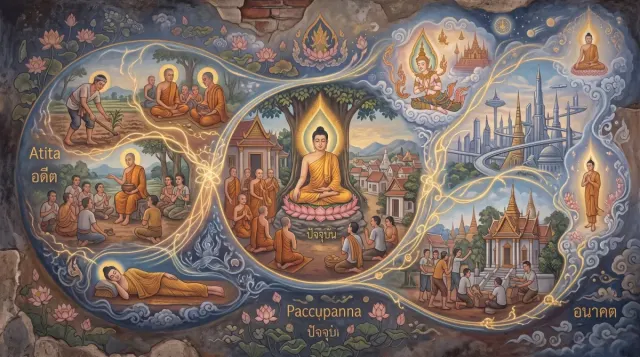
One side holds that everything exists, including the past that has ceased and the future not yet arisen. The T…

Mahāmoggallāna's verses: the happiness of forest dwelling, the body as a hut of bones, a steady mind that can …