
Outside the Walls and The Treasure Store: Dedicating to Relatives, and a Treasure No One Can Steal
Tirokuḍḍasuttaṃ · nidhikaṇḍasuttaṃDeparted relatives wait outside the walls and at crossroads. Weeping does not help them, but a gift given to t…


Cetiyarājajātakaṃ
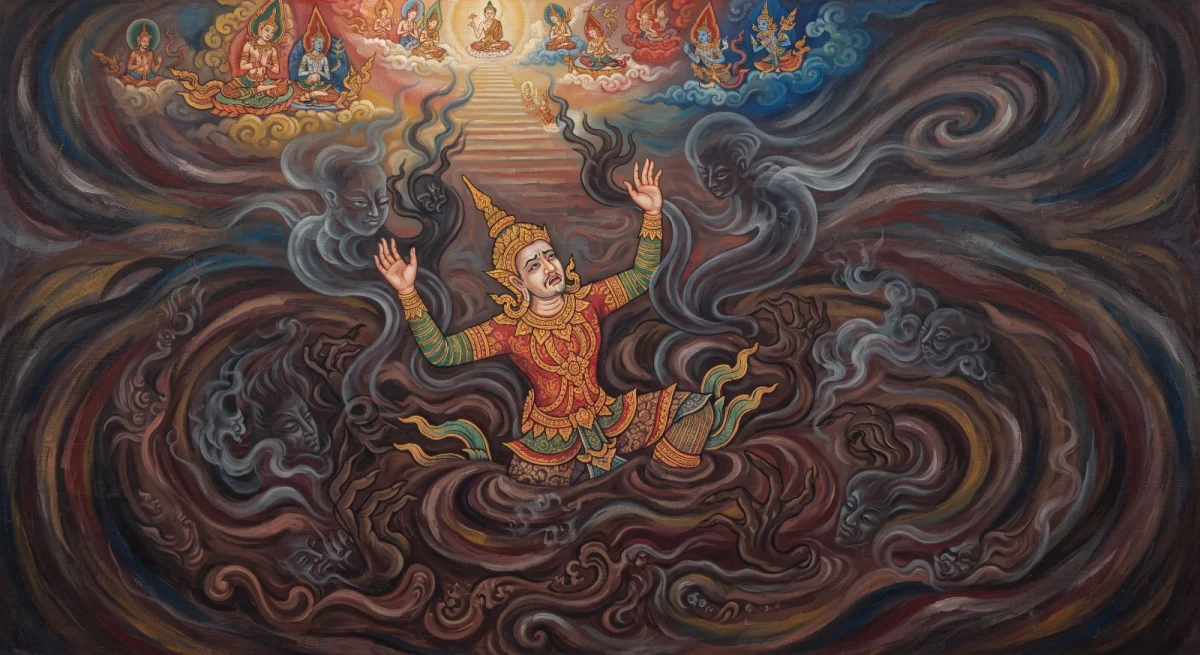
King Cetiya knows the truth but deliberately answers otherwise. A sage warns him again and again that if he speaks the truth he can be as he was before, but the king keeps repeating the lie and sinks deeper into the earth each time. The verses conclude that the wise do not praise bias born of liking, and that one should speak only truth with a mind free of ill will.
In the Cetiya Jātaka of the Book of Eights (Aṭṭhaka Nipāta) in the Jātaka, Khuddaka Nikāya, the verses open with a warning: Dhamma, when destroyed, destroys the one who destroys it; Dhamma not destroyed destroys no one, so one should not destroy Dhamma. The following verses repeat that when someone who knows is asked a question and deliberately answers otherwise, the deities depart, the mouth stinks, he falls from his position, rain does not fall in season, his tongue becomes forked like a snake's or absent like a fish's, and his sons scatter in all directions. Every verse ends: if you speak the truth, O king, you will be as before; if you speak falsely, you will sink further into the earth.
The last verse says that this king once travelled through the air, but lost his power and was swallowed by the earth. Therefore the wise do not praise going astray through liking (chandāgati); one should have a mind free of corruption and speak only words bound up with truth.
In the Tipiṭaka the Jātaka consists only of verses. The commentary tells that King Upacara of the Cetiya kingdom could travel through the air. He had once promised Korakalamba, a fellow student, the post of royal chaplain, but the post belonged to Korakalamba's elder brother, the brahmin Kapila. So the king announced he would falsely declare Kapila the younger and Korakalamba the elder. The whole city came to watch, since in that age no one yet knew what lying was. The sage Kapila warned the king with these verses; the commentary explains that the Dhamma of the first verse here means respect for one's elders. Each time the king repeated the lie he sank a stage deeper, from his ankles until the earth swallowed him entirely. The commentary says the Teacher told this story when monks were discussing how Devadatta had been swallowed by the earth.
The first verse says that Dhamma, when destroyed, destroys the destroyer; Dhamma not destroyed destroys no one. Therefore one should not destroy Dhamma, lest the Dhamma destroyed destroy you. The commentary explains that in this story Dhamma means respect for those who are elder or senior, which the king was about to distort.
Before bending a rule or the truth to help someone you like, ask yourself how you would feel if someone bent the same rule against you one day. A rule you break today will not protect you tomorrow.
Several verses repeat the phrase about one who knows and, when asked a question, answers it otherwise. The Jātaka does not blame someone who doesn't know or is mistaken; it blames knowing the truth and deliberately saying something different.
If you're not sure, say "I'm not sure, let me check" rather than guessing. And if you know the answer but it puts you at a disadvantage, still answer truthfully, or say plainly that you can't answer that yet.
Every verse ends the same way: if you speak the truth, you will be as before. The one giving the warning does not condemn the king at the first lie, but offers him the chance to correct it again and again.
When you realise you've said something untrue, correct it at the first opportunity, for example by sending a follow-up message: "What I told you earlier wasn't right; the truth is..." The sooner you correct it, the less harm it does.
The verses warn that if he still speaks falsely, he will sink further into the earth. The commentary tells that the king repeated the lie seven times and sank a stage at a time, from ankles to shins, knees, waist and navel, until the earth swallowed him entirely. He would not back down because he wanted to keep his word.
Watch for the thought "I've said it now, I can't back down", because that is the thought that leads to repeating a lie. Admitting a mistake once hurts less than having to keep inventing more.
The verses say that when someone speaks falsely the deities depart, and that person's sons scatter in all directions. The commentary tells that the four young deities who guarded the king with swords laid down their swords and vanished, unwilling to protect a liar.
Trust is what makes the people around us want to help. When we lie often, those who once stood by us gradually step back, even if no one says so. Guard the truth as you would guard a relationship.
The verses conclude that the wise therefore do not praise chandāgati, bias born of affection or liking. The commentary tells that the lie began because the king wanted to give a post to a friend as he had once promised, and explains that he ignored the warnings because of the fault of taking a bad person as a friend.
When you have to decide on work or benefits involving a close friend or relative, separate the relationship from the facts. If you can't, step back from making that decision.
The last verse says one should not have a corrupted mind, and should speak only words bound up with truth. Truth here goes together with a mind that is neither malicious nor biased.
When you have to say something true that is unpleasant to hear, first check that you are speaking to solve a problem, not to win or to shame anyone, then choose a suitable time and words.
The picture of a king sinking step by step fits real life closely. The first lie usually seems small, but when asked again, most people choose to repeat it to save face, and with each repetition the way back gets harder.
Notice that the sage leaves the door open every time. In real life too, the sooner we admit the truth, the less damage is done.
Being swallowed by the earth and having a forked tongue are the language of the Jātaka. What we can see today is that people who lie repeatedly gradually lose their credibility, their friends and their own footing.
Tap to read the actual passage on the page cited.
Departed relatives wait outside the walls and at crossroads. Weeping does not help them, but a gift given to t…

A sage who had fallen on hard times was mocked that his wisdom was no use. He replied that he knew when to wit…

A bandit who had killed many turned around and reached awakening — "I have stopped, Aṅgulimāla; you stop too."…

A good person is in no hurry to reveal others' faults but speaks fully of their virtues, admits their own faul…