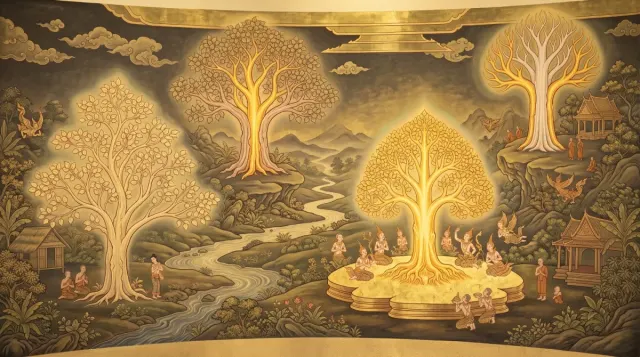
Puggalapaññatti: Four Trees — Heartwood and Softwood in a Community
Rukkhūpamā puggalāA softwood tree may be surrounded by heartwood, and a heartwood tree by softwood — a simile reminding us that …


Cullakaseṭṭhijātakaṃ
The wise can establish themselves even with small capital, as one blows a tiny flame into a great fire. The commentary tells of a poor young man who started with a single dead mouse, grew his trade step by step until he prospered, and then went back to thank the treasurer whose words had started it all.
In the Cullakaseṭṭhi Jātaka of the Book of Ones of the Jātaka, Khuddaka Nikāya, the Tipiṭaka text is a single verse: a wise and discerning person establishes himself even with a little capital, as one blows a small fire into a great blaze. The Thai translation's heading is "on the clever person who establishes himself".
The story comes from the Jātaka commentary. Its frame story concerns Cūḷapanthaka, who for a long time could not memorise a single verse, until his elder brother told him to leave the order. The Buddha gave him a clean white cloth to rub while repeating a phrase. The cloth grew soiled, he saw impermanence and attained arahantship. When the monks praised the Buddha for raising up someone who seemed to have no hope, he told a story of the past.
In the past, the Bodhisatta was the treasurer Cullaka in Bārāṇasī. Seeing a dead mouse on the road, he remarked that a wise man could take this mouse and use it to support a wife and start a business. A poor young man overheard, picked up the mouse and sold it as cat food. With that tiny sum he bought molasses and gave drinks of water to flower gatherers, who gave him flowers in return, which he sold. Step by step he expanded his trade until he prospered. Later he went to the treasurer to say his success came from the treasurer's words. The treasurer gave him his daughter in marriage and made him his heir. The commentary identifies the young man as Cūḷapanthaka.
The verse says the wise establish themselves even with a little capital. What makes the difference is not the size of the starting capital but the wisdom in using it.
Instead of waiting until you have a large sum, start with what you already have: a skill you can use, an hour a day, or small, regular savings.
The verse compares establishing oneself to building a fire: start with a small flame, gently blow and add fuel until it becomes a great blaze. Put a large log on at once and the small flame may go out.
Grow a business or investment step by step within your means. Don't borrow a large sum for something you haven't tried on a small scale first.
The commentary tells how the treasurer said a wise man could establish himself with a dead mouse on the road. People walked past; only one young man listened and actually acted. He picked up the mouse and sold it to someone who needed cat food, earning a tiny first capital.
When you hear good advice from someone experienced, try acting on at least one piece of it that week instead of letting it pass.
The commentary tells how the young man used his money to buy molasses and offered drinks of water to flower gatherers returning tired from the forest. They gave him flowers in return, which he sold, and by noticing people's needs in this way he kept expanding his trade.
Look for small hardships of people around you, at work and in your community, that you can help with. These are often where good work or good relationships begin.
The commentary tells how, once he had prospered, the young man went to the treasurer and said all his wealth came from the treasurer's words about the dead mouse. Seeing that he was wise and grateful, the treasurer gave him his daughter in marriage and made him his heir.
When you succeed, go back and thank your teacher, your first boss or whoever advised you. Gratitude often opens further good opportunities.
In the commentary's frame story, Cūḷapanthaka could not memorise a single verse for a long time, but when the Buddha gave him a suitable method, rubbing a white cloth while repeating a phrase, he realised the Dhamma. The commentary links him to the young man who started with a dead mouse in the past.
If you learn something more slowly than others, try a method that suits you, such as learning by doing instead of memorising, rather than concluding you are no good.
This Jātaka doesn't promise that anyone can get rich from one mouse. The verse's point is that wisdom and care let small capital grow, like a fire that must be gently blown and fed, not one that blazes up by itself at once.
In the story, the young man shows three strengths that work in real life: he sees value in what others overlook, he notices what the people around him need, and he builds goodwill before he gets anything back.
The frame story of Cūḷapanthaka applies to learning and training the mind too. Someone who starts slowly or learns with difficulty can still reach the goal with a method that suits them. In real life, make money honestly, without taking advantage of others.
Tap to read the actual passage on the page cited.
A softwood tree may be surrounded by heartwood, and a heartwood tree by softwood — a simile reminding us that …

The nun Bhaddā Kāpilānī tells of travelling through many lives beside the man who would become Mahākassapa, li…

King Pasenadi eats so much he is left panting. The Buddha speaks a verse: one who is mindful and knows moderat…

Ten things one who has gone forth should reflect on often: that I am no longer like a householder, that my lif…