
The Greater Discourse on Emptiness: The Danger of Socialising
MahāsuññatasuttaṃSeeing many beds laid out in one dwelling, the Buddha taught the danger of delighting in company, dwelling in …


Dhammadevaputtajātakaṃ
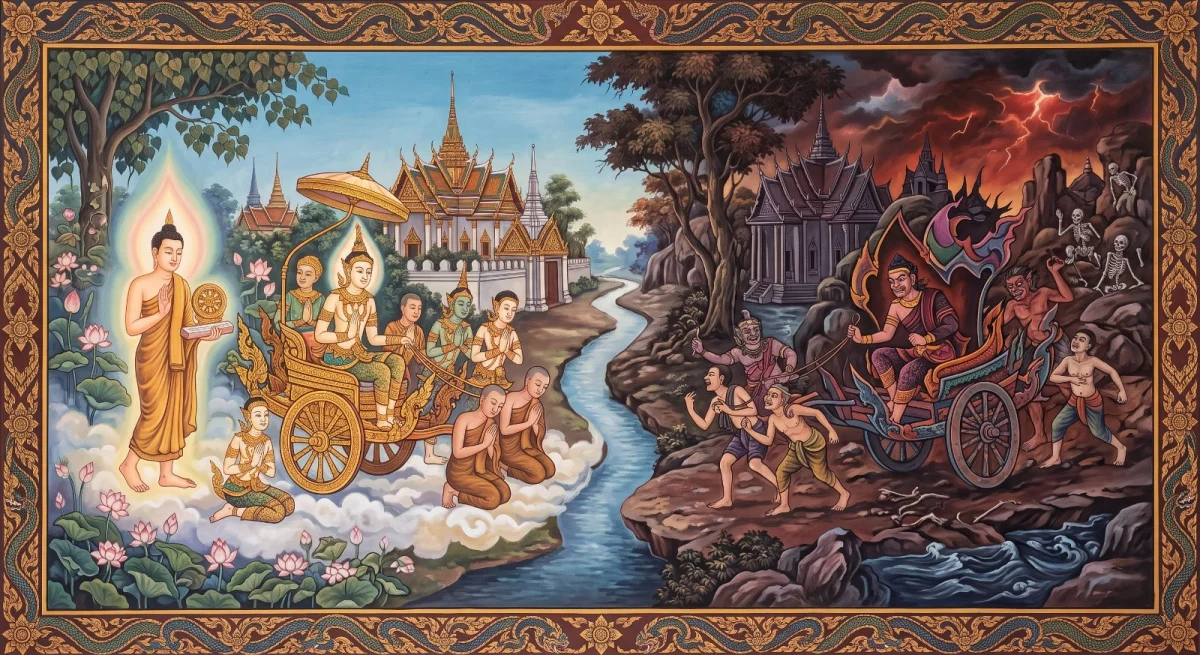
A deity named Dhamma and a deity named Adhamma meet head-on in their chariots. Dhamma asks for the road with reasons; Adhamma demands a fight, with the road going to the winner. Dhamma replies that he will give way and bear harsh words, and Adhamma falls from his own chariot. The verses conclude that one whose strength is patience overcomes the strength of battle.
In the Dhammadevaputta Jātaka of the Book of Elevens in the Jātaka, Khuddaka Nikāya, the verses are an exchange between two deities who meet on the road. The deity Dhamma asks Adhamma to give way, since he brings honour and merit, is praised by ascetics and brahmins, and Dhamma arose in the world first while Adhamma came later. Adhamma replies that he has never given way to anyone, and will not do so for a request or for what is fitting: let the two of them fight, and the road will belong to the winner. He adds that iron hammers strike gold, not the other way round.
Dhamma answers that if Adhamma is strong in battle and has no elders or teachers to respect, he will give him the road, and will even bear his harsh words. On hearing this, Adhamma falls headfirst from his chariot, lamenting that he wanted a fight but got none. The verses go on to say that Dhamma, whose strength is patience, overcame the strength of battle and drove on along the same road. The last two verses conclude that those in whose homes mother, father, ascetics and brahmins are not honoured go to a bad destination, like Adhamma falling; those in whose homes they are honoured go to a good destination, like Dhamma riding on.
In the Tipiṭaka the Jātaka consists only of verses. The commentary adds that the Bodhisatta was the deity Dhamma, who on uposatha days travelled around Jambudīpa urging people to abstain from the ten unwholesome courses of action, support their parents and practise the three kinds of good conduct, while Adhamma urged the opposite, and that their chariots met in mid-air. It explains the strength of patience here as forbearance, and says that when Adhamma fell the earth opened and he was reborn in Avīci. The Teacher told this story when monks were discussing how Devadatta had been swallowed by the earth.
When they meet on the road, Dhamma doesn't begin with threats. He gives his reasons: he brings honour and merit, ascetics and brahmins praise him, gods and humans revere him, so he is worthy of the road. Then he asks Adhamma to give way.
When you need to ask for something or reach agreement with someone who seems unfriendly, always start by explaining your reasons politely, even if you expect them not to listen.
Dhamma says that Dhamma appeared first and Adhamma arose in the world afterwards, so he is the elder, the better and the more ancient. The commentary explains that Dhamma here means the ten wholesome courses of action, which have existed since the beginning of the aeon.
When you catch yourself thinking "everyone cheats anyway", remember that honesty and consideration are the original foundation that lets a society function; the damage came later. Doing good is not the odd one out.
Adhamma replies that he will not give way for a request or for what is fitting: let the two of them fight, and the road will belong to whoever wins. This stance rejects every reason and turns the matter into a question of winning and losing.
When a conversation shifts from "what is right" to "who wins", recognise that arguing further won't settle anything. Pause the matter, or find a mediator both sides accept.
Adhamma argues that people strike gold with an iron hammer, not iron with gold; if Adhamma defeats Dhamma today, iron will look as fine as gold. He believes the hard and crude will always beat what is precious, but the ending of the Jātaka shows this belief is false.
When you see someone gain an advantage through power or aggression, remember that a temporary advantage doesn't make the method any better. What is gained by crushing others is still iron, not gold.
Dhamma answers that if Adhamma is strong in battle and has no elders or teachers to respect, he will give him the road and even bear his harsh words. On hearing this, Adhamma falls headfirst from his chariot, lamenting that he wanted a fight but got none.
On the road, when someone cuts in front of you and honks, slow down and let them go. Not retaliating doesn't make you the loser; it ends, right there, something that could have escalated.
The verses conclude that Dhamma, whose strength is patience, mighty and truly resolute, overcame the strength of battle and drove on along the same road. The commentary explains the strength here as forbearance.
Before replying to a message that makes you angry, wait a while and ask whether the reply helps you reach your original goal. If it doesn't, you don't need to reply; just carry on.
The last two verses say that those in whose homes mother, father, ascetics and brahmins are not honoured go to hell after death, like Adhamma falling; those in whose homes they are well honoured go to a good destination, like Dhamma riding on in his chariot.
Make small signs of respect at home a habit, such as greeting your parents before you leave or letting an elder finish speaking. Children at home learn more from what they see than from what they are told.
This Jātaka pictures a situation we meet often: two sides facing each other on a narrow road — on actual streets, in meetings, and in online arguments. One side wants to talk with reasons; the other wants to settle it by force or volume.
Notice that Dhamma doesn't win by fighting. He wins by giving way and bearing harsh words. This kind of patience isn't surrendering to what is wrong; it is refusing to be dragged into the game the other side has set up.
The words hell and heaven in the verses are the language of the Jātaka. In daily life, we can at least see that a home that respects parents and good people feels very different from one that respects no one.
Tap to read the actual passage on the page cited.
Seeing many beds laid out in one dwelling, the Buddha taught the danger of delighting in company, dwelling in …
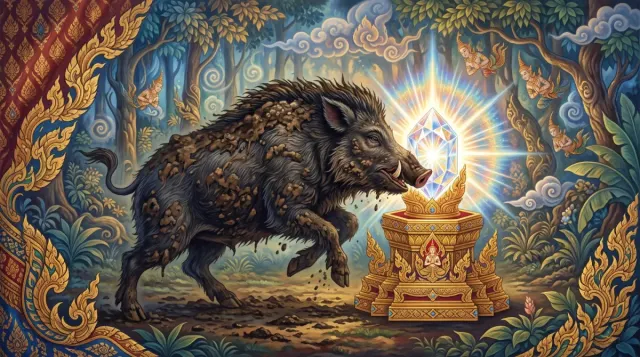
A drove of boars is frightened by a lion's reflection in the crystal at their cave mouth, so they set about ru…
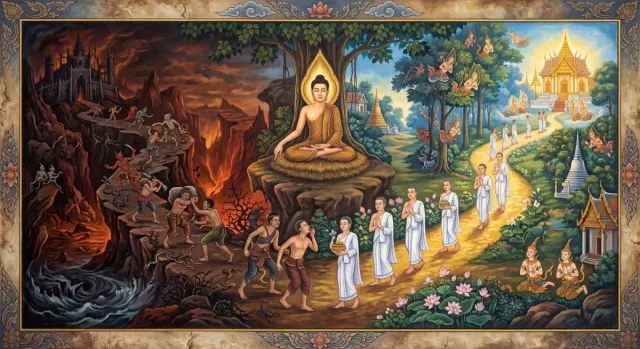
King Brahmadatta admits he has transgressed the Dhamma and asks the sage Saṅkicca where such a person goes. Th…
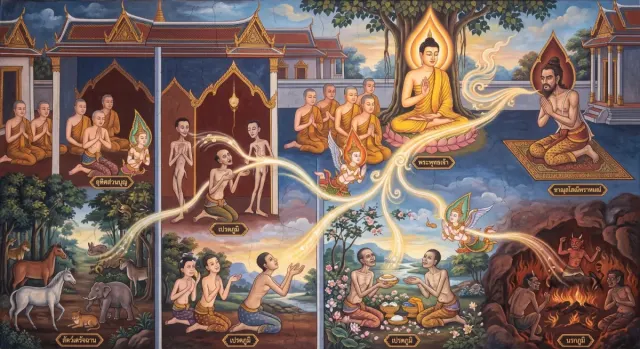
The brahmin Jāṇussoṇi asks whether gifts given for dead relatives reach them. The Buddha says they reach only …