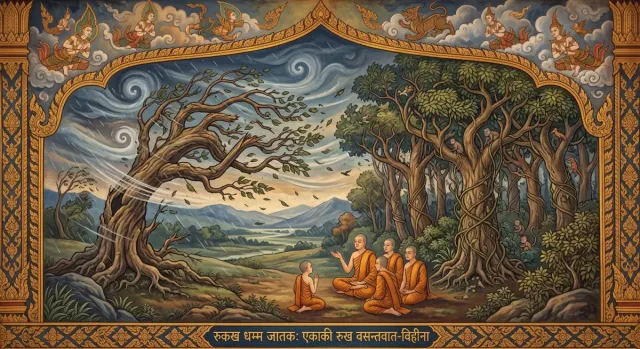
The Nature of Trees Jātaka: A Lone Tree Falls to the Wind
Sādhu sambahulā ñātīMany relatives who support one another are a good thing. Trees growing together in a forest withstand the wind…


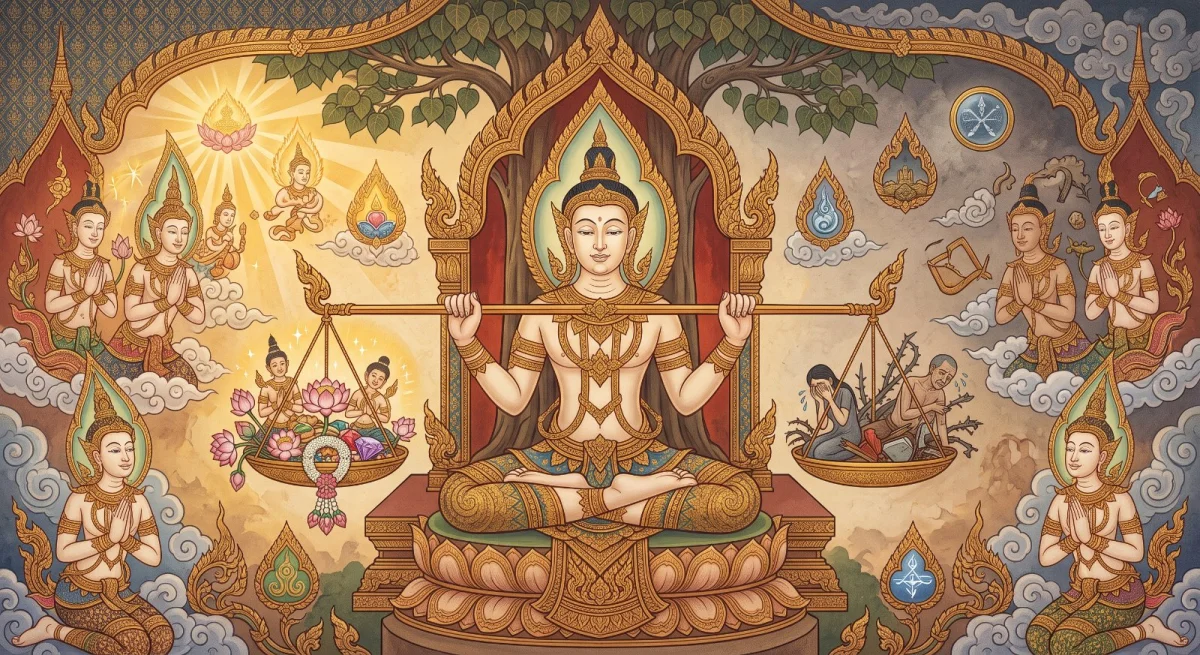
Sukhe ca dukkhe ca bhavanti tulyā
A king who once enjoyed every pleasure is thrown by an enemy into a place of hardship, yet his complexion and strength do not fade, because of the patience and austerity he had long aspired to. Good people stay balanced in both pleasure and pain, like a pair of scales.
In the Ekarāja Jātaka of the Book of Fours, Jātaka, Khuddaka Nikāya, there are four verses. King Dubbhisena asks King Ekarāja: once you enjoyed perfect sensual pleasures; now you have been thrown into a rough pit — why have you not lost your former complexion and strength? Ekarāja replies that patience and austerity were what he had long aspired to; now that he has them, why would he lose his complexion and strength? And good people, deeply cooled, are balanced in both pleasure and pain, like a pair of scales.
The background comes from the commentary. A minister who misbehaved at the Benares court was banished and incited King Dubbhisena of Kosala to seize the city. Dubbhisena had the king of Benares hung up over the threshold. The king of Benares developed loving-kindness towards his captor and attained jhāna. The commentary goes on to say that a burning arose in Dubbhisena's body; when he learned the cause, he had the king released and came to ask his forgiveness.
At the end, according to the commentary, Dubbhisena returned the kingdom, punished the minister who had incited him, and went home, while the king of Benares handed the kingdom to his ministers and went forth.
Dubbhisena says that Ekarāja once enjoyed supreme, perfect sensual pleasures and has now been thrown into a rough pit. The commentary explains that the "pit" means the place where he was hung.
When life shifts from very good to very hard, admit plainly that it has changed. Acceptance is where regaining your footing begins.
What surprises his captor is that even in hardship Ekarāja has not lost his former complexion and strength. Outward suffering has not crushed his mind.
In hard times, keep up the small things that keep you yourself: sleep, meals, chanting, or talking with people you love.
Ekarāja answers that patience and austerity were what he had aspired to from before; now that he has them, why would he lose his complexion? The commentary explains patience here as forbearance and austerity as ascetic practice. Hardship becomes a chance to train in what he had resolved on.
When you must endure something, change the question from "Why me?" to "What is this a chance to practise?"
Ekarāja says that everything that ought to be done has been completed. The commentary explains this as the giving, virtue and observance days he had kept beforehand, and the great honour newly gained as the jhāna born of loving-kindness. His mind already had a refuge.
Do good and train your mind on ordinary days; don't wait for disaster. On hard days you can only draw on what you've already stored up.
Good people dispel pleasure with pain, or dispel hard-to-bear pain with pleasure. The commentary explains that the pain of being thrown into the pit displaced the pleasure of kingship, and then the happiness of jhāna relieved that pain in turn.
On very painful days, find happiness that costs nothing — sitting quietly, walking slowly, or helping someone — to hold your mind up.
Good people, deeply cooled, are balanced in both pleasure and pain, like a pair of scales. The commentary explains that they show no change between pleasure and pain. True scales don't tip because of weight placed on one side.
Before responding to good or bad news, take one deep breath and ask: if my mind were a level balance, what should I say or do now?
Real life has days when everything is taken away: work, health or status. This jātaka doesn't say we should feel nothing. It shows that someone who has trained in patience and done good beforehand has somewhere to stand inside when the ground outside disappears.
The image of the scales works both ways. On days of praise or promotion, don't float off balance; on days of disappointment, don't sink so low you can't see a way forward.
Patience in this jātaka means not letting resentment rule the mind. It doesn't mean staying in a situation where you are being harmed. If you face violence or exploitation, look for a way out and seek help from people you trust.
Tap to read the actual passage on the page cited.
Many relatives who support one another are a good thing. Trees growing together in a forest withstand the wind…

The Buddha tells of seven Buddhas, then describes in detail the bodhisatta Vipassī, who left his 84,000 follow…

Sitting alone, the Elder Pārāsariya asks how one can do one's own task without harming anyone. The answer is t…
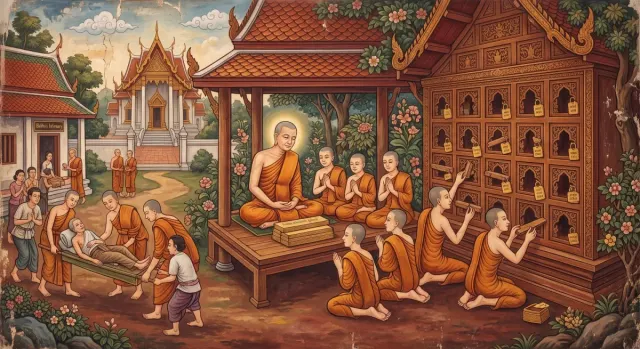
The rules on monks' sandals and leather goods. Every time the Buddha prohibited something, the group of six mo…