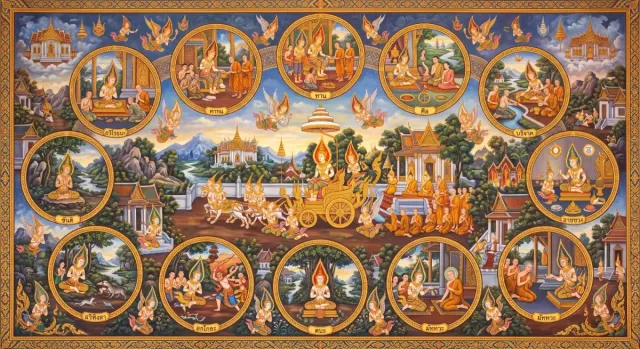
The Ten Royal Virtues
Dasa rājadhammāTen virtues of a ruler — generosity, virtue, self-sacrifice, honesty, gentleness, austerity, non-anger, non-vi…


Appena bahuṃ jeyyāma
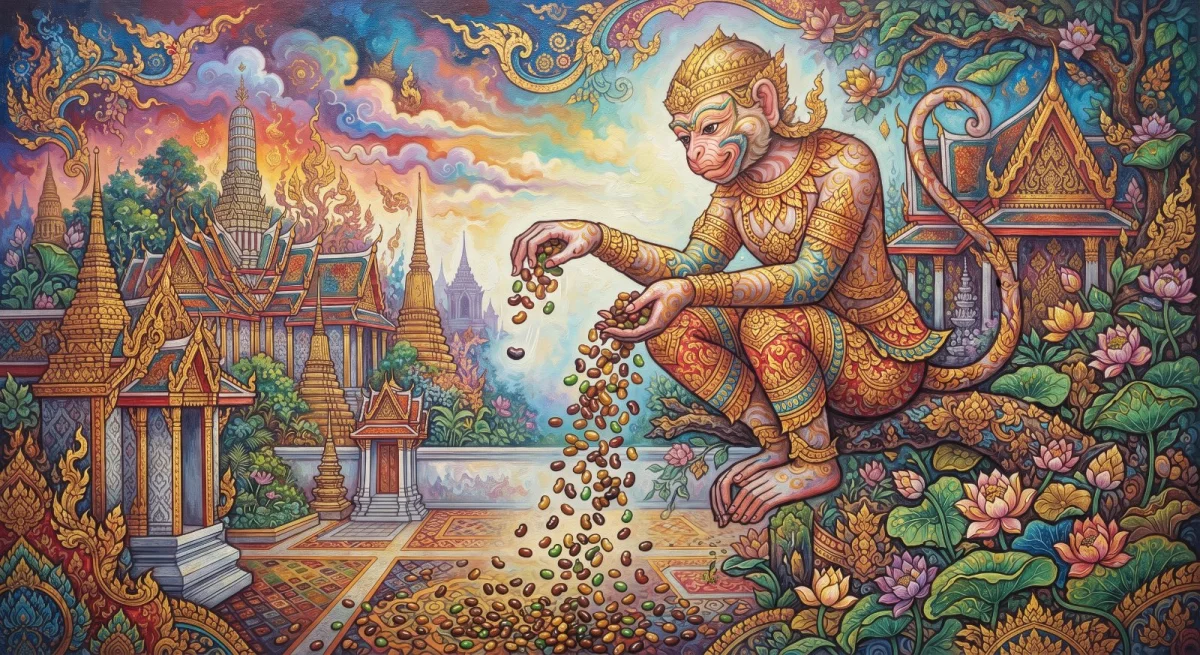
A monkey holding a handful of peas drops one, throws away all the rest to look for it, and ends up with nothing. The verses warn that the very greedy likewise lose much for the sake of a little.
In the Kaḷāyamuṭṭhi Jātaka of the Dukanipāta in the Jātaka, Khuddaka Nikāya, there are two verses. The first, addressed to the king, says this monkey that forages among the branches is a fool without wisdom: it has thrown away a whole handful of peas (kaḷāya) and searches for the single pea that fell to the ground. The second says: so it is with us, and with others who are very greedy; we lose much for the sake of a little, as the monkey lost all its peas for the sake of one.
The story comes from the commentary. The Bodhisatta was a minister who gave Dhamma advice to the king of Bārāṇasī. When unrest broke out at the border, the king set out with his army even though it was the rainy season, and camped in the royal park. Soldiers put peas for the horses in a trough. A monkey came down, stuffed its mouth full, took a handful as well, and climbed a tree to eat. When one pea slipped from its hand, it dropped all the rest to search for it, and not finding it, climbed back up and sat glumly on a branch.
The minister compared this to marching in the rainy season, when the going is hard: a small gain would be sought at the cost of many men and animals. So the king turned back. According to the commentary, the Buddha told this to King Pasenadi of Kosala, who was also about to march out in the rainy season and stopped to see the Buddha first.
The verse says the monkey threw away the whole handful of peas. The commentary says it had peas filling both its mouth and its hand, but dropped them all because just one pea fell.
When you lose something small, stop and look at what is still in your hands. Don't let a small regret make you lose everything you have.
The monkey searches for the one pea that fell to the ground. The commentary says it couldn't find it and climbed back up to sit dejected on a branch, like someone who had lost a thousand lawsuits.
If you've missed an opportunity or lost money, set a clear limit on the time for regret or repair, then return to looking after what you can still do.
The verse says this monkey has no wisdom. The commentary explains that fools who don't look at the large amount but only at the small one act just like this monkey.
Before deciding something that has upset you, write two columns: what you stand to gain, and what you may lose. Then compare them honestly.
The second verse says: so it is with us, and with others who are very greedy. The speaker includes himself and doesn't treat greed as only other people's problem.
When you laugh at someone's greed in the news or on social media, also ask yourself where you give up a lot to gain a little.
The verse concludes that the very greedy lose much for the sake of a little, like the monkey that lost all its peas for the sake of one.
Don't fall out with friends or relatives over a small sum of money. The relationship you lose is usually worth more than the money you get back.
The commentary explains that the minister compared marching in the rainy season, when ravines and streams are full of water, to seeking a small gain at an unsuitable time while losing many animals and men.
Before starting a project or an investment, ask whether the timing is right. If costs are unusually high right now, waiting for the right moment may be worth more.
In the commentary, King Pasenadi of Kosala made a point of visiting the Buddha before marching, thinking that if going would turn out badly the Buddha would say so. The king in the story of the past likewise listened to his minister and turned back.
When you must make an important decision while emotions are still running high, call someone you trust who will speak frankly before you act.
The image of a monkey throwing away a handful for one pea shows up often in real life: quarrelling with family over a small sum, spending a whole day chasing a small discount, or losing a regular customer by refusing to give a little.
The second verse is worth noticing, because the minister doesn't just say "what a foolish monkey" and stop. He includes himself: "so it is with us". Greed that sees only what is right in front of us is everyone's issue, not just other people's.
The commentary's story also teaches about timing. Even something worth doing can cost more than it gains if done at the wrong time, and pausing to take advice before deciding is not weakness.
Tap to read the actual passage on the page cited.
Ten virtues of a ruler — generosity, virtue, self-sacrifice, honesty, gentleness, austerity, non-anger, non-vi…

A young vulture who looked after his aged parents flew beyond the limit his father had warned him about and wa…
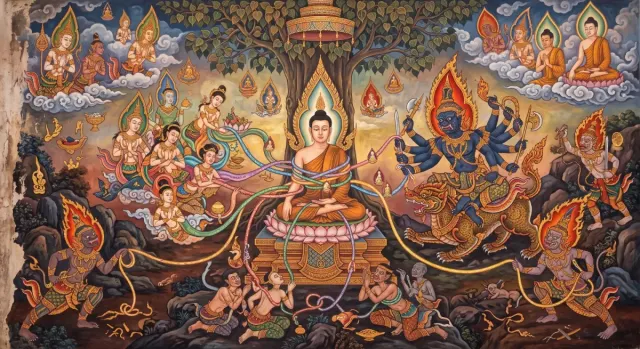
A monk asks for a teaching in brief so he can go and practise alone. The Buddha gives the shortest possible an…

Perception broken into eighteen elements — six sets of three (sense faculty, object, consciousness) — showing …