
The Treatise on Breathing: The Breath Grows Subtle Like a Fading Gong
ĀnāpānakathāThe Paṭisambhidāmagga explains in detail that as you know the long and short breath, desire and gladness make …


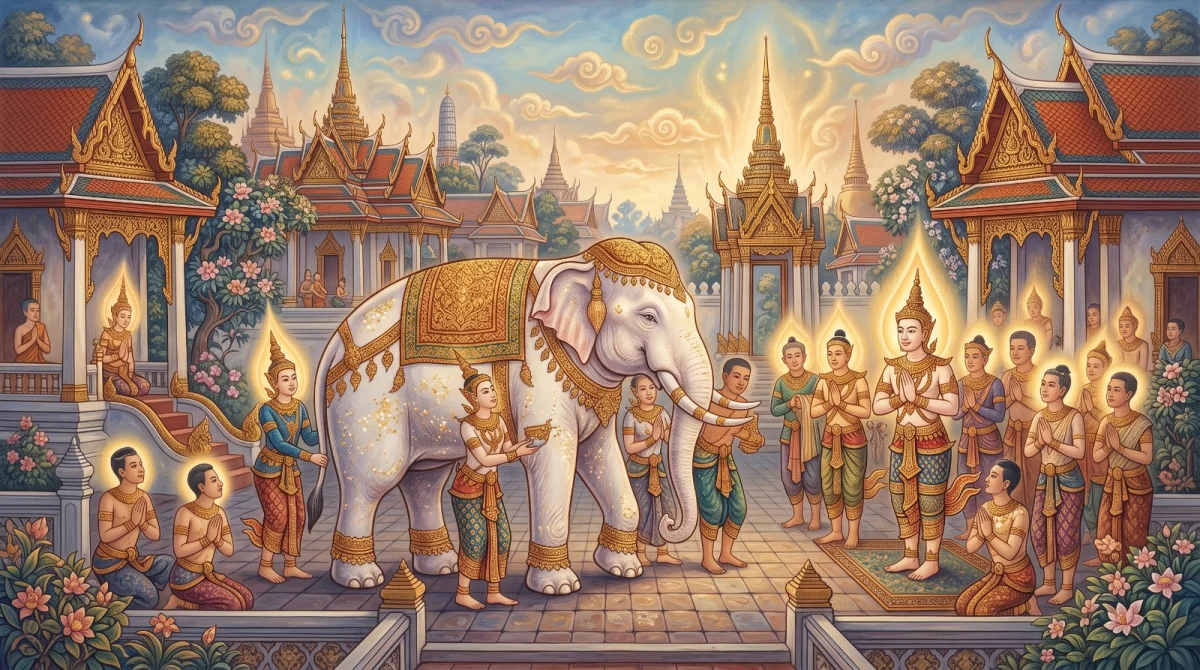
Kurudhammajātakaṃ
When drought struck Kaliṅga, envoys asked the king of Kuru for his auspicious elephant, but the rain still didn't fall. So they came back to ask for the five precepts the Kuru people kept so carefully — from the king down to the gatekeeper, each worried that some small incident had tarnished their virtue.
In the Kurudhamma Jātaka of the Tikanipāta in the Jātaka, Khuddaka Nikāya, there are three verses. Brahmins tell the king that, knowing his faith and virtue, they have come to ask for his elephant the colour of añjana flowers to take to Kaliṅga. The king says that whoever comes to him with a purpose, whether someone he supports or not, should not be refused; this is the word of the teachers of old. He then gives the elephant with its ornaments and its trainer.
The rest comes from the commentary. The Bodhisatta was King Dhanañjaya Koravya of Kuru. He kept the Kurudhamma, which the commentary explains as the five precepts, and ten others kept them just as he did. In Kaliṅga there was drought, famine and disease, so brahmins were sent to ask for the auspicious elephant. But when the elephant arrived the rain still didn't fall. The king of Kaliṅga sent the elephant back and had envoys ask for the Kurudhamma to be written on a gold plate.
The envoys went to one person after another, and each declined, thinking their virtue might be tarnished by some small matter. The envoys pointed out that without intention the precepts are not broken, and wrote down each person's virtue. When the king of Kaliṅga kept the five precepts, rain fell throughout the land. The commentary says the Buddha told this story because of a monk who killed a goose by flicking a pebble at it.
In the first verse, the brahmins say they know the king's faith and virtue, and so dare to ask for the añjana-coloured elephant to take to Kaliṅga. The commentary explains faith as belief in action and its results, and virtue as restraint, not transgressing.
Think about what kind of person those around you know you to be. A reputation for integrity is built from small actions repeated every day.
The king says that whoever comes to him with a purpose, whether someone he supports or not, should not be refused; this is the word of the teachers of old. The commentary explains that these teachers of old are one's parents. He then gives the elephant with its ornaments and trainer.
When someone comes asking for help, even if you can't do everything, listen and help as far as you can rather than brushing them off at once.
In the commentary, once the elephant reaches Kaliṅga the rain still doesn't fall. The king of Kaliṅga hears that rain falls in Kuru because of the king's virtue, not because of the elephant. So he sends it back and has envoys go to write down the Kurudhamma, the five precepts, on a gold plate.
When your home or team has problems, before looking for an object or ritual to fix things, look first at the behaviour behind them, such as how people speak, how work is shared, or honesty with one another.
In the commentary, the king shoots arrows to the four directions at a festival. One falls into the water and can't be found, so he worries that it may have killed a fish. The envoys say that without intent to kill it isn't killing, and write down the five precepts from him: not killing, not stealing, no sexual misconduct, no false speech, and no intoxicating drink.
When you realise something you did may have affected others unintentionally, take note and be careful next time, without punishing yourself as if you had done wrong on purpose.
In the commentary, the land surveyor has to plant his stake in a crab's hole, since moving it would shortchange either the crown or the farmer, and then worries that the crab died. The viceroy worries that his retinue stood waiting in the rain all night. The charioteer worries that the horses now race every time they pass the spot where he once urged them on. Each is told that without intention there is no kamma.
When your work involves giving orders or keeping others waiting, think of those on the receiving end, for example by giving clear times so no one waits needlessly.
In the commentary, the chaplain refuses a fine chariot the king offers him, because he had wanted it beforehand. The merchant worries that he had a handful of rice ears tied from a field whose royal share hadn't yet been paid. The grain measurer worries he tipped the counting grain onto the wrong heap. The gatekeeper worries that he mistakenly called a man's sister his wife.
Check your honesty in small things, such as using shared supplies for personal use, logging extra hours, or stating guesses without checking, and correct them when you find them.
In the commentary, the envoys give each person the same kind of answer: an action without intention is not kamma; a desire merely arising in the mind is not theft; and one who shrinks from something this small could hardly commit a serious breach. When the king of Kaliṅga keeps the five precepts, rain falls throughout the land.
When you feel guilty about something small, ask two questions: did I intend it, and what can I put right? If you didn't intend it and have put it right, forgive yourself and move on.
This Jātaka carries two lessons that should be read together. The first is care in keeping the precepts: each character pays attention even to effects they didn't intend, such as a crab in its hole or people left standing in the rain. The second is the envoys' reply that the precepts aren't broken by what one didn't intend. Care should come with understanding, not endless self-blame.
The lucky elephant also fits today. Troubled organisations and families often look for an object or ceremony to fix things, but what really improves a group is how the people in it behave.
If someone keeps feeling guilty about small things until it causes distress or they can't function, that may be anxiety worth discussing with a professional, not a sign they need to be stricter with themselves.
Tap to read the actual passage on the page cited.
The Paṭisambhidāmagga explains in detail that as you know the long and short breath, desire and gladness make …

The Buddha asks Sāriputta what benefit a monk whose defilements are destroyed sees, that he still shows the ut…

A street chief in Haṃsavatī gathered his whole neighbourhood — cooks, dyers, smiths, water-carriers, cake-sell…

Eight qualities of the great ocean the Buddha compared to his Dhamma and discipline — gradually deepening, nev…