
Dhammasaṅgaṇī: The Mātikā, Matrix of the Abhidhamma
Kusalā dhammā akusalā dhammā abyākatā dhammāThe Dhammasaṅgaṇī opens with the mātikā, a list of 22 triads and 142 dyads for classifying phenomena — such as…


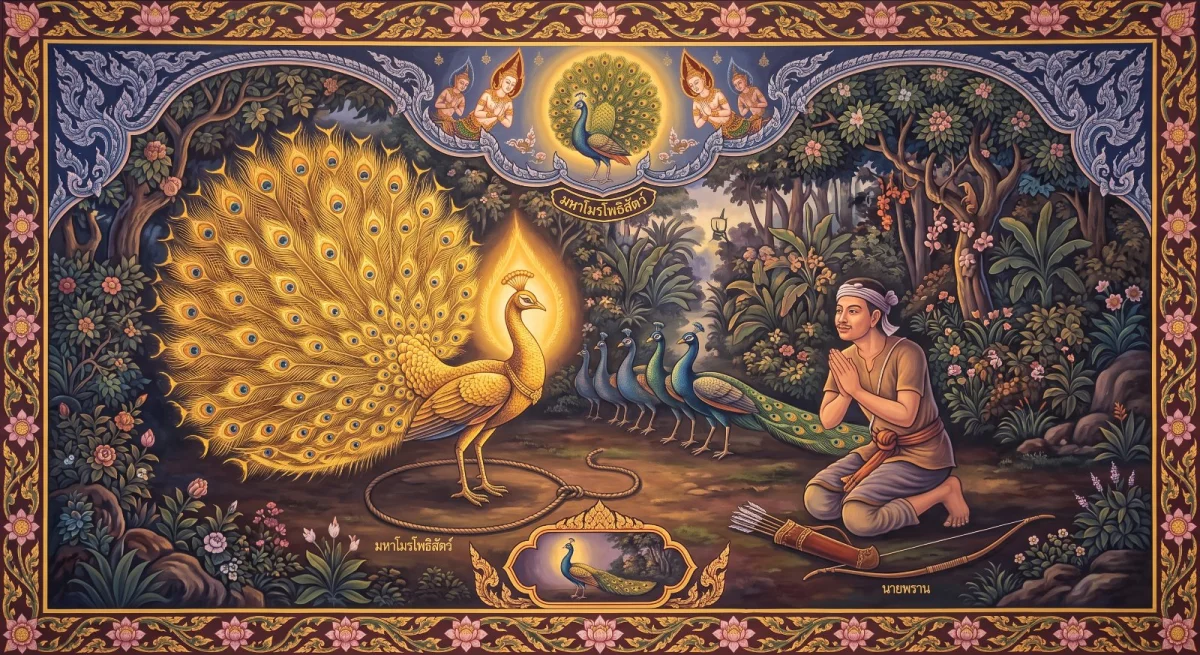
Mahāmorajātakaṃ
A hunter spends seven years trying to snare a peacock king, yet once he catches it he means to let it go. The peacock asks why, and their conversation shows the hunter that the view that good and bad deeds bear no fruit is wrong. He gives up hunting like a snake shedding its skin and frees all the birds he had caged.
In the Mahāmora Jātaka of the Miscellaneous Book (Pakiṇṇaka Nipāta) in the Jātaka, Khuddaka Nikāya, the verses begin when the peacock king is caught in a snare and asks the hunter: if you caught me for wealth, don't kill me; take me alive to the king and you will get much. The hunter replies that his arrow is not for killing him today; he will cut the snare so the peacock king can go as he pleases. The peacock asks: you pursued me for seven years, enduring hunger and thirst night and day — why now release me? Have you given up killing today?
The hunter asks what happiness awaits one who abstains from killing and gives safety to all beings. The peacock answers that such a person is praised in this life and goes to heaven at death. The hunter tells how he had believed ascetics and brahmins who taught that there are no gods, that good and bad deeds bear no fruit and that giving was invented by fools, and so he harmed birds. The peacock asks about the moon and the sun and points out that those views are thereby refuted. The hunter agrees and asks what he should do so as not to fall into hell. The peacock advises him to go and ask peaceful renunciants. The hunter declares that he has abandoned the hunter's life like a snake shedding its old skin, and gives life to the hundreds of birds caged in his home. The last verse says the hunter went out to snare the peacock king, but was himself freed from suffering.
In the Tipiṭaka the Jātaka consists only of verses. The commentary adds that the Bodhisatta was a golden peacock in the Himalaya who recited protective verses every morning and evening. Kings over several reigns sent hunters who failed to catch him; the seventh hunter used a trained peahen's call, and the peacock, stirred by desire, forgot his verses and was caught. Seeing that such a virtuous creature should not be harmed, the hunter resolved to free him, and after hearing the teaching attained paccekabodhi. The commentary says the Teacher told this story to a monk who was discontented and wished to disrobe.
The peacock asks: you pursued me for seven years, enduring hunger and thirst night and day; now that I am caught, why do you want to set me free? The hunter had striven for a long time, yet on the day he got what he was after, he could still stop to think and choose not to harm.
When a goal you've worked hard for is nearly achieved, but you see that reaching it means harming someone, have the courage to stop. Past effort is no reason to keep going down the wrong path.
The hunter asks what happiness awaits one who abstains from killing and gives safety to all beings. The peacock answers that such a person is praised in this very life and goes to heaven when the body breaks up.
Try to let the people and animals around you feel safe near you — no threats, no shouting, no taking frustration out on pets or strays.
The hunter says some ascetics and brahmins teach that there are no gods, life ends here, good and bad deeds bear no fruit, and giving was invented by fools. Trusting the words of those he took to be arahants, he harmed birds. The commentary explains that these were ascetics close to the hunter's family.
Check where the beliefs you use as excuses — "everyone does it" or "it's fine if no one sees" — came from, and whether that source is really trustworthy.
When the peacock points out that those views are refuted, the hunter says: surely what you say is true — how could giving be fruitless? Then he asks what he should do, how he should live, and whom he should associate with so as not to fall into hell.
When you find a belief of yours was wrong, say plainly, "I misunderstood this," then ask what you should do, instead of looking for excuses.
The peacock doesn't answer everything himself. He advises that there are renunciants in ochre robes, living homeless, going for alms in the morning, not wandering at the wrong time, peaceful; go to them at a suitable time and ask what you wish to know, and they will explain the good of this world and the next as they understand it.
When you have an important question about life, find someone whose way of living matches what they say, and arrange a time convenient for them so you can ask attentively.
The hunter says he has abandoned the hunter's life, as a snake sheds its old skin or a green tree drops its yellow leaves; today he gives up being a hunter.
If some part of your work or habits harms others, begin shedding it piece by piece — for example, stop using sales tactics that mislead customers, even if sales dip at first.
The hunter says that to the hundreds of birds he has caged at home he gives life today; may they be freed and go to their own homes. The last verse sums up that the hunter set out with a snare to catch the peacock king, but was himself freed from suffering. The commentary tells that all the birds were released through his act of truth.
Once you decide to change, look back at what needs putting right from your past actions — returning something, apologising, or ceasing to pressure someone you used to pressure.
This Jātaka shows that someone who has done wrong for a long time can change in a single day, if they see the truth clearly and someone answers their questions reasonably and without contempt. Even while hanging upside down in the snare, the peacock answers the hunter calmly.
A caution: in real life, people whose work causes harm can't always change careers at once; they may have family obligations or debts. Starting by reducing the harm step by step is part of the same journey.
Another lesson is that our views come from the people we listen to. The hunter harmed birds because he believed the wrong teachers; when he heard better reasons, he was ready to change.
Tap to read the actual passage on the page cited.
The Dhammasaṅgaṇī opens with the mātikā, a list of 22 triads and 142 dyads for classifying phenomena — such as…

The Parivāra sets out five ways a formal act of the Saṅgha fails: in its subject matter, its motion, its annou…

The Buddha's foot is cut by a stone splinter, causing sharp pain. He bears it mindfully and with clear compreh…

A piece of sugar cane, four fruits, a field watchman's portion of kummāsa, food for a weary monk — stories fro…