
The Fruits of the Contemplative Life
SāmaññaphalasuttaṃKing Ajātasattu asks whether going forth yields any fruit visible in this life. The Buddha answers step by ste…


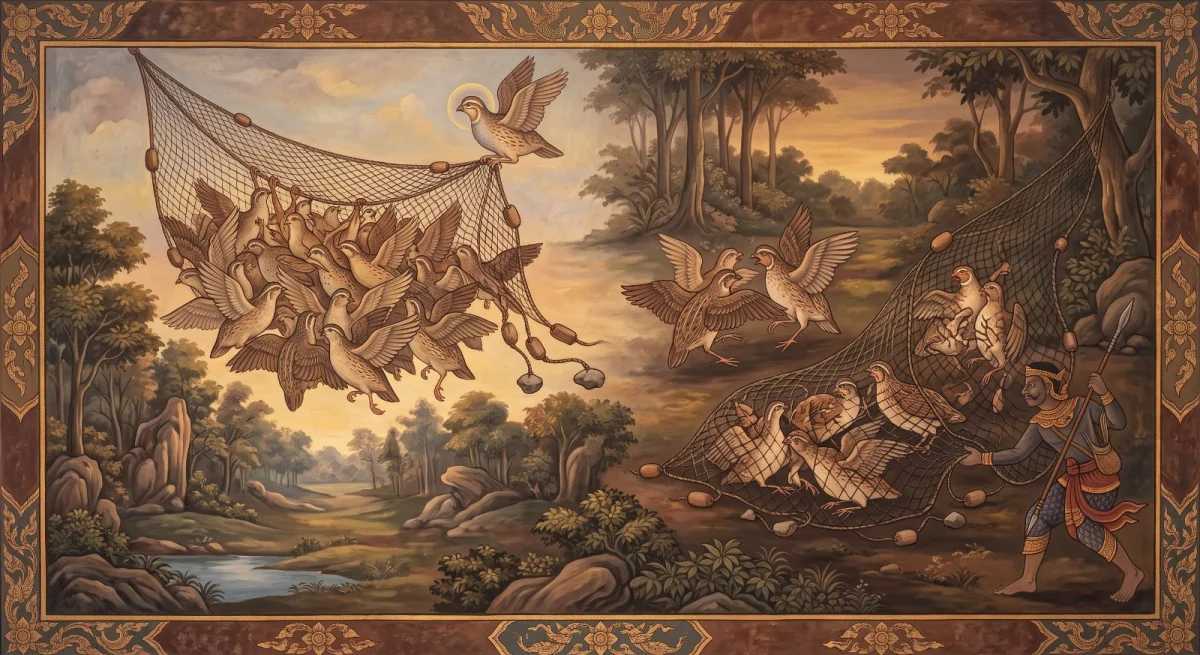
Sammodamānā gacchanti jālamādāya pakkhino
A flock of birds works together to lift a fowler's net and fly away with it day after day, until they quarrel over something small and each waits for the other to lift. The story teaches that division opens the door to danger.
The Sammodamāna Jātaka in the Ekanipāta of the Jātaka, Khuddaka Nikāya, has a single verse: the birds, in harmony, carry off the net; when they quarrel, they will fall into my power. The commentary says this verse was spoken by the fowler.
In the Tipiṭaka the Jātaka consists only of verses; the story comes from the commentary. The Bodhisatta was born as the leader of a flock of several thousand quails. A fowler would imitate their call to gather them, then throw a net over them. The Bodhisatta taught the flock that when the net fell, each bird should put its head through a mesh, and together they should lift the net, fly off, drop it on a thorn bush, and escape from underneath. For many days the fowler spent until dark freeing his net and went home empty-handed.
Then one bird, landing to feed, accidentally trod on another's head. Although it said it hadn't meant to, the other stayed angry, and the quarrel grew into "I suppose you're the only one who lifts the net." The Bodhisatta saw that there is no safety in quarrelling and led his own followers elsewhere. When the fowler came again, the remaining birds each told the others to lift the net, and all were caught. The commentary says the Buddha told this story to warn his quarrelling relatives.
The verse says the birds, in harmony, carry off the net. The commentary tells how, when every bird put its head through a mesh and flew at once, the whole net rose and was carried off and dropped on a thorn bush.
For a task that seems too heavy, such as caring for a sick parent or organising a big event, divide the roles clearly and act together.
The commentary says the Bodhisatta did not just tell the flock to be united; he explained the method step by step: put your head through a mesh, lift and fly, drop the net on a thorn bush, and escape from underneath.
When asking a team to cooperate, also say what each person should do, when and how. Cooperation comes much more easily.
The commentary says one bird accidentally trod on another's head and asked it not to be angry, but the other stayed angry. A small thing that should have ended with an apology became a quarrel for the whole flock.
When someone admits a mistake and apologises, let the matter end there. Don't carry it on and turn it into the whole relationship.
The verse is the fowler's words. He saw that as long as the birds stayed in harmony he could not catch them, but when they quarrelled they would fall into his power. Those who wish harm need only wait for the day a group splits.
When siblings fight over an inheritance or a team splits into factions, remember that the ones who really gain are often outsiders.
The commentary says that when the fowler threw the net again, the birds said to each other, "Didn't you lift the net until your feathers fell out? Go on, lift it then." Each waited for the other to do the work, no one lifted the net, and all were caught.
In a team, when you start hearing "You're so clever, do it yourself," talk it through quickly before shared work becomes nobody's responsibility.
The commentary says the Bodhisatta saw that there is no safety in quarrelling, so he led his own followers to live elsewhere. He did not join the quarrel and did not stay where danger was about to come.
If you can't stop a quarrel, at least don't take sides, and keep those in your care out of that conflict.
The image of birds lifting a net together fits any group — a family, a team, a community or a country. A big problem that no one can carry alone can often be lifted when everyone pulls together.
Notice that the split did not begin with anything big. It began with an accidental step on someone's head, then one side refused to accept the apology, and the small matter grew into arguments about who had done more.
Tap to read the actual passage on the page cited.
King Ajātasattu asks whether going forth yields any fruit visible in this life. The Buddha answers step by ste…

Two consecutive debates in chapter 3. One side holds that a mind with lust is liberated, and that a mind alrea…

Three sets from the section on fours: those who praise or blame, trust or distrust without reflecting; those w…
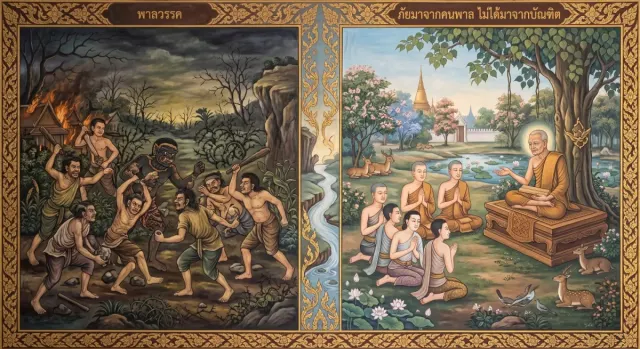
All fears, dangers and troubles arise from the fool, not from the wise, like a fire from a hut of reeds that b…