The Discourse on Perfection: Six Kinds of Conceit, Raising and Lowering Oneself
Mānaṃ omānaṃ atimānaṃ adhimānaṃ thambhaṃ atinipātaṃSix things to give up before realising arahantship: conceit, the sense of being inferior, arrogance, overestim…


Dhotakamāṇavapucchā
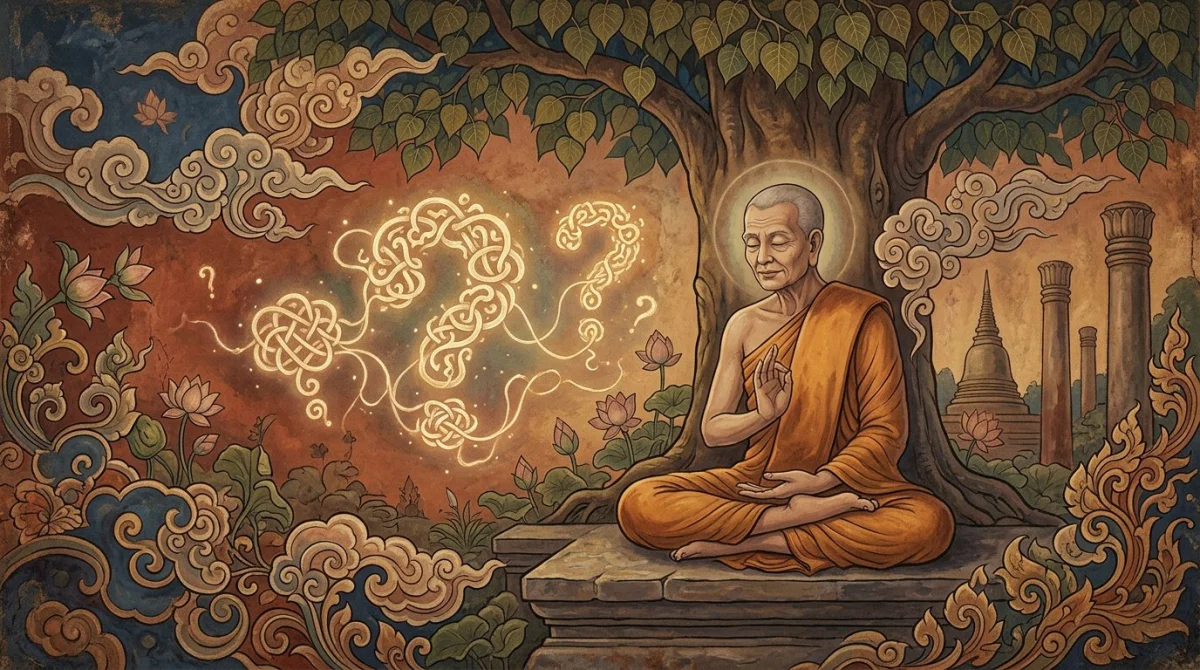
Dhotaka asks the Buddha to free him from doubt. The Buddha says he cannot free anyone from doubt; by knowing the supreme Dhamma yourself, you will cross this flood.
In the Pārāyana Vagga of the Sutta Nipāta, Khuddaka Nikāya, the young brahmin Dhotaka is one of the brahmin Bāvarī's sixteen pupils who go to question the Buddha. He says he longs to hear the Buddha's voice and then train himself for his own quenching. The Buddha replies: then be prudent and mindful, make an effort right here; having heard the sound from here, train for your own quenching.
Dhotaka pays homage and asks the Buddha to free him from doubt. The Buddha answers plainly: I am not able to free anyone in the world who is still in doubt; but when you know the supreme Dhamma, you will cross this flood yourself.
Dhotaka then asks for the teaching on seclusion that he should understand, so that he may live unobstructed like space. The Buddha describes a peace visible here and now, and teaches him to see whatever he knows, above, below and across the middle, as a tie in the world, and not to create craving for any kind of existence.
When Dhotaka says he wants to hear the Buddha's voice, the Buddha says: then be prudent and mindful and make an effort right here; having heard the sound from here, train yourself for your own quenching.
After hearing a Dhamma talk or reading a book, write down one point you'll actually try this week, rather than just finishing and moving on.
Dhotaka asks to be freed from doubt. The Buddha says he is not able to free anyone in the world who is still in doubt; but knowing the supreme Dhamma, you yourself will cross this flood in this way.
Stop looking for people to confirm again and again that you're doing it right. Once your principles are clear enough, act and see the results yourself.
Dhotaka asks to be taught the Dhamma of seclusion that he should understand, so that he may be unobstructed like space and, right here, live calm and independent.
Notice what your mind got snagged on today — someone's words, some event — and let it pass like wind through an open space.
The Buddha says he will describe a peace visible here and now, evident to oneself, which, once understood, lets one who is mindful cross over the craving that spreads through the world.
Peace needn't wait for a long holiday or a distant retreat. Find the short moments of calm already in your day and get to know them clearly.
He says: whatever you know, above, below and across the middle, understand it as a tie in the world, and do not create craving for any kind of existence.
When you feel "I'll only be happy once I become that", see the thought as a tie and don't simply believe it.
In the same section, the young brahmin Hemaka says that the teachings of earlier teachers were all hearsay, not evident to oneself, and only increased speculation. The Buddha says that those who have understood the unchanging state of nibbāna, which dispels desire and lust for pleasing things seen, heard and sensed, and who are mindful, cross over the craving that spreads through the world.
If reading or hearing many opinions only makes you think in circles and feel more confused, stop taking in more, and look at the craving in your own mind instead.
Many people hope a teacher, a book or a course will make their doubts about life disappear. The Buddha's answer to Dhotaka is very honest: a teacher can point the way, but doubt ends only when we know and see for ourselves.
This doesn't mean we don't need teachers — the Buddha goes on to teach Dhotaka in detail. But the learner's role is to listen and then train, be mindful and make an effort, not wait for someone to hand over a ready-made answer.
In daily life, when you hesitate about your practice, shift from looking for someone to reassure you to acting and seeing the results for yourself.
Tap to read the actual passage on the page cited.
Six things to give up before realising arahantship: conceit, the sense of being inferior, arrogance, overestim…

Four stages of realisation, measured by which fetters have been abandoned — not by unusual experiences or anyo…
Upāli's past lives according to the Apadāna: a proud brahmin, a prince intoxicated with his birth who drove an…

Three monks' rules about those the Saṅgha appoints to a duty. The group of six taught nuns without appointment…