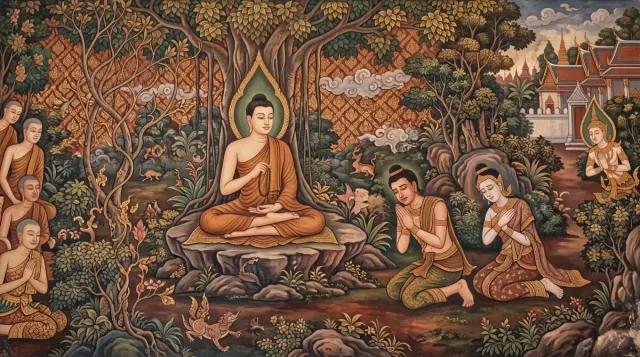
The Dasaratha Jātaka: Wise Rāma and the News of His Father's Death
DasarathajātakaṃWhen news comes that their father the king has died, everyone weeps, but wise Rāma does not grieve. He explain…



Pāṭaligāmiyasuttaṃ
Arriving at Pāṭaligāma, the Buddha tells the lay followers that an immoral person faces five dangers — from loss of wealth, bad reputation and lack of confidence among people to dying confused — while a virtuous person gains the five opposite benefits. Also included: the verse on crossing the Ganges and the monk who stubbornly took his own road.
In the Pāṭaligāmiya Sutta of the Udāna, Khuddaka Nikāya, the Buddha, wandering in Magadha, arrives at Pāṭaligāma. The lay followers there invite him to stay in their rest house, spreading the seats, setting out a water pot and lighting an oil lamp. When all are seated, the Buddha speaks to the householders about the five dangers of failure in virtue for the immoral and the five benefits of accomplishment in virtue for the virtuous, and goes on teaching late into the night.
The same discourse tells that the Magadhan ministers Sunīdha and Vassakāra are building a town at Pāṭaligāma to ward off the Vajjians. The Buddha says it will become a foremost city, but will face three dangers: fire, water and internal dissension. Reaching the Ganges in full flood, where people are looking for boats and rafts, he utters a verse about crossing the flood by the bridge of the noble path.
This page focuses on the teaching directly for householders and adds the account from the Dvidhāpatha Sutta in the same chapter. The discourses on nibbāna, on Cunda's alms meal and on Visākhā's grandchild who died are close to principles already covered elsewhere, so they are not included here.
The immoral person suffers great loss of wealth because of heedlessness, while the virtuous person gains a great mass of wealth because of heedfulness.
Look at last month's spending for money lost through heedlessness — fines, gambling, drinking or impulse buying — and cut one item at a time.
A bad reputation spreads about the immoral person, while a good reputation spreads about the virtuous person.
Before doing something you wouldn't want anyone to know, ask yourself whether you'd still do it if it were being talked about at work tomorrow.
Whatever assembly the immoral person approaches — of nobles, brahmins, householders or ascetics — they approach without confidence, embarrassed. The virtuous person approaches with confidence, unembarrassed.
Notice whether, entering a meeting or meeting someone important, you worry that someone might know what you've kept hidden. Real confidence comes from having nothing to hide.
The immoral person dies confused, while the virtuous person dies unconfused.
Ask yourself what you'd want to see if you looked back on your life on your last day, and start doing that today.
At death, the immoral person is reborn in a state of deprivation, a bad destination, the nether world, hell, while the virtuous person is reborn in a good destination, a heavenly world.
However much you believe in a next life, virtue already brings four benefits in this one, so keeping it can never be a losing bet.
Reaching the Ganges in full flood, where some people look for boats and some for rafts, the Buddha and the Saṅgha appear on the far shore. He utters a verse: those who cross the flood of saṃsāra and the lake of craving build the bridge of the noble path, leaving the swamps of sensuality untouched. Ordinary people tie rafts even to cross a little water, but the Buddha and his wise disciples cross without rafts.
Big problems in life can't be crossed with temporary shortcuts. Ask whether you're building a solid bridge or just finding a raft to get through each day.
In the Dvidhāpatha Sutta, Venerable Nāgasamāla, travelling with the Buddha, comes to a fork in the road. He says to take one road, the Buddha says to take the other, three times. Nāgasamāla puts the Buddha's bowl and robe down on the ground and goes his own way, where robbers beat him, break his bowl and tear his outer robe. The Buddha utters a verse: one who knows, even while living among those who don't, avoids the wicked, as a crane drinks only the milk from milk mixed with water.
When someone more experienced repeatedly warns that the path you've chosen is risky, don't decide out of a wish to win. Ask for their reasons before acting.
Four of these five dangers and benefits concern this life: wealth, reputation, confidence when meeting people, and dying without confusion. Only the last concerns what happens after death. Virtue here isn't just about merit and demerit, but about living without having to hide or be on guard.
The Buddha links the immoral person's loss of wealth to heedlessness. This doesn't mean every virtuous person becomes rich, but someone who doesn't drink to the point of losing mindfulness, doesn't cheat and doesn't live heedlessly is better able to protect their wealth.
The story of Nāgasamāla in the same chapter is a different kind of warning: stubbornly choosing your own way without heeding the warnings of those who know can bring harm.
Tap to read the actual passage on the page cited.
When news comes that their father the king has died, everyone weeps, but wise Rāma does not grieve. He explain…

The Parivāra lists the reasons training rules were laid down, in pairs: for the comfort of the community, to r…

A recitation that names the qualities of the Buddha, Dhamma and Saṅgha one by one, each ending "by this truth,…

When a monk declares final knowledge, one should neither rush to approve nor to reject, but ask about the four…