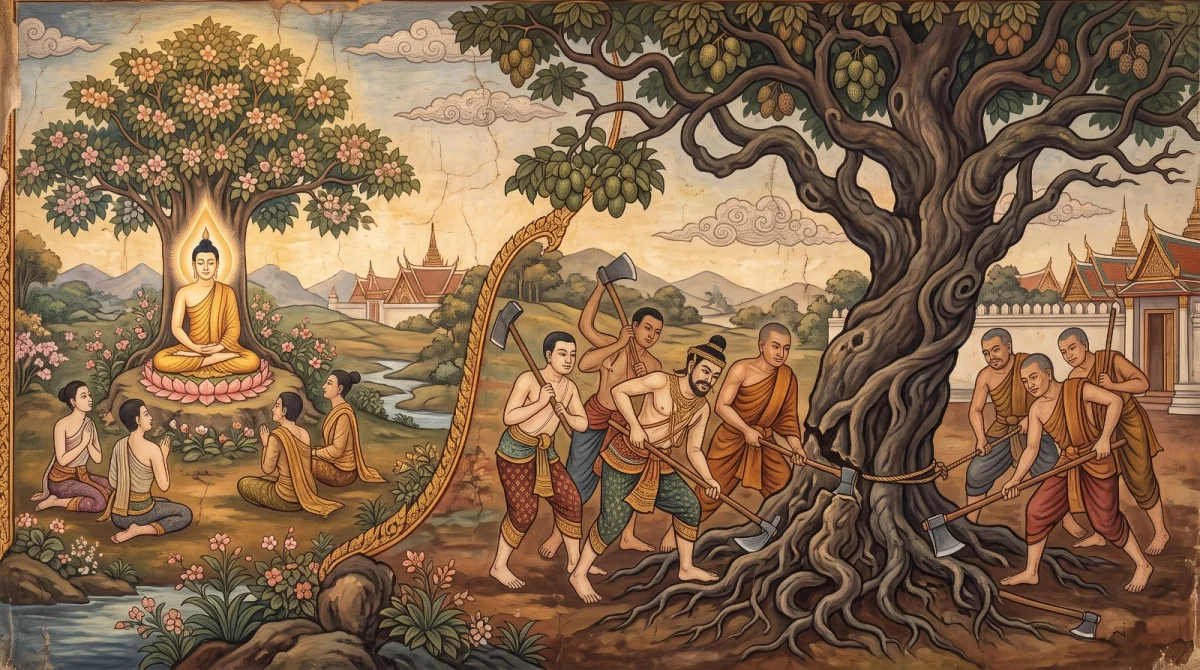
The Treatise on Realisation: Cutting the Tree at the Root Before It Fruits
Going deeper

The Treatise on Realisation: Cutting the Tree at the Root Before It Fruits

Abhisamayakathā

By what does one realise, and when are defilements abandoned? Past defilements are already gone, future ones haven't arisen, and present ones can't be abandoned while they are happening. The Paṭisambhidāmagga answers with the simile of a young tree cut at the root: fruits not yet produced never come at all.

7 points

In the Treatise on Realisation (Abhisamayakathā) of the Chapter on Wisdom of the Paṭisambhidāmagga, Khuddaka Nikāya, the question is asked: by what does realisation (abhisamaya) come about? By mind? Then someone without knowledge could realise. By knowledge? Then someone without mind could realise. The questioning continues until the answer: one realises by present mind and knowledge at the moment of the supramundane path.

It then raises what sounds like a riddle: does one who realises abandon past defilements, future defilements, or present ones? It shows that all three seem impossible, before answering with the simile of a young tree cut at the root.

This is analytical material about path and fruition; the technical lists are for overall understanding. But the logic of cutting at the root can be applied to caring for the mind in daily life.

  1. 1

    Realisation by mind and knowledge together Cittena ca ñāṇena ca abhisameti

    If one realised by mind alone, someone without knowledge could realise; if by knowledge alone, someone without mind could. So it must be by mind and knowledge together. At the moment of the path, mind is dominant in producing and is a condition for knowledge; knowledge is dominant in seeing and is a condition for mind; both have cessation as their object.

    Applying it in daily life

    Understanding alone without a ready mind, or a determined mind without understanding, isn't enough to change a habit. You need both working together.

  2. 2

    Not by past, future or ordinary mind Lokuttaramaggakkhaṇe paccuppannacittena ca ñāṇena ca abhisameti

    He rejects each option in turn: not by sense-sphere, fine-material or immaterial mind, not by past or future mind, and not by present mundane mind, but by present mind and knowledge at the moment of the supramundane path. This point is for overall understanding.

    Applying it in daily life

    Realisation happens only in the present moment. Recalling an old insight or picturing future success is not seeing itself. Practise coming back to now, often.

  3. 3

    Every factor is part of realisation Dassanābhisamayo sammādiṭṭhi

    He asks whether realisation is only this much, and answers no: at the moment of the path, realisation as seeing is right view, realisation as directing is right intention, and so on through the enlightenment factors, powers and faculties, up to nibbāna as realisation in the sense of the final end. This point is for overall understanding.

    Applying it in daily life

    Progress of the mind doesn't come from a single virtue. Speech, livelihood, effort and mindfulness are all part of one picture. Don't neglect any of them.

  4. 4

    The riddle: when are defilements abandoned? Atīte kilese pajahati

    If one abandons past defilements, one would be destroying what is already destroyed. If future ones, one would be abandoning what hasn't arisen. If present ones, then someone in the grip of lust would abandon lust at that very moment, with dark and bright states occurring together. So he asks: then is there no developing of the path and no abandoning of defilements?

    Applying it in daily life

    Notice that we like to "fight" emotions when they are at their strongest, which rarely works. Calmer moments are a better time to tend their causes.

  5. 5

    A young tree cut at the root Taruṇo rukkho ajātaphalo

    He answers that the development of the path exists and the abandoning of defilements exists. It is like a young tree that hasn't yet borne fruit: if a man cuts it at the root, the fruits not yet produced are never produced, those not yet appeared never appear. Defilements that would arise from a cause never arise when the cause is cut.

    Applying it in daily life

    If you know you get irritable when short of sleep, sleeping enough is cutting the root. If opening certain apps makes you envious, not opening them is cutting the root. Deal with the cause before the fruit grows.

  6. 6

    Seeing the danger in arising, the mind leaps to non-arising Uppāde ādīnavaṃ disvā

    Arising is a cause and condition for defilements to be produced. When the mind sees the danger in arising, it leaps into nibbāna, where there is no arising. He says the same about kamma as a condition for defilements. This point is for overall understanding.

    Applying it in daily life

    Lasting change of a bad habit usually starts with seeing its harm clearly for yourself, not from being forbidden. Write down the real harm it has caused and read it over.

  7. 7

    With the cause ceasing, suffering ceases Hetunirodhā dukkhanirodho

    He concludes: with the cessation of the cause, suffering ceases. Thus the development of the path exists, the realisation of fruition exists, the abandoning of defilements exists, and the realisation of the Dhamma exists.

    Applying it in daily life

    When a problem keeps recurring, ask "what is the cause?" before asking "how do I stop the symptom?" Treating symptoms helps for a while; treating causes helps for long.

Try it in daily life

The lesson you can use at once: you can't fix yesterday's anger because it has passed, and you needn't fight anger that hasn't arisen. What you can do is tend the causes that make it arise, like cutting a tree at the root before it bears fruit.

Another point is seeing the danger in "arising", so that the mind inclines towards non-arising. In daily terms, when you clearly see how a habit brings suffering, the mind lets go of it by itself more than through force.

Bear in mind that the treatise is about abandoning defilements through the path, which is profound. Applying it to daily life is an analogy; it doesn't mean that preventing emotions in this way is attaining the Dhamma.

Sources in the Tipiṭaka

Tap to read the actual passage on the page cited.

Other principles worth reading

Log in to earn 40 merit points for reading this page