
The Debates on Duration of Mind and Hot Embers: Does One Mind Last All Day, and Is Everything Burning?
CittaṭṭhitikathāTwo consecutive debates in chapter 2. The first asks whether a single mind lasts a whole day; the Theravāda qu…


Sotāvadhāne paññā sutamaye ñāṇaṃ
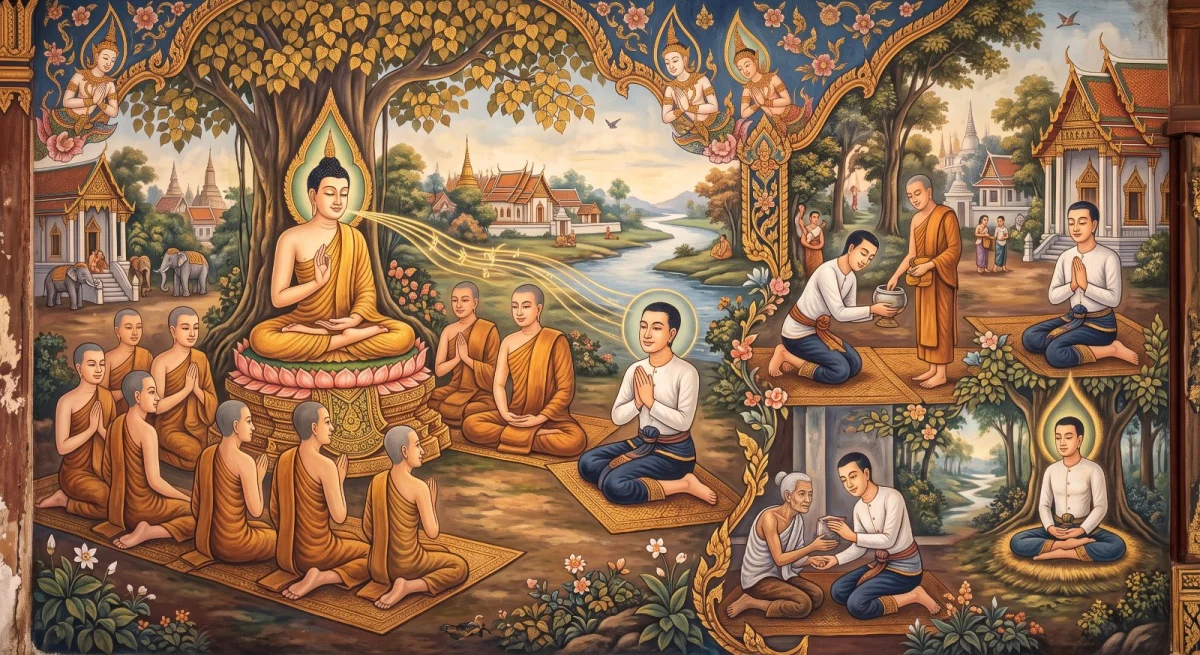
The first of the seventy-three knowledges in the Paṭisambhidāmagga is not about remembering many words. It is hearing a teaching and being able to tell which things are to be directly known, fully understood, abandoned, developed or realised — and which way what is happening in the mind is heading.
In the Paṭisambhidāmagga of the Khuddaka Nikāya, the section on knowledge opens with sutamaya-ñāṇa, knowledge consisting in what has been heard. It is defined as the wisdom in lending an ear and retaining the teaching one has heard.
What makes this more than memory is what the listener then understands clearly. The first set is knowing: these things are to be directly known, these are to be fully understood, these are to be abandoned, these are to be developed, these are to be realised. The next set is knowing whether the things in question partake of decline, of stability, of distinction or of penetration. Then come the understandings that all formations are impermanent, all formations are suffering, all things are non-self, and the four noble truths.
Each heading is then expanded over many pages: what is to be abandoned and in how many ways abandoning happens, what is to be developed from a single thing up to a set of ten. All of it is still at the level of clear understanding from hearing, not attainment, which belongs to the later knowledges.
What is to be directly known, the text says, is everything: the five aggregates, the sense bases, the elements, the realms of existence, the jhānas, the divine abodes, dependent origination, up to nibbāna. Direct knowing here means knowing the nature of the thing as it is, not knowing its name.
When you meet a new Dhamma term, don't stop at the translation. Ask when this arises in your own mind and what it actually feels like.
What is to be fully understood is what is suffering: eye, ear, nose, tongue, body and mind, the objects that strike them, consciousness, contact, and the pleasant, painful and neutral feeling born of that contact. The text adds that when someone striving for a state has gained it, that state has thereby been fully understood and reviewed.
When irritation comes, trace it back: what did the eye see, what did the ear hear, and what kind of feeling arose. Just knowing it is enough; you needn't fix it immediately.
Five kinds of abandoning are set out: abandoning by suppression, which belongs to one developing the first jhāna; abandoning of views by substitution of opposites; abandoning by cutting off, which is the supramundane path; abandoning by tranquillisation at the moment of fruition; and abandoning as escape, which is cessation, nibbāna.
Don't judge yourself a failure because defilement is not gone. Holding it down today counts as one recognised kind of abandoning.
The text lists them by number. One thing to be developed: mindfulness of the body accompanied by pleasantness. Two: serenity and insight. Three: the three concentrations. Four: the four establishings of mindfulness. Five: right concentration with five factors. Six: the six recollections. Seven: the seven factors of awakening. Eight: the noble eightfold path. Nine: the nine factors of effort for purity. Ten: the ten kasiṇas.
If you don't know where to start, start at the top of the list: easy, unforced mindfulness of the body while walking, showering or washing dishes.
Realising, as explained here, means realising by making the thing one's object — looking straight at it — up to nibbāna that merges in the deathless. Whatever has been realised has thereby been touched.
Something you have been avoiding looking at, such as your parents' ageing or your own, can be looked at directly once, instead of glancing away again.
The text gives a clear example of someone who has attained the first jhāna. If perception and attention accompanied by sensuality still occur, that partakes of decline. If the delight appropriate to that jhāna remains in place, that partakes of stability. If perception and attention without applied thought occur, that partakes of distinction. If perception and attention accompanied by disenchantment and dispassion occur, that partakes of penetration.
At the end of the day ask four questions. Did the mind go backwards, stay where it was, improve, or begin to loosen from something it used to cling to?
Even the statements that all formations are impermanent, all formations are suffering, all things are non-self, and all four noble truths, are still placed under knowledge from hearing — clear understanding at the level of what has been heard. Knowledge seen for oneself comes in the later items of the seventy-three. This point is for overall understanding.
When you feel you understand a teaching well, ask when you last actually watched it happen in yourself.
People today can hear the Dhamma more easily than in any earlier age — one talk ends and the next begins. What is usually missing is the step this knowledge describes: after listening, can you tell whether what you just heard is something to understand, something to stop doing, or something to start practising?
Try the five-part sieve every time you hear or read a teaching. This one I should understand more clearly. This one I should notice when it arises in the mind. This one I should give up. This one I should do more of. This one is the goal I have to see for myself. Simply sorting things into these boxes begins to turn listening into practice.
The discourse is also blunt about the limits. Knowledge at this level is not yet freedom. Knowing a great deal and stopping there is exactly what it calls a state that partakes of stability: not declining, but not going anywhere either.
Tap to read the actual passage on the page cited.
Two consecutive debates in chapter 2. The first asks whether a single mind lasts a whole day; the Theravāda qu…

The monk Sudhamma felt slighted when the householder Citta invited senior monks without consulting him first, …

Three monks' rules about those the Saṅgha appoints to a duty. The group of six taught nuns without appointment…

Key verses from Dhammapada chapters 6–10: one who points out faults is like a revealer of treasure; a solid ro…