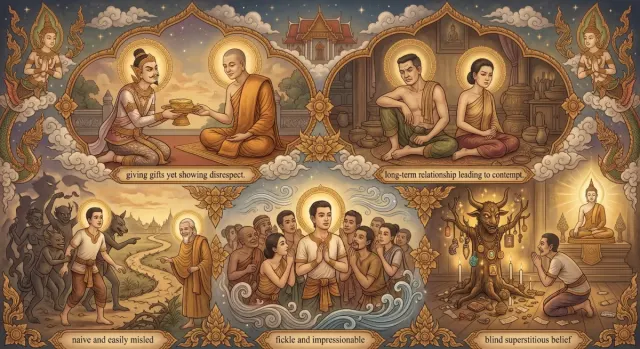
Puggalapaññatti: Looking Down After Giving, Contempt from Familiarity, Credulity, Fickleness and Dullness
Datvā avajānātiFive kinds of person from the section on fives: one who gives and then looks down on the recipient, one who lo…


Dve puggalā dullabhā lokasmiṃ
Pairs from the end of the section on twos: the one who helps first and the grateful one who repays are rare; those who hoard or give away everything they get are hard to satisfy; whose taints grow; who seeks out whom; and the one who is satisfied and the one who satisfies others.
In the Puggalapaññatti of the Abhidhamma Piṭaka, in the section on groups of two (Duka-niddesa), after a run of opposite pairs such as the angry and the not angry, or those with and without a sense of shame, the section ends with a short but practical set of pairs: persons rare in the world, persons hard and easy to satisfy, persons in whom the taints grow or don't grow, persons of low and refined inclination, and the one who is satisfied and the one who satisfies others.
The Puggalapaññatti is the fourth book of the Abhidhamma Piṭaka. It sets out designations of types of persons, and many sets match discourses in the Aṅguttara Nikāya. This set also appears in the Hope Chapter of the Book of the Twos, which says that the one who helps first and the grateful one are rare, and describes those hard and easy to satisfy in the same words.
Most of the text here gives only a name or a brief definition without much explanation. The applications on this page are therefore interpretations for daily life, not the scripture's own commentary.
These types are for questioning yourself — for example, "Am I someone who helps first, or who waits for others to go first?" — not for deciding who is ungrateful.
The text says two persons are rare in the world. The first is the pubbakārī — literally "one who does first" — someone who helps others first, without waiting for anyone to help them.
Be the one to offer help first once this week — for example, helping a new colleague set up their computer without waiting to be asked.
The second is the one who is grateful and thankful (kataññū katavedī): who recognises the help others have given and repays it. In the Book of the Threes of the Aṅguttara Nikāya too, the grateful and thankful person is named as one of three things rarely found in the world.
Think of one person who once helped you and whom you never properly thanked. Send them a message of thanks or find a way to return the favour.
Two persons are hard to satisfy: one who stores away whatever they get, and one who gives away whatever they get. The text doesn't elaborate further.
Notice whether you hoard, or spend everything as soon as it comes in. Both make it feel as if there is never enough.
Two persons are easy to satisfy: one who doesn't store away whatever they get, and one who doesn't give away whatever they get.
Set a simple rule for income or things you receive: use some, save some and share some, without going to either extreme.
The taints grow in two persons: one who has scruples about what doesn't call for scruples, and one who has no scruples about what does. In those who do the opposite, the taints don't grow.
Write down what you're worried about, then separate what is genuinely wrong and should be fixed from what is needless worry that can be put down.
One who is immoral and of bad character and associates with, keeps company with and attends on other immoral people of bad character is said to be of low inclination. One who is virtuous and of good character and associates with other virtuous people of good character is said to be of refined inclination.
Look at the people you spend the most time with, and ask whether you chose them out of habit or because they help you become a better person.
Paccekabuddhas and the Tathāgata's disciples who are arahants are called satisfied. The Perfectly Enlightened Buddha is called both satisfied and one who satisfies others. This point is for overall understanding.
When you've found something truly fulfilling — for instance, learning something beneficial — pass it on so others can be fulfilled too, rather than keeping it to yourself.
The two rare people form a pair. The one who helps first helps without waiting for anyone to help them first; the grateful one recognises the good others have done for them and repays it. If you can be both, the relationships around you will have someone who starts and someone who carries on.
The point about being hard to satisfy is a good mirror for how you receive. Someone who stores away everything they get and someone who lets everything they get slip away both leave the giver feeling that nothing is ever enough.
The point about the taints is a reminder that worrying in the wrong place is itself a problem. Some people fret over small things that aren't wrong at all, yet pay no attention to what really is wrong.
Tap to read the actual passage on the page cited.
Five kinds of person from the section on fives: one who gives and then looks down on the recipient, one who lo…

The Buddha tells the householder Anāthapiṇḍika that when the mind is unguarded, bodily, verbal and mental acti…

The Buddha tells the monks to remember the householder Ugga as having eight wonderful qualities. When a monk a…

The Parivāra sets out twenty-four ways the kathina is not validly spread, such as merely marking or washing th…