
The Six Channels of Ruin
Cha apāyamukhāniSix roads to decline the Buddha warned householders about — worth knowing so you don't lose money, time and pe…


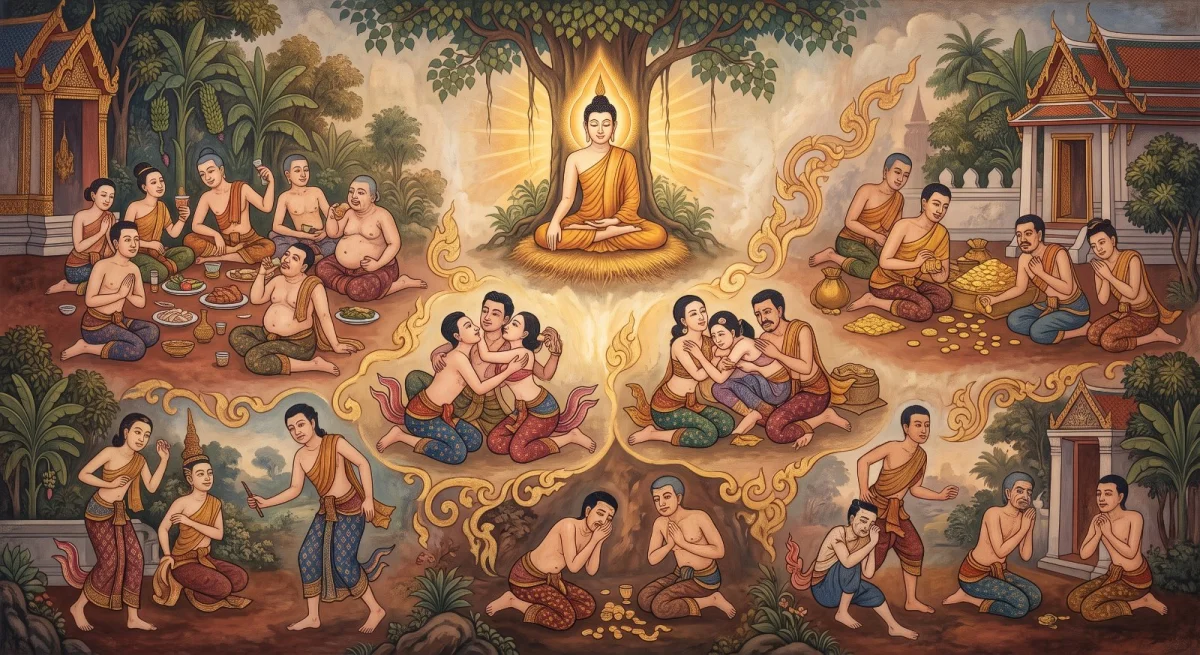
Rāsiyasuttaṃ
The headman Rāsiya asks whether the Buddha condemns all austerity. The Buddha teaches the middle way, then distinguishes ten kinds of people living the household life by how they gain wealth, how they use it, and whether they are free of attachment to it.
In the Rāsiya Sutta of the Gāmaṇi Saṃyutta, Saṃyutta Nikāya, the headman Rāsiya asks: he has heard that the ascetic Gotama criticises all austerity and reviles every ascetic who lives rough — is that correct? The Buddha says those who say so are not repeating what he has said, but misrepresenting him with what is untrue.
He then teaches the two extremes a monastic should not pursue and the middle way, the noble eightfold path, and distinguishes ten kinds of enjoyers of sensual pleasures, which the Thai translation groups into three sets by how wealth is sought, stating on what grounds each deserves blame and on what grounds praise.
He analyses three kinds of austere ascetics by the same method, and ends with three things visible here and now: when lust, hatred and delusion are abandoned, one no longer intends harm to oneself or others. Rāsiya is inspired and declares himself a lay follower.
Rāsiya had heard that the Buddha condemns every kind of austerity and every ascetic. The Buddha says those who say so are not repeating what he said, and are misrepresenting him with what is untrue. He then explains the matter by making distinctions.
When you hear "that person is against this whole thing", go to the source first. A qualified view often gets retold until it becomes a blanket statement.
A monastic should not pursue devotion to sensual pleasure, which is low, vulgar and unbeneficial, nor devotion to self-mortification, which is painful and unbeneficial. The middle way awakened to by the Tathāgata is the noble eightfold path, leading to peace, direct knowledge and Nibbāna.
When choosing how to look after yourself — eating, exercise or work — ask whether the approach leads to calm and understanding, or simply indulges or punishes you.
The ten kinds of enjoyers are distinguished by a series of questions: is wealth sought lawfully and without violence (the Thai translation says "without rashness")? Having gained it, does one make oneself happy? Does one share it and make merit? And for the last group, does one use it without greed or infatuation, seeing the danger and having the wisdom that leads to release?
Use these four questions to review your finances once a year. You may find the point to fix isn't income, but spending or attachment.
There are three kinds. One who seeks unlawfully, doesn't make himself happy and doesn't share is blamed on three grounds. One who seeks unlawfully but makes himself happy is blamed on two and praised on one. One who seeks unlawfully but makes himself happy and shares and makes merit is blamed on one and praised on two. Making merit doesn't erase the blame for how the wealth was gained.
If any income comes from exploitation or cheating, donating it doesn't make it clean. What needs fixing first is how it was earned.
There are also three kinds here. Each is praised for the part sought lawfully and blamed for the part sought unlawfully, then further praised or blamed according to whether they make themselves happy and whether they share and make merit.
Many real lives are in this group. Separate the income you can be fully proud of from the part that is still murky, and gradually reduce the latter.
There are four kinds. One who seeks lawfully but neither makes himself happy nor shares is praised on one ground and blamed on two. One who makes himself happy but doesn't share is praised on two and blamed on one. One who makes himself happy and shares, but is greedy, infatuated and blind to the danger, is praised on three and blamed on one. One who does all this and uses wealth without greed or infatuation, seeing the danger and having the wisdom that leads to release, is praised on all four grounds.
If you already earn honestly, the next steps are using it to look after yourself and your family in moderation, sharing, and training the mind not to be bound to the numbers in your account.
Of those who go forth in faith and then torment themselves, some attain no wholesome state and no superhuman distinction, and are blamed on three grounds. Some attain wholesome states but no superhuman distinction: blamed on two, praised on one. Some attain both, yet are still blamed on one ground — for tormenting themselves.
Even when a goal is achieved, a method that harms you is still not praiseworthy. If some work or training is wrecking your health, change the method rather than taking pride in the suffering.
One overcome by lust, hatred or delusion intends harm to oneself, to others or to both. Once they are abandoned, one no longer intends such harm. This is visible here and now, immediate, inviting inspection, and to be personally known by the wise.
Next time anger or craving subsides, notice that the thought of hurting yourself or others fades with it. That is a result you can verify right away, without waiting for a future life.
What is striking in this discourse is that the Buddha doesn't divide people into good and bad in black and white, but assesses them point by point. One person can deserve praise on one ground and blame on another at the same time. This way of looking lets you assess yourself more precisely and fairly than a blanket verdict.
The four criteria are still current: was the money earned honestly, without harming anyone? Is it used so you and your family live well? Is it shared and put to good use? And is it used without becoming its slave? Even someone who earns honestly but refuses to spend anything on looking after themselves is still blamed on that point.
On austerity, the discourse doesn't endorse self-torment. Tormenting oneself is always blamed, even in one who has attained the goal. Good effort doesn't require harming your body or your mental health.
Tap to read the actual passage on the page cited.
Six roads to decline the Buddha warned householders about — worth knowing so you don't lose money, time and pe…

The Nikkhepakaṇḍa arranges paired categories into clusters and defines the same set of defilements again and a…
The last section of the Aṅguttara Nikāya gives eleven things for understanding lust: the four absorptions, the…
Key verses from Dhammapada chapters 21–23: give up a lesser happiness for a greater one; the good shine from a…