
The Great Discourse on the Final Nibbāna: Doṇa Mediates the Division of the Relics
Amhāka buddho ahu khantivādoAfter the Buddha's final passing, some monks wail while others endure mindfully. When seven parties send envoy…


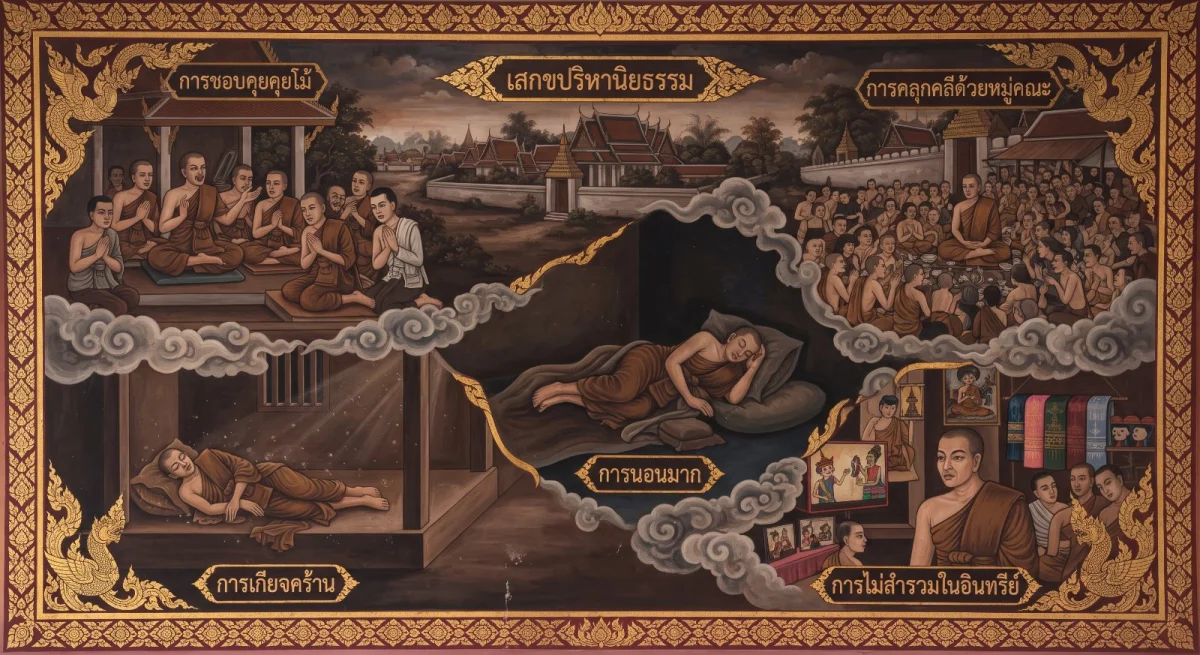
Sekhassa bhikkhuno parihānāya saṃvattanti
Delight in work, in talk, in sleep, and in company, unguarded senses, and immoderate eating — six things that slowly wear down one still in training. With a warning about letting the day slip away on trivial tasks, and six kinds of respect that prevent decline.
In the Sekha Sutta of the Sekhaparihāniya Chapter, Aṅguttara Nikāya, Book of Sixes, the Buddha says six things lead to the decline of a monk in training (sekha): delight in work, delight in talk, delight in sleep, delight in company, not guarding the sense doors, and not knowing moderation in eating. Their opposites lead to non-decline. A sekha is one still training, who has not yet reached the end.
Similar lists appear in the Thera Chapter of the Book of Fives. The first Sekha Sutta there gives the same first four items, but the fifth is not reviewing the mind as it has been freed. The second Sekha Sutta speaks of having many duties, letting the day pass on trivial work, unsuitable socialising, entering the village too early and returning too late, and not easily getting talk that wears away defilements. Each item ends: "neglecting seclusion, not devoted to inner serenity of mind."
Following the Sekha Sutta in the Book of Sixes are two Aparihāniya Suttas, in which a deity tells the Buddha of qualities that prevent a monk's decline, and the Buddha relates it to the monks. This set concerns individual training, unlike the seven principles of non-decline that concern a community's welfare.
Delighting in work. In the first Sekha Sutta of the Book of Fives, the Thai Royal Edition renders the same term as delight in construction: being absorbed in doing this and that until work becomes a hiding place from training the mind.
Notice whether you pick up tasks because they're necessary or because you don't want to sit quietly with yourself. If the latter, set aside ten minutes with no work at all.
Delighting in talk. Much talk scatters the mind outward. The second Sekha Sutta says a trainee should get talk that wears away defilements, such as talk on fewness of wishes, contentment, seclusion, energy, virtue, concentration and wisdom.
Before opening a group chat or starting idle conversation, ask whether you want to talk because something needs saying, or because your mind can't sit still.
Delighting in sleep. This isn't the rest the body needs, but indulging in sleep so that time which could be used for training is lost.
Sleep enough for your health, but if you're awake and lingering in bed because you don't want to start the day, get up and give the first five minutes to your breath.
Delighting in company. The second Sekha Sutta specifies that the problem is unsuitable socialising with householders and renunciates, to the point of neglecting seclusion.
Socialise, but also plan time alone — for example, a walk by yourself without earphones once a week.
Not guarding the doors of the sense faculties: letting the eye, ear, nose, tongue, body and mind take in objects without mindfulness, so that liking and disliking flow in and take over.
Before opening an app that keeps you scrolling, take one breath and decide what you'll look at and for how many minutes.
Not knowing moderation in food: eating too much or eating by craving, which makes the body heavy and the mind drowsy. The side of non-decline is knowing moderation in eating.
Try stopping when you sense you're a few mouthfuls from full, and notice whether your mind is clearer that afternoon.
In the second Sekha Sutta of the Book of Fives, the Buddha gives five causes of decline: having many duties and being unskilled in tasks large and small; letting the day pass on trivial work; socialising unsuitably with householders and renunciates; entering the village too early and returning too late; and not easily getting talk that wears away defilements. Each has the same result: neglecting seclusion and not devoting oneself to inner serenity.
In the evening, review what small matters used up your day, and set aside time for inner calm before those matters tomorrow.
In the first Aparihāniya Sutta, a deity tells the Buddha of six qualities that prevent a monk's decline: respect for the Teacher, the Dhamma, the Saṅgha, the training, heedfulness, and hospitality. The Buddha approves and relates it to the monks. In the second Aparihāniya Sutta, the last two become respect for conscience and for prudence.
Hospitality (paṭisanthāra) means welcoming and greeting with goodwill. Give real attention to greeting the people around you, since the Buddha counts it alongside respect for the Triple Gem and the training.
These six sound as if written about people today: working until there's no time for yourself, chatting all day, oversleeping, constant socialising, unmindful scrolling, and eating by mood. None is a grave wrong, but together they slowly consume the time and energy needed to train the mind.
"Delight in work" doesn't mean abandoning duties. In the second Sekha Sutta, what is criticised is letting the day slip away on trivial tasks while neglecting inner calm. Necessary duties should still be done well.
To use this, pick the one item that fits you best this week and reduce it a little — say, turn off notifications after nine at night, or stop eating when just full enough.
Tap to read the actual passage on the page cited.
After the Buddha's final passing, some monks wail while others endure mindfully. When seven parties send envoy…

Short Dhamma riddles between devas and the Buddha: what stays good until old age, who is a friend at home and …

A piece of sugar cane, four fruits, a field watchman's portion of kummāsa, food for a weary monk — stories fro…
A brahmin who once asked for a boon — that he might always have a large following — who once held a wrong view…