
The Sīlavīmaṃsa Jātaka: Virtue, Letting Go, and the Happiness of a Settled Mind
Sīlaṃ kireva kalyāṇaṃA chaplain who tested whether he was honoured for his virtue sees three scenes on his way to going forth: a ha…


Sabbehi piyehi manāpehi nānābhāvo vinābhāvo aññathābhāvo
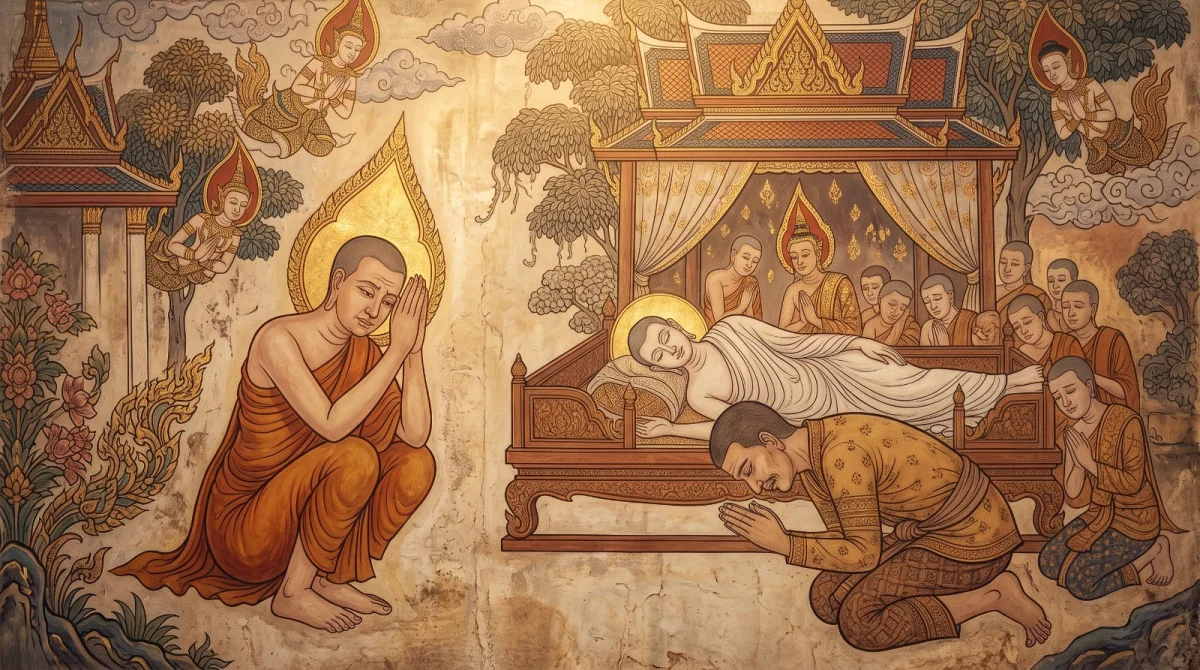
The novice Cunda brings Sāriputta's bowl and robe with news of his passing, and Ānanda feels as if the world has gone dark. The Buddha consoles him with the truth of separation, the simile of a great tree whose largest branch has broken off, and the teaching to make oneself and the Dhamma an island.
In the Satipaṭṭhāna Saṃyutta of the Saṃyutta Nikāya (Mahāvagga, Nāḷanda chapter), two discourses describe the time after the two chief disciples attained final nibbāna.
In the Cunda Sutta, Sāriputta is gravely ill at the village of Nālaka in Magadha, attended by the novice Cunda, and passes away from that illness. Cunda takes his bowl and robe to Ānanda at Jeta's Grove. Ānanda brings the novice to the Buddha and says that on hearing the news his body felt as if drugged, he could not get his bearings, and the teachings were no longer clear to him.
In the Cela (Ukkacelā) Sutta, not long after Sāriputta and Moggallāna have passed away, the Buddha is sitting in the open with the Saṅgha at Ukkacelā on the bank of the Ganges in the Vajji country. He surveys the silent Saṅgha and says: this assembly seems empty to me.
Both discourses end with the same teaching: whatever is born, come to be, conditioned, is subject to falling apart; it is impossible to wish that it not fall apart. So dwell with yourself as an island and the Dhamma as an island, by developing the four foundations of mindfulness.
Sāriputta was gravely ill at Nālaka, attended by the novice Cunda. When Sāriputta passed away, Cunda took his bowl and robe and travelled to tell Ānanda at Jeta's Grove, and the two went together to inform the Buddha.
Caring for someone at the end of life and breaking the news appropriately are valuable work. If this task falls to you, do it with respect, and you needn't carry it alone.
Ānanda said that on hearing that Sāriputta had passed away, his body felt as if drugged, he could not get his bearings, and even the teachings were not clear to him. The discourse records this feeling plainly, without hiding it.
If after a loss you can't think straight or remember things, that is a normal reaction. Give yourself time, and postpone major decisions if you can.
The Buddha asked: when Sāriputta attained final nibbāna, did he take with him the aggregate of virtue, of concentration, of wisdom, of liberation, or of the knowledge and vision of liberation? Ānanda answered that he did not.
When you think of someone who has died, ask what good they left in you, such as habits, teachings or ways of seeing the world. Those remain with you.
Ānanda said Sāriputta had been an adviser who instructed, inspired, encouraged and gladdened, tireless in teaching the Dhamma and helpful to his fellow monks. The monks still remembered the nourishment of Dhamma, the wealth of Dhamma, and the help of Dhamma he gave.
At a memorial, try telling stories of how the person helped others, rather than speaking only of the sadness of their passing.
The Buddha said: have I not told you before that there is change, separation and becoming otherwise with regard to all that is dear and agreeable? Whatever is born, come to be, conditioned, is subject to falling apart. It is impossible to wish that it not fall apart.
Recall this truth on ordinary days, not only on days of loss, and spend your time fully with the people you love while they are still here.
The Buddha compared it to a great tree standing with heartwood, whose largest branch breaks off. Just so, while the great Saṅgha stands with its heartwood, Sāriputta has attained final nibbāna.
When an organisation or family loses a key person, the tree still has its heartwood. Work together to help what remains keep growing.
In the Cela Sutta, the Buddha looked over the silent Saṅgha and said: this assembly seems empty to me. When Sāriputta and Moggallāna were alive, the direction where they lived was not empty, and I had no concern for it. He also said it is wonderful of disciples that they carry out the Teacher's instructions and are dear to and respected by the four assemblies.
Feeling that a meeting or a home seems emptier after someone has gone is a recognition of their worth. You can talk about this feeling with others who share the loss.
The Buddha said that there is no sorrow or lamentation in the Tathāgata even though such a pair of disciples has passed away. Then he taught: dwell with yourselves as an island, yourselves as refuge, the Dhamma as an island, the Dhamma as refuge, with no other refuge, by contemplating body, feelings, mind and phenomena, ardent, clearly comprehending and mindful.
In a time of grief, the refuge you can take immediately is returning to body and mind moment by moment, such as knowing the breath and knowing that you are sad, without rushing the sadness away.
These discourses offer a gentle picture of loss. The Buddha doesn't rebuke Ānanda for grieving. He asks a question that helps him see that what was most valuable in the one who has gone has not vanished, and he brings the mind back to a refuge that will never disappear.
Grief is natural for those who still love and are attached. The Buddha's freedom from sorrow is the fruit of complete liberation, not a standard we must force ourselves to meet at once. Allowing yourself to grieve, speaking of the good qualities of the one who has died, and having people around to support you are all part of healing.
If grief after a loss is so heavy that you cannot function for a long time, seek help from those close to you or from a professional.
Tap to read the actual passage on the page cited.
A chaplain who tested whether he was honoured for his virtue sees three scenes on his way to going forth: a ha…

Mindfulness directed to the body — seven methods from the Kāyagatāsati Sutta. The body is always in the presen…

Four kinds of people by how they understand the Dhamma — from one who understands as soon as the heading is st…

The first three rules of the Chapter on Fellow Monastics forbid three responses to being corrected by a rule: …