
The Janasandha Jātaka: Ten Things Left Undone Today That Bring Regret Later
JanasandhajātakaṃKing Janasandha teaches that there are ten things which, if not done beforehand, cause regret later: not earni…


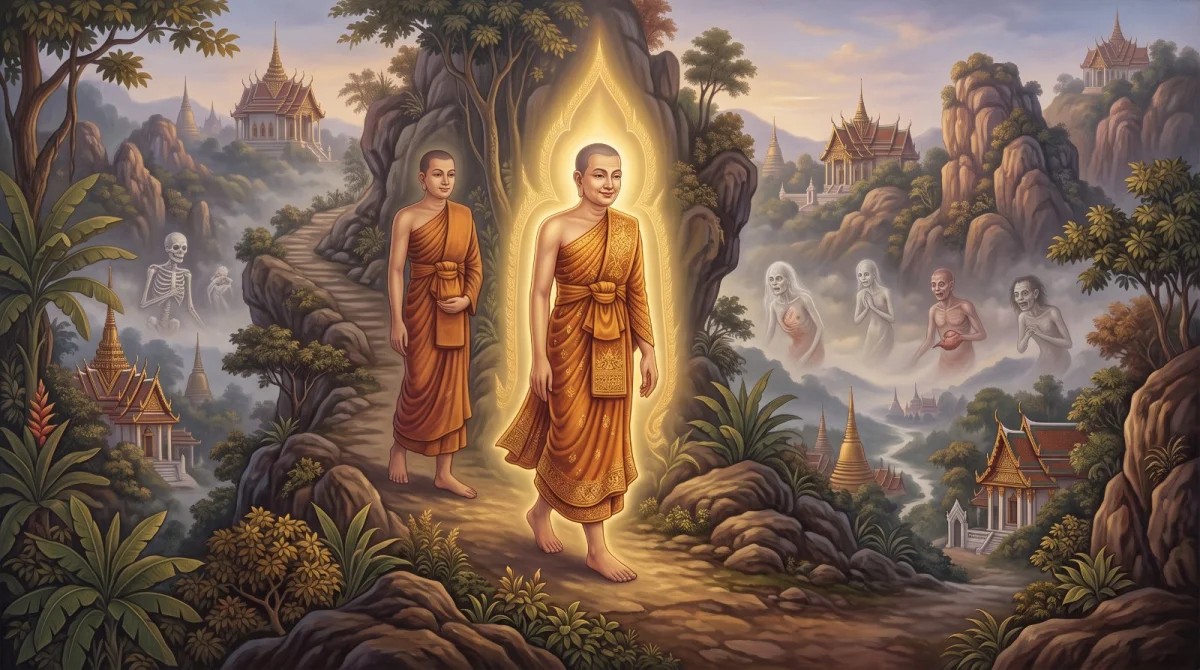
Cakkhubhūtā vata bhikkhave sāvakā viharanti
Coming down from the Vulture's Peak, Mahāmoggallāna smiles but won't explain until they are before the Buddha. The Buddha confirms what he saw: beings experiencing the remaining results of kamma after hell, from a cattle butcher, a slanderer and a corrupt judge to bad monks from the time of the Buddha Kassapa.
The Lakkhaṇa Saṃyutta of the Saṃyutta Nikāya has two chapters of short discourses that begin the same way. Venerable Lakkhaṇa and Venerable Mahāmoggallāna are staying on the Vulture's Peak. One morning, while going down for alms in Rājagaha, Mahāmoggallāna smiles at a certain spot. Lakkhaṇa asks why; he replies that it's not the time, and to ask him in the Buddha's presence. When they visit the Buddha, he tells what he saw: a strangely formed being flying through the air, pecked and torn by vultures and crows, crying out in pain.
The Buddha says: the disciples have vision and knowledge indeed. He himself had seen that being before but did not declare it, because if others did not believe it, that would lead to their long-lasting harm. He then explains what each being had done in Rājagaha, how they burned in hell for a long time and are still experiencing the remaining results: a cattle butcher, people who killed animals for sale, a slanderer, a corrupt judge, a woman whose jealousy led her to harm her co-wife, and bad monastics in the dispensation of the Buddha Kassapa.
This page describes the images only briefly. These discourses are not for judging anyone in a present-day occupation or for creating fear, but for showing that actions have long consequences and for looking back at our own actions.
When Lakkhaṇa asks why he smiled, Mahāmoggallāna says it isn't the time to answer this question and to ask him in the Buddha's presence. He tells the story only when they visit the Buddha after the meal.
With news that might cause misunderstanding or alarm, don't rush to share it on the road or in a group chat. Wait until there's context and someone who can confirm or explain.
The Buddha says he had seen that being before but did not declare it, because if he had, others would not have believed him, and their disbelief would lead to their harm and suffering for a long time. Now that a disciple has seen it as a witness, he confirms it.
Some truths must wait for evidence or for listeners to be ready. Holding them back for now isn't lying; it is considering the listener's welfare.
The first being, seen as a skeleton, had been a cattle butcher in Rājagaha. Through the result of that kamma he burned in hell for many hundreds, thousands and hundreds of thousands of years, and through the remaining result he had such a form. The following discourses mention people who killed birds, sheep, pigs and deer for sale. This point is for overall understanding.
See that an action doesn't end when it's done. Before choosing a livelihood or a way of working, consider how much it harms other lives, and reduce that as far as you can.
Mahāmoggallāna saw a man with needles for body hairs; the needles entered his head and came out of his mouth, and so on down to his feet. The Buddha says he had been a slanderer in Rājagaha. Words that pierced others to divide them come back to pierce oneself.
Before passing one person's story on to another, ask whether you're helping or dividing people. If it's the latter, let it stop with you.
One being had to carry an organ as big as a pot on his shoulders when walking and sit on it when sitting. The Buddha says he had been a corrupt judge in Rājagaha. The injustice he did became a burden he could not put down.
When you have to judge others' affairs, as a boss, teacher or parent, hear both sides and don't be biased by self-interest. Fairness means you carry nothing home.
A woman covered with burning coals had been the chief queen of the king of Kaliṅga. Overcome by jealousy, she poured a pan of burning coals over her co-wife.
When envy arises toward a rival or someone who receives more love, recognise it as a hot coal in your own hand. The longer you grip it, the more it burns.
A man sunk in a pit of dung, eating it with both hands, had been a brahmin in the time of the Buddha Kassapa. He invited the Saṅgha for a meal, had troughs filled with dung, and then invited them to eat and take away as much as they liked.
Pranking or humiliating people of good intention, even as a joke or a prank video, is a serious form of contempt. Choose to honour people instead of making their embarrassment your entertainment.
Mahāmoggallāna saw a monk whose outer robe, bowl, belt and body were all ablaze. The Buddha says he had been a bad monk in the dispensation of the Buddha Kassapa. The following discourses say the same of a nun, a trainee nun, a novice monk and a novice nun.
A position, uniform or religious role doesn't make anyone good automatically, whether ourselves or those we respect. Look at actions, and the more trust a role carries, the more care it requires.
What applies straight away is not the frightening images but the attitude of the elder and of the Buddha. Mahāmoggallāna doesn't tell a strange story on the road at once; he waits for the right place and time. The Buddha himself doesn't say things people aren't ready to believe, because it might harm them. This is a lesson in speaking truth with a sense of time and place.
The images of each kind of kamma share something: the result mirrors the shape of the action. The slanderer is pierced through by needles; the corrupt judge must carry a heavy burden everywhere. Use them as a question to yourself: what is what I do to others today building for me?
Tap to read the actual passage on the page cited.
King Janasandha teaches that there are ten things which, if not done beforehand, cause regret later: not earni…

A king sends his minister Sayha to invite a friend who has gone forth to return and take high office, but he d…

The Parivāra opens by firing the same set of questions at every training rule — where was it laid down, about …
The Bodhisatta lies in a charnel ground; some come to harm him, others bring gifts, and his mind stays even li…