
The Six Directions
Cha disāDuties towards the six groups around you — parents, teachers, partner, friends, those you lead, and those who …


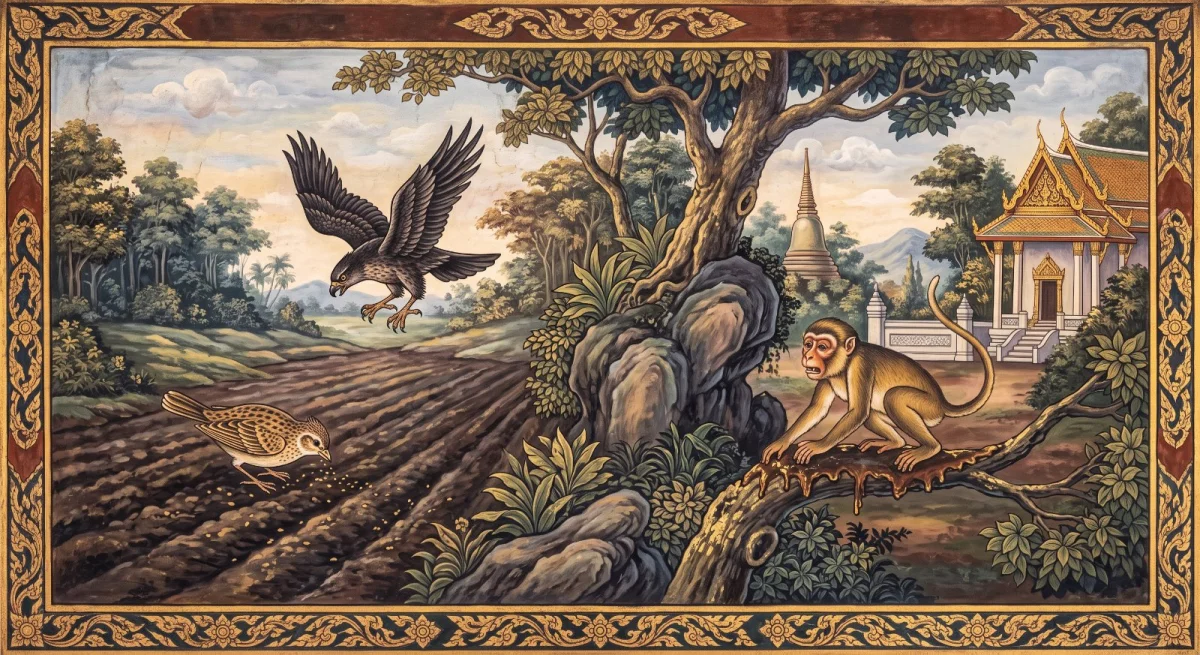
Gocare bhikkhave caratha sake pettike visaye
A quail that strayed from its range was seized by a hawk, but escaped once back in its own ploughed field. A greedy monkey grabbed a sticky trap and ended up stuck all over. The Buddha teaches that our own territory is the four foundations of mindfulness, while Māra's territory is the five cords of sensual pleasure.
In the Satipaṭṭhāna Saṃyutta of the Saṃyutta Nikāya (Mahāvagga, Ambapāli chapter), two short discourses sit side by side and end with the same teaching: don't roam outside your own range; roam in your own ancestral territory.
In the Sakuṇagghi Sutta, the Buddha tells how a hawk swooped down and seized a quail. The quail lamented that it had gone foraging outside its range; in its own territory, a ploughed field full of clods, the hawk would be no match for it. Proud of its strength, the hawk let it go to try. The quail stood on a big clod and challenged the hawk. When the hawk dived at full force, the quail slipped into a crack in the clod, and the hawk struck its own breast against the earth.
In the Makkaṭa Sutta, the Buddha tells of level ground in the Himalayas where both monkeys and people can go. Hunters set sticky traps along the monkey trails. Monkeys that are not foolish or greedy see the trap and keep well away. A greedy monkey grabs it with one hand and gets stuck; it uses the other hand to free itself and gets stuck; then its feet; finally it bites with its mouth and is stuck there too. Held fast at five points, it is at the hunter's mercy.
Both discourses conclude that a monk's foreign territory is the five cords of sensual pleasure; roaming there, Māra gets an opening. One's own ancestral territory is the four foundations of mindfulness; staying there, Māra gets no opening.
A hawk swooped down and seized a quail. The quail lamented its bad luck: it had roamed in someone else's territory, not its own feeding ground. Had it stayed in its own ancestral range, this hawk would have been no match for it.
Notice the situations where you slip most often, such as staying up too late, being too hungry, or being among people who urge you to drink. That is outside your range.
When the hawk asked what its territory was like, the quail said: a ploughed field covered with clods. There a small bird has cracks to hide in, which a large hawk cannot use to its advantage.
Build your mind a "home field", such as returning to the breath or to the feel of your feet on the floor, which you can use whenever you feel yourself being pulled away.
Proud and boasting of its strength, the hawk released the quail, saying it would not escape even there. When the quail stood challenging it from a big clod, the hawk folded its wings and dived with full force. The quail slipped into a crack, and the hawk struck its breast against the clod.
When you feel "I've definitely got this under control", take it as a signal to be more careful, not less.
In the Himalayas there are places neither monkeys nor people can go, places only monkeys can go, and pleasant level ground where both can go. On that level ground hunters set sticky traps on the monkey trails. Monkeys that are not foolish or greedy see the trap and keep well away.
Traps are usually set in comfortable, pleasant places. Not going near in the first place is far easier than prying yourself loose afterwards.
A greedy monkey grabs the trap and its hand sticks; it uses the other hand to free it and that sticks too; then both feet stick; finally it bites and its mouth sticks. Held fast at five points, it lies groaning, ruined, and the hunter can do with it as he likes.
When you realise you're caught in something, don't use the same thing to get out. Stop struggling first, then look for a way out that lies outside the trap, such as asking others for help.
The Buddha says a monk's foreign territory is the five cords of sensual pleasure: sights, sounds, smells, tastes and touches that are desirable, lovely and enticing. For one who roams there, Māra gets an opening and gets a hold.
Before opening an app or entering a space designed to absorb you, ask yourself briefly: am I going in with a purpose, or am I walking the monkey trail?
A monk's own ancestral territory is the four foundations of mindfulness: contemplating the body as body, feelings as feelings, mind as mind, and phenomena as phenomena, ardent, clearly comprehending and mindful. For one who roams there, Māra gets no opening.
Make returning to body and mind a familiar home. For example, each time you switch activities, pause and know three breaths first.
"Your own territory" in these discourses is not a place but where the mind goes. A mind that stays with its own body, feelings and mental states has a secure hiding place. A mind that drifts off chasing enticing sights, sounds and tastes is like a bird out in the open.
The image of the monkey stuck in the trap fits modern life closely. We often try to fix problems caused by craving by feeding the craving further, such as scrolling to relieve the stress of scrolling. The more we struggle, the more of us gets stuck.
The hawk offers another lesson: someone so confident in their own strength that they grow careless can get hurt exactly where they thought they had the advantage.
Tap to read the actual passage on the page cited.
Duties towards the six groups around you — parents, teachers, partner, friends, those you lead, and those who …

An ordinary horse wants the place and food of a thoroughbred, but people see its crookedness. A mendicant who …

The nun Bhaddā Kāpilānī tells of travelling through many lives beside the man who would become Mahākassapa, li…
Upananda gave a robe to a monk to persuade him to travel together, but when the monk chose to accompany the Bu…