Ten Reasons: Why the Buddha Laid Down Training Rules
Dasa kho upāli atthavase paṭiccaVenerable Upāli asks for how many reasons the Tathāgata laid down training rules. The Buddha says ten: from th…


Yodhājīvasuttaṃ
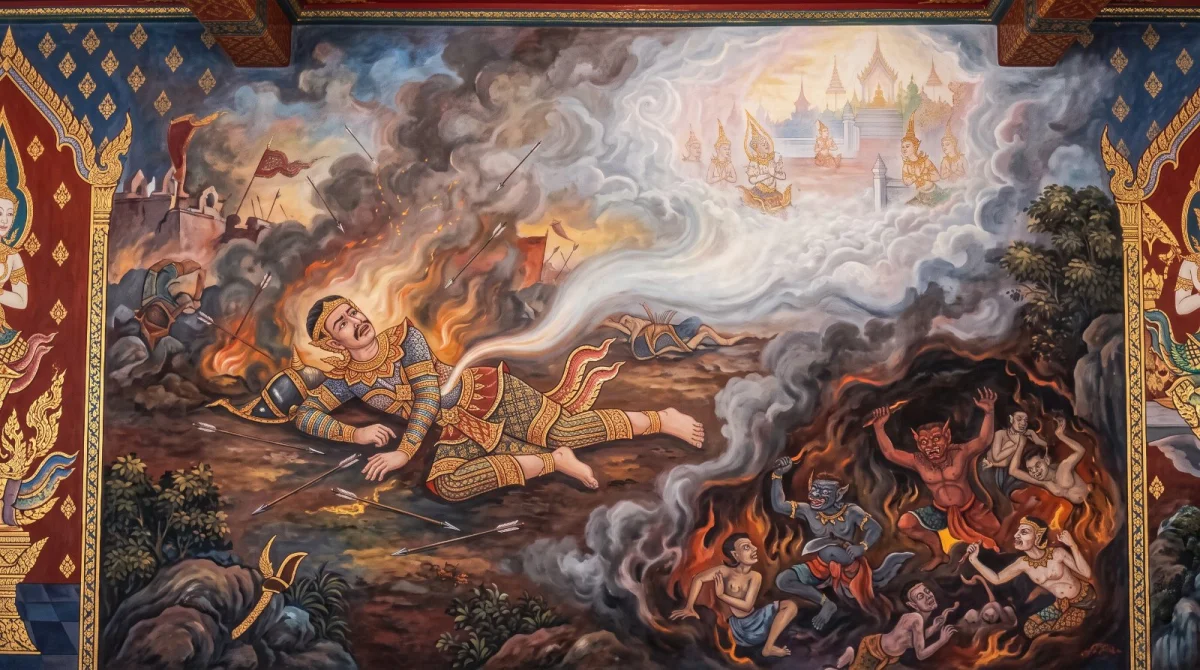
A headman who is a professional warrior asks about his teachers' claim that a warrior killed in battle is reborn among the Sarajita devas. The Buddha asks him to set the question aside, but he asks three times. The Buddha then says a mind set on "may these beings be slain" leads to hell. The warrior weeps at having been deceived for so long. An elephant warrior and a cavalry warrior ask the same.
In the Yodhājīva Sutta of the Gāmaṇi Saṃyutta, Saṃyutta Nikāya, a headman who is a professional warrior tells the Buddha he has heard the teachers and teachers' teachers of warriors of old say that a warrior who strives and exerts himself in battle and is killed by the enemy is reborn in the company of the devas called Sarajita, and he asks what the Buddha says. The Buddha replies, "Enough, headman, let that be. Don't ask me that." The warrior asks a second and a third time.
The Buddha then says that a warrior who strives in battle has a mind already seized, debased and misdirected by the thought: "Let these beings be slain, be destroyed, be annihilated, perish, or not exist." If he is killed by the enemy, he is reborn in the hell called Sarajita. And if he holds the view that he will be reborn among the Sarajita devas, that is wrong view, and for one with wrong view the Buddha declares one of two destinations: hell or the animal realm.
The headman weeps — not because of the answer, but because he was deceived for so long by the warriors of old — and declares himself a lay follower. The Hatthāroha Sutta (an elephant warrior) and Assāroha Sutta (a cavalry warrior) that follow have the same content. In the Tālaputa Sutta just before, Tālaputa, the headman of an acting troupe, asks about a belief concerning his own profession and receives a similar kind of answer.
The headman says he heard from the teachers and teachers' teachers of warriors of old that a warrior who strives in battle and is killed by the enemy is reborn in the company of the Sarajita devas. He didn't think of it himself; it was passed down.
Write down beliefs in your field or workplace that "everyone says", and ask yourself whether you have ever really checked them.
The Buddha says, "Enough, headman, let that be. Don't ask me that." But when he has asked three times, the Buddha says he cannot hold him back, and answers.
If you need to tell a hard truth, first give the other person a chance to choose whether they are ready to hear it. When they insist, speak plainly.
The Buddha says that a warrior who strives in battle has a mind already seized, debased and misdirected. What he points to is the mind that was set beforehand, not merely dying on the battlefield.
In a competition or negotiation, notice whether you intend "to do my best" or "to make the other side fail". The two affect the mind very differently.
That mind is the thought: let these beings be slain, be destroyed, be annihilated, perish, or not exist. One with such a mind who is killed by the enemy is reborn in the hell called Sarajita, not among the Sarajita devas as believed.
When you are so angry you secretly think "let them be ruined", recognise it as a small seed of the same kind, and put it down before you speak or act.
If he holds the view that being killed in battle leads to rebirth among the Sarajita devas, that is wrong view. The Buddha says that for one with wrong view there is one of two destinations: hell or the animal realm.
A belief that makes harming others feel good is more dangerous than doing wrong and knowing it is wrong, because it closes the way back.
The headman weeps, and says he is not weeping at what the Buddha said, but because he has long been cheated, deceived and misled by the warriors of old. He then goes for refuge to the Buddha, the Dhamma and the Saṅgha for life.
When you find that something you long believed is wrong, let yourself grieve, but don't stop at grief. Make it the starting point of a new path.
An elephant warrior and a cavalry warrior ask about the same belief and receive the same answer. In the Tālaputa Sutta, the headman of an acting troupe asks whether an actor who makes people laugh with truth and lies is reborn among the devas of laughter. The Buddha says such an actor heaps up things that provoke greed, hatred and delusion in his audience, is himself intoxicated and heedless, and that the view is wrong view.
Every profession has stories it tells to reassure itself. Ask whether your work makes others more greedy, angry and deluded, or helps them become better.
This discourse is not a ruling on modern military or national defence policy. What the Buddha points to is the state of mind while acting. A mind set on others being killed and destroyed does not become merit just because tradition calls it an honourable death.
In ordinary life, many professions have sayings handed down that make harming others seem justified, such as "business has to be ruthless" or "in this industry you have to step on people to survive". This discourse invites us to examine such beliefs by asking: when I work, how is my mind set?
Another lesson is the headman's persistence in asking until he got an answer, and his honesty in weeping and admitting he had been deceived. The truth may hurt, but it is better than living with a wrong belief forever.
Tap to read the actual passage on the page cited.
Venerable Upāli asks for how many reasons the Tathāgata laid down training rules. The Buddha says ten: from th…

A renunciant who has lived under a king's patronage for twelve years sees signs that the king has lost faith i…

One person lies when questioned as a witness, another says just what they know and saw, and another speaks wor…

Rādha asks what is called "a being". The Buddha says it is one attached to the five aggregates by desire, like…