
The Discourse on Perversions: Four Distortions at Three Levels of the Mind
VipallāsakathāSeeing the impermanent as permanent, suffering as happiness, not-self as self, and the unattractive as attract…


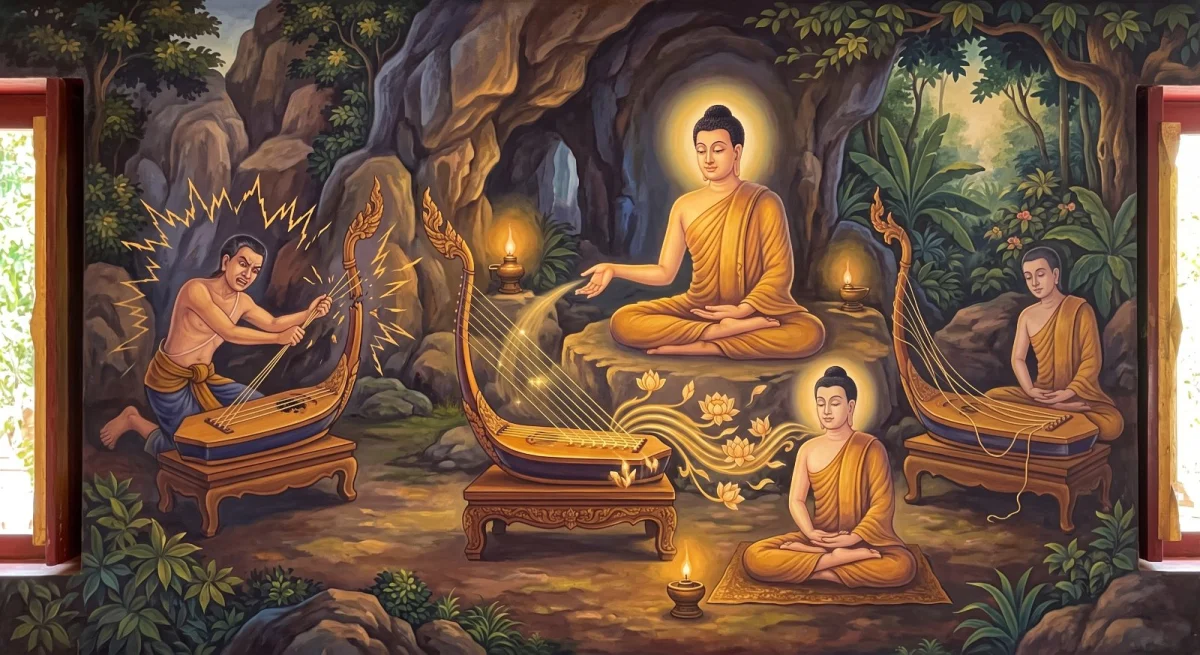
Soṇasuttaṃ · vīṇūpamā
Effort that is too tight leads to restlessness; too slack leads to laziness — the Buddha's teaching to Soṇa, who strove until his feet bled.
Soṇa Koḷivisa was the son of a wealthy family, raised in such comfort that hair grew on the soles of his feet. After ordaining, he practised walking meditation so hard that his feet split and the walking path was stained with blood, yet he still did not attain awakening, and he thought of disrobing to use his wealth for merit.
The Buddha came and asked: when you were a householder, were you skilled at playing the lute? If the strings were too tight, would it sound good? If too loose? And if neither too tight nor too loose, but tuned just right? Soṇa answered that only the last would sound good. The Buddha said: effort aroused too strongly leads to restlessness; effort too slack leads to laziness. Therefore establish balanced effort and find the evenness of the faculties.
Soṇa followed this and before long attained arahantship.
Effort beyond what is balanced makes the mind agitated, tense and eager for results, until it cannot settle and becomes restless.
If meditation gives you headaches or stress, or you get angry at yourself for failing, ease off, shorten the time and be kinder to yourself.
Too little effort makes the mind dull, drowsy and stagnant.
If you keep putting practice off, set a small goal you're sure to meet, such as five minutes a day. Consistency matters more than length.
Tune effort to the right level, neither too much nor too little, and keep it steady.
A little every day is better than a lot followed by a week off. Sustainable effort is effort you can still make on a tired day.
Bring the faculties into balance. The commentaries explain this as pairing faith with wisdom and energy with concentration, with mindfulness watching over the balance.
Much faith without wisdom makes one credulous; much wisdom without faith makes one overthink; much energy without concentration makes one restless; much concentration without energy makes one dull. See which of your pairs is tilted.
This principle reaches far beyond meditation — work, exercise, study and raising children all have their own "too tight" and "too loose".
Signs of strings too tight: stress, frustration with yourself, wanting quick results, and burning out easily. Signs of strings too loose: procrastination and easy excuses. See which side you're on lately and adjust a little at a time, like a musician turning the tuning peg bit by bit.
Tap to read the actual passage on the page cited.
Seeing the impermanent as permanent, suffering as happiness, not-self as self, and the unattractive as attract…

The Cittayamaka asks whether a mind that is arising has already arisen. Answering forces you to separate the m…

Rādha asks what is called "a being". The Buddha says it is one attached to the five aggregates by desire, like…

A young brahmin asks whether brahmins can claim "only this is true". The Buddha distinguishes three stages: pr…