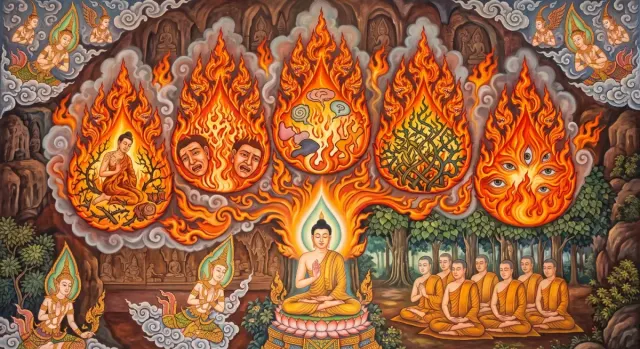
The Kukkuḷa Sutta: The Aggregates Are Burning Embers, and the Fitting Practice
Rūpaṃ bhikkhave kukkuḷaṃThe five aggregates are burning embers. Seeing this, one grows disenchanted, dispassionate and liberated. At t…



Amoghaṃ divasaṃ kayirā
Verses of three elders on time. Sambhūta teaches when to go slow and when to hurry, Kātiyāna is roused to get up and make an island for himself, and Sirimaṇḍa warns that the rain soaks what is covered, and that each passing night is life reduced.
In the Theragāthā of the Khuddaka Nikāya, several elders speak of time and heedfulness. This page brings three together: the Elder Sambhūta from the Book of the Fours, and the Elders Kātiyāna and Sirimaṇḍa from the Book of the Sixes.
Sambhūta contrasts the fool and the wise by timing: one who hurries when it's time to go slow and goes slow when it's time to hurry wanes like the moon in the dark fortnight. Kātiyāna's verses are a wake-up call addressing him by name: get up and sit, don't keep sleeping, don't let the King of Death win. Sirimaṇḍa begins with the image of rain soaking what is covered, then speaks of a world burned by death, old age and sickness as by a mass of fire.
The commentary explains the rain verse as referring to concealed wrongdoing: one who hides a fault is soaked all the more by defilement, while one who reveals it is not.
Sambhūta says that one who hurries when it's time to go slow and goes slow when it's time to hurry is a fool and meets suffering through poor management. Their good fortune wanes like the moon in the dark fortnight; they lose standing and fall out with friends.
Notice whether you rush to reply to messages when angry but put off seeing a doctor or having an important talk with family. Try swapping the pace of the two.
One who goes slow when it's time to go slow and hurries when it's time to hurry is wise and reaches happiness through good management. Their good fortune grows full like the moon in the bright fortnight; they gain standing and renown and do not fall out with friends.
Before starting each task, briefly ask whether it would suffer more from delay or from haste, and choose your pace to match the answer.
The verses call on Kātiyāna to get up and sit, not to sleep much, to be wakeful, and not to let the King of Death, kinsman of the heedless, beat him, lazy as he is, as if by a trick. Be heedful in the first and last watches of the night, and make firm effort.
Schedule the most important task of your day for the time you are freshest, and don't spend that time scrolling on your phone.
Just as the force of the great ocean's waves overwhelms one who cannot cross, birth and old age overwhelm you. Make a good island for yourself, for you have no other refuge. The Teacher has shown this path beyond ties and beyond the fear of birth and old age.
Ask yourself what inner ground you will stand on when heavy events crash over you, and start building it today, for example with daily meditation, even for five minutes.
Just as a lamp with a feeble flame is bent by the wind like a creeper, so you, not grasping, should shake off Māra. Free of lust for feelings, wait for your time here, cooled.
When strong emotions come like gusts of wind, remember they are only blowing past. If you don't hold on to them, they can do little to your mind.
Sirimaṇḍa says that rain soaks what is covered and does not soak what is open, so open what is covered and the rain will not soak you. The commentary explains this as concealed wrongdoing. The next verses say the world is struck down by death, surrounded by old age, pierced by the dart of craving; old age, sickness and death come like a mass of fire, with no strength to resist and no speed to flee.
When you make a mistake at work or at home, say so plainly and early. Hidden mistakes tend to grow and rob the mind of peace.
Make the day not in vain through attention, whether a little or a lot, for as each night passes, life is reduced by that much. Whether walking, standing, sitting or lying down, the last night draws near; you have no time to be heedless.
Each night before sleeping, ask yourself one question: what did I do today that benefited my own mind or someone else, however small?
These three sets of verses answer a common modern problem: putting off what matters while rushing what needs careful thought. Heedfulness doesn't mean hurrying everything, but knowing what should be done now and what should wait.
The warning against sleeping too much was aimed at monastics' laziness, not a call to go without sleep. Enough sleep is part of caring for body and mind. What to watch out for is sleeping while awake: spending the day without noticing.
Tap to read the actual passage on the page cited.
The five aggregates are burning embers. Seeing this, one grows disenchanted, dispassionate and liberated. At t…

The Buddha sets kinds of happiness side by side in thirteen pairs, such as the happiness of a householder and …

The wanderer Vekhanassa exclaims "This is the supreme colour!" The Buddha compares lights from a firefly to th…

One who has not yet realised the Dhamma but has unwavering confidence that these things are impermanent is cal…