
The Shorter Discourse on the Mass of Suffering: Why We Get Pulled Back to Sensual Pleasure
CūḷadukkhakkhandhasuttaṃMahānāma knows that greed, hatred and delusion defile the mind, yet at times they still overwhelm it. The Budd…



Vanasaṃyuttaṃ
Short stories of forest deities who kindly admonish monks: one sits thinking unwholesome thoughts, one sleeps by day, one talks with lay visitors too long, one sniffs a lotus and is called a thief of scents. Lessons in heedfulness anyone can use.
The Vana Saṃyutta of the Saṃyutta Nikāya, Sagāthāvagga, collects fourteen short discourses. Most tell of monks dwelling in forests in Kosala, where a deity living in that forest, out of compassion and wishing for their good, speaks verses to stir a sense of urgency, and the monks come back to mindfulness.
These stories are set in monastic life, so some warnings concern monastic discipline directly, such as mixing with householders. But the broad principles — watching your thoughts, not wasting time, and not overlooking small faults — apply to everyone.
Notably, the deities don't come out of contempt but out of kindness, and some monks answer back, showing that receiving admonition is a skill in itself.
A monk resting by day thinks about household matters. The deity warns: you came to the forest wishing for seclusion, but your mind wanders outside. Remove your fondness for people and you will be happy. As a bird covered in dust shakes it off, so an ardent, mindful monk shakes off the dust of defilement.
If on holiday or in meditation you keep thinking about work or checking your phone, notice it and shake it off like a bird shaking off dust. No need to blame yourself; just come back to where you are.
A monk falls asleep during his daytime rest. The deity warns: get up, monk, why sleep? How can one pierced by the dart of craving lie sleeping? Strengthen the faith with which you went forth, and don't fall under the sway of sleep.
Enough rest is essential, but if you notice you're sleeping or scrolling to escape work you meant to do, recall why you started, then get up and do it for five minutes.
Venerable Kassapagotta teaches a hunter at an unsuitable time. The deity warns that one not ready to understand hears the Dhamma without grasping the meaning; even with ten lamps blazing, he would not see forms, for he has no eyes to see.
Before advising or teaching someone, see whether they want to listen and are in a state to hear it. Sometimes waiting for the right moment helps more than speaking at once.
Venerable Ānanda spends too long receiving lay visitors. The deity warns: having gone to the foot of a tree, keep nibbāna in mind, meditate, don't be heedless; what will all this chatter do for you?
Notice how much time unnecessary chats, meetings or messaging take from what you set aside for important things, and set a clear time to finish.
Venerable Nāgadatta goes into the village early and returns after midday, mixing with householders, sharing their joys and sorrows until entangled with families. The deity warns that it fears he will fall under the power of the mighty King of Death.
Helping others is good, but if whole days go to other people's matters with no time left to look after your own mind, set aside personal time every day.
A monk dwells on thoughts of sensuality, ill will and harming. The deity warns: through unwise attention you are being devoured by your thoughts. Give up unwise attention and reflect wisely; recollecting the Teacher, the Dhamma, the Saṅgha and your own virtue, you will surely find gladness, rapture and happiness.
When you keep circling thoughts of wanting, resentment or revenge, shift your attention — recall good things you've done or someone you respect — instead of fighting the thoughts head-on.
A group of monks are restless, arrogant, loud-mouthed, rambling, unmindful, with unguarded senses. The deity says the Buddha's earlier disciples lived simply and were not greedy, but these monks make themselves hard to support, eating and then lying about in others' homes. Yet the deity pays homage to the Saṅgha and says the rebuke is only for the heedless; the heedful deserve homage.
When criticising a group or organisation, name the problem behaviour clearly and set apart those who act well, instead of lumping everyone together.
A monk sniffs a lotus in a pond. The deity warns that smelling a flower not given is a factor of theft: you are a thief of scents. The monk objects that people who dig up lotus roots and break flowers do far more, so why not blame them? The deity replies that it doesn't speak to one deeply stained, but to one seeking purity, even a hair-tip of evil looks as large as a cloud. When the monk asks the deity to warn him again, it replies that he should know for himself the way to a good destination.
When warned about something small, don't reply straight away that "others do much worse". The standard you set for yourself needn't match those around you, and don't wait for others to keep warning you.
Everyone has their own "forest": time alone when no one sees. These discourses invite us to ask where our mind goes then, what we think about, and how we spend that time.
The warnings in the Forest Collection are short and direct, but they come from goodwill. When someone warns you, even if their words are a bit sharp, separate the content from the tone before brushing it aside.
The story of the thief of scents teaches that the more sincerely you train, the more clearly small faults show. This isn't about nitpicking yourself into stress, but about a sensitivity that grows gradually with practice.
Tap to read the actual passage on the page cited.
Mahānāma knows that greed, hatred and delusion defile the mind, yet at times they still overwhelm it. The Budd…
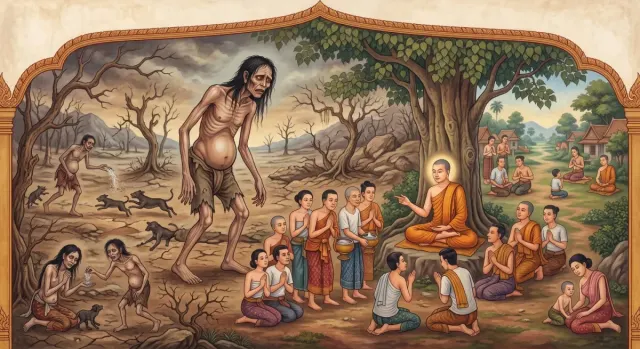
Stories of ghosts who explain their past deeds: a pig-mouthed ghost who didn't restrain his speech, a foul-mou…

Kesi the horse trainer trains horses gently, harshly, or both, and the Buddha trains people the same way. But …

The Section on States of Mind begins with the wholesome sense-sphere mind accompanied by joy and associated wi…