
The Pairs on Roots: Few Roots, Much That Grows From Them
MūlayamakaṃThe Yamaka opens by asking whether all wholesome states are wholesome roots, then asks the reverse: whether al…


Velāmasuttaṃ
The greatest gift is still less fruitful than keeping the precepts; precepts less than loving-kindness for the time it takes to milk a cow; and loving-kindness less than perceiving impermanence for a finger-snap.
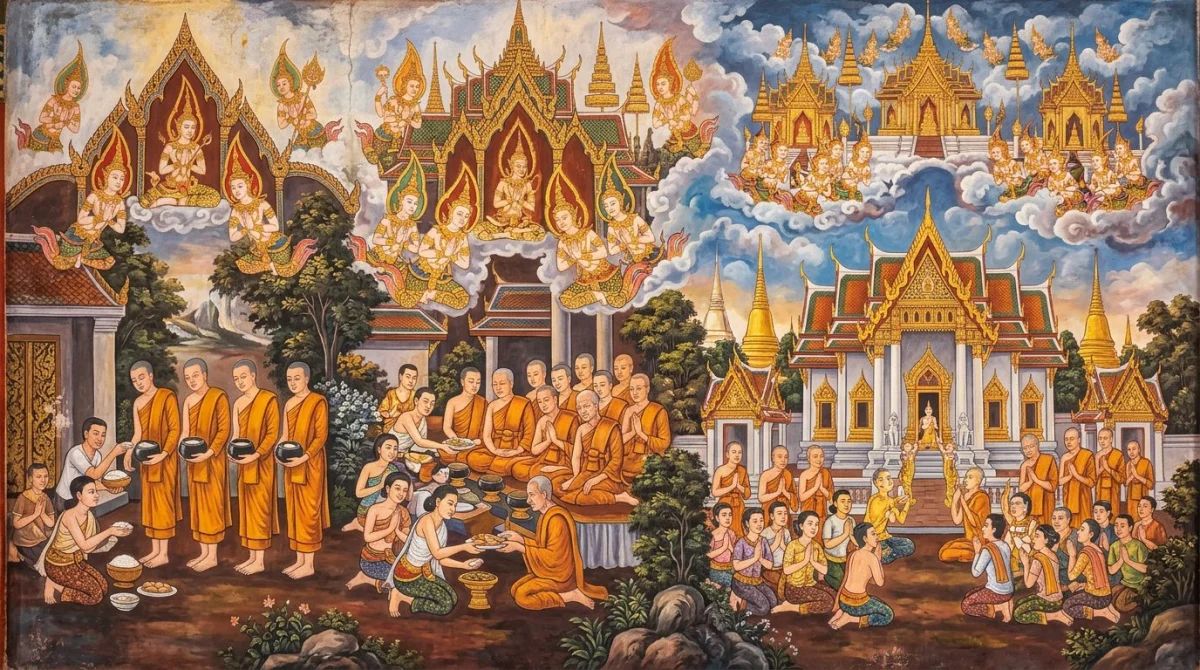
In the Sīhanāda Vagga of the Book of Nines, the Buddha tells Anāthapiṇḍika about the brahmin Velāma, who gave an unbelievably vast gift — bowls of gold and silver, elephants, horses, chariots, milch cows and immense quantities of cloth. The Buddha reveals that he himself was Velāma in a past life, but there was no one worthy of offerings to receive that gift.
He then ranks, step by step, what is more fruitful than that great gift: giving to one of right view, to noble ones at each level, to the Buddha and the Saṅgha; building a dwelling for the Saṅgha; going for refuge; undertaking the five precepts; developing loving-kindness even for as long as it takes to pull a cow's udder; and finally developing the perception of impermanence even for a finger-snap, which is most fruitful of all.
A gift of immense wealth, but with no one worthy to receive it, so it is less fruitful than everything that follows.
The size of a gift isn't the only measure; the purity of giver and receiver matters just as much.
Feeding one person accomplished in view is more fruitful than that great gift, and the fruit grows at each step when given to once-returners, non-returners, arahants, paccekabuddhas, and the Buddha with the Saṅgha.
Support those who genuinely practise well, rather than choosing by fame or grandeur.
Building a dwelling for monastics from all directions is more fruitful than the gifts above.
Long-term gifts for common benefit, such as supporting places for practice, have wider reach than gifts to individuals.
Going for refuge to the Buddha, Dhamma and Saṅgha with a confident heart is more fruitful than building a dwelling.
Reciting the refuges daily with genuine intention, not just by rote, is merit that costs nothing.
Undertaking the five precepts is more fruitful than going for refuge, because it gives safety to all beings.
A day of fully kept precepts is worth more than a grand merit-making while still breaking precepts. See "The Five Precepts".
Developing a mind of loving-kindness even for as long as it takes to pull a cow's udder is more fruitful than undertaking the five precepts.
A few minutes of sincere loving-kindness each day is very valuable. See "Eleven Benefits of Loving-Kindness".
Developing the perception that all things are impermanent, even for a finger-snap, is the most fruitful of all.
Pause today and see that every feeling, thought and event that has passed — none of it remains. This is the highest merit in this discourse.
This discourse doesn't say giving is worthless, but that merit has many levels, and the higher ones cost no money at all. Virtue, loving-kindness and seeing impermanence are open to everyone, every day.
Try a daily merit plan that costs nothing: keep the precepts fully, spend a short time radiating loving-kindness, and pause for a moment to see that everything passing through today is changing. Read alongside "The Three Grounds for Making Merit" and "Five Gifts of a Good Person".
Tap to read the actual passage on the page cited.
The Yamaka opens by asking whether all wholesome states are wholesome roots, then asks the reverse: whether al…

Three debates opening chapter 16 ask whether one person can directly restrain another's mind, support it, or h…

The Paṭisambhidāmagga explains the four foundations of mindfulness as contemplating body, feeling, mind and ph…

Seeing Sāriputta's radiant face, Ānanda asks what he has been dwelling in. He answers that he entered jhāna wi…