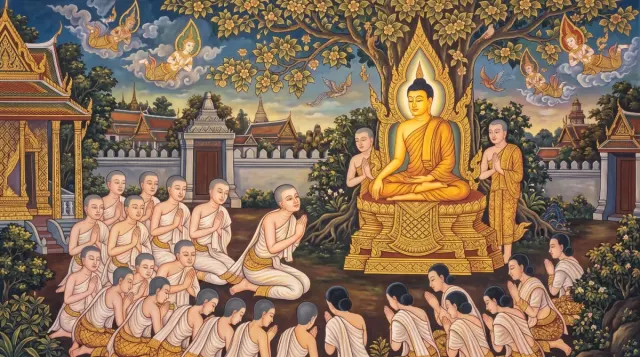
Mahāpajāpatī Gotamī Asks to Go Forth: Determination That Opened the Way for Women
Bhabbo ānanda mātugāmoMahāpajāpatī Gotamī asked that women be allowed to go forth and was refused. She shaved her head, put on ochre…



Pañcasikkhāpade ratā
A servant woman who kept the precepts with unflagging effort, a woman living near the fishermen's gate who both shared and kept the uposatha, a lay follower who set her heart on the wrong aim and was reassured, and a young man who said "no" to every precept before accepting them one by one.
In the Vimānavatthu of the Khuddaka Nikāya, several deities speak mainly not of giving objects but of keeping the five precepts and observing the uposatha. The speakers include a servant woman in another family's household, lay women from various towns, and a young man who took the refuges and precepts on the very day he died. This page draws on the Dāsī, Lakhumā, Bhaddittikā, Uposatha, Chattamāṇavaka and Nāga Mansion stories.
Verses repeated across several stories say that the speaker observed the eight-factored uposatha on the fourteenth, fifteenth and eighth days of the fortnight and during the special fortnight, abstained from killing, stealing, sexual misconduct, false speech and intoxicants, and delighted in the five training rules.
The Vimānavatthu is a text of the Khuddaka Nikāya that a number of scholars regard as composed in a later layer, and it teaches through imagery of mansions and heavenly happiness. Rebirth is presented here as the text teaches it, with the focus on conduct that anyone can apply. Those who keep the precepts in these stories include both the well-off and those who were servants, so wealth or status is no measure of anyone's goodness.
In the Dāsī Mansion story, a female deity tells that as a human being she was a servant in another family's household, yet a lay follower of the Buddha who kept the precepts and practised with effort. She resolved not to stop striving even if this body should break apart, and says that the path of the five training rules is safe, free of thorns, straight, and proclaimed by the good.
Work that means taking orders all day doesn't close the path to goodness. A daily-wage worker or a domestic helper can keep the five precepts just as fully as a business owner.
In the Lakhumā Mansion story, a female deity tells that her house stood near the fishermen's gate. She offered rice, cakes, preserved greens and drinks to the disciples who passed by, and kept the uposatha on observance days, and she says she lives in this mansion because of restraint and sharing. At the end she asks Venerable Mahāmoggallāna to tell the Buddha that the lay follower named Lakhumā pays homage at his feet.
The two go well together: share things with your neighbours, and keep one day on which you deliberately give up something that agitates the mind, such as alcohol, shopping or social media.
In the Bhaddittikā Mansion story, the Buddha questions a female deity. She tells him that she was a lay follower in Kimbilā, endowed with faith and virtue, delighting in sharing, offering cloth, food, lodging and lamps, keeping the uposatha on observance days and living heedfully. She says the eight-factored uposatha is of immeasurable benefit and brings happiness.
The uposatha precepts don't have to be kept only at a monastery. A day off spent without an evening meal, without entertainment, and sleeping simply is training a lay person can do at home.
In the Uposatha Mansion story, a lay follower named Uposathā from Sāketa kept the precepts and uposatha like the others. But she tells that because she often heard about the Nandana Grove, desire arose and she set her heart on being reborn there instead of following the Buddha's teaching, and afterwards she regretted having set her heart on a lower state. Venerable Mahāmoggallāna reassures her: don't be afraid; the Buddha has declared that you will reach the distinction of stream-entry.
If you realise you are doing good because you want some reward, you don't have to give up the good deed. Just adjust the aim toward lessening the defilements in your mind.
In the Chattamāṇavaka Mansion story, a male deity tells the Buddha that as a young brahmin named Chatta he met him on the road. The Buddha told him to take the Buddha, Dhamma and Saṅgha as refuge, and to abstain from killing, stealing, adultery, false speech and intoxicants. To each one he first said no, but afterwards he did as the Buddha had said, one precept at a time.
If some precepts still feel too hard, don't force yourself to take them all on in a single day. Accepting them one by one after honest reflection is a sincere beginning.
Chatta kept the five precepts and continued his journey, and robbers killed him on the road for his belongings. He says that this was the only wholesome deed he could recall, and invites the Buddha to see the fruit of restraint kept for just a moment, saying that even a little good done in the Tathāgata's Dhamma bears great fruit.
No one knows how much time they have left. The good you plan to start "when you're ready" is better started today, even if it is just one thing.
In the second Nāga Mansion story, a male deity riding a white elephant tells that he was a lay follower of the Buddha who abstained from killing, did not take what was not given, was content with his own wife, did not lie, did not drink intoxicants, and gave food and drink respectfully.
In modern relationships the third precept includes faithfulness of heart and online. Contentment with the partner you have is the foundation of a home where people can trust each other.
The five precepts in these stories don't belong to special people. They are kept by a servant woman, housewives, and a young man hearing the Dhamma for the first time. The starting point is open to anyone who makes the intention.
A simple way to begin is to choose one day a week or a month as your own precept day. Live more simply than usual, give up things that scatter the mind, and notice how the mind grows lighter.
If you slip or can't keep everything, you can always start again. The story of the lay follower named Uposathā shows that even after setting your heart on the wrong aim, there is still encouragement and a way forward.
Tap to read the actual passage on the page cited.
Mahāpajāpatī Gotamī asked that women be allowed to go forth and was refused. She shaved her head, put on ochre…
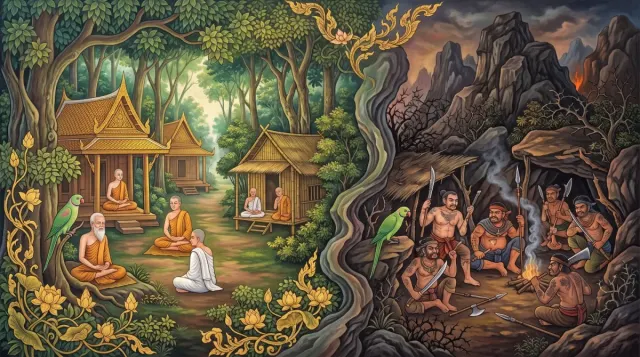
Two parrots are brothers from the same mother. One grows up among robbers, the other in a hermitage. When a lo…

Joy, grief and equanimity are each analysed six times over, once for each sense, and then divided into the kin…

Five strengths of a practitioner — faith, energy, mindfulness, concentration and wisdom — to be kept in balanc…