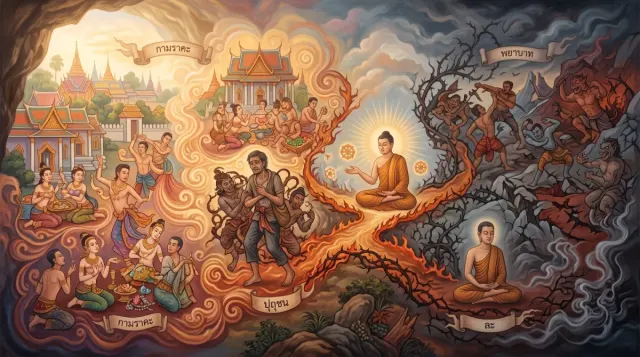
The Debate on Abandoning: Can an Ordinary Person Abandon Sensual Lust and Ill Will?
JahatikathāOne side holds that an ordinary person can abandon sensual lust and ill will by the fine-material path. The Th…


Yācanabahulā viññattibahulā
The monks of Āḷavī built oversized huts and kept asking villagers for labour and materials until people fled at the sight of a monk. The Buddha told the stories of the nāga Maṇikaṇṭha, a flock of birds and Raṭṭhapāla to teach that constant asking endears you to no one.
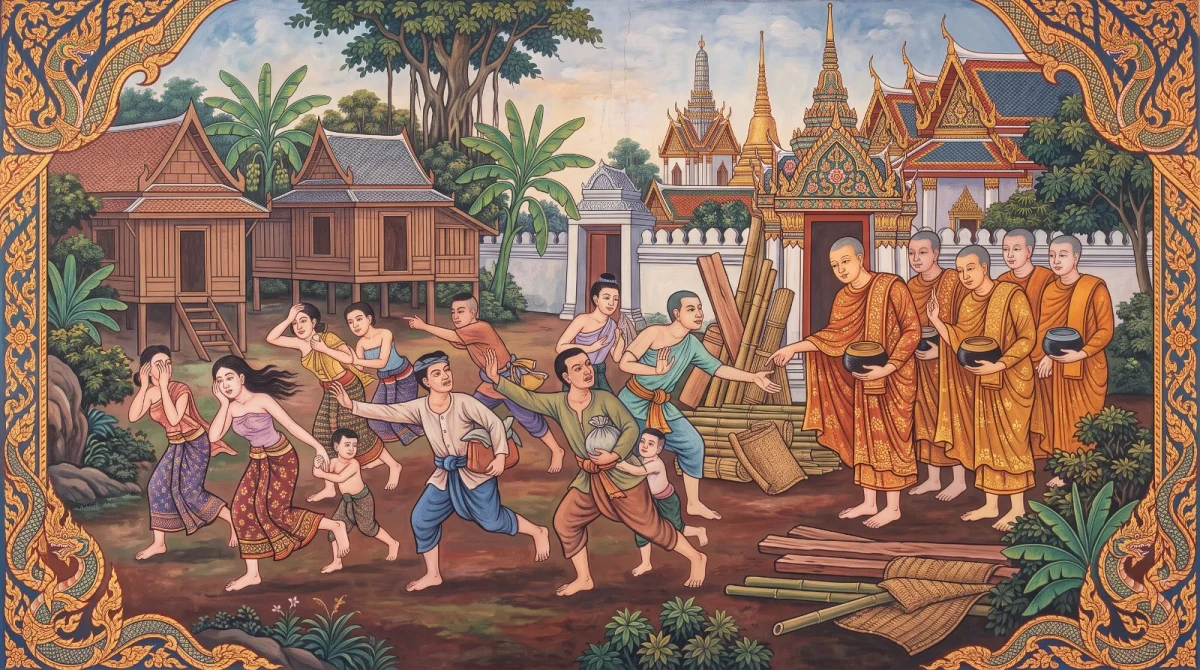
In the Vinaya Piṭaka, Mahāvibhaṅga, Saṅghādisesa section, is the origin story of the sixth saṅghādisesa rule. The monks of Āḷavī built huts for themselves, with no other owner, by begging for materials themselves, and built them with no limit on size. So the huts were never finished, and they kept pleading with villagers for men, labour, oxen, carts, knives, axes, hoes, chisels, creepers, bamboo, grass and clay. When people saw a monk they were alarmed, ran away, took another road, turned their faces, and shut their doors; they even fled from a cow, thinking it was a monk.
When Venerable Mahākassapa came to Āḷavī on almsround, people fled from him too. He asked what had happened and reported it to the Buddha. The Buddha rebuked the monks and told three stories: a hermit who asked a nāga king for his jewel until the nāga never returned; a monk who asked a flock of birds for feathers until they left; and Raṭṭhapāla, who asked nothing of his father because one who asks is not loved. He then laid down that a monk building a hut by his own begging must keep to a set size and bring monks to inspect the site first.
This is a monks' rule about building dwellings, but the origin story teaches everyone about consideration for others, not overreaching our means, and the value of wealth others work hard to earn.
The huts the monks of Āḷavī built by their own begging were for themselves alone and had no limit on size, so they were never finished. The monks had to keep pleading for men, labour, oxen, carts, tools, bamboo, grass and clay.
Before building a house, organising an event or starting a project, assess how far you can finish it with your own resources. Don't make plans that depend on asking others indefinitely.
Villagers harassed by requests were alarmed on seeing a monk, ran away, took another road, turned their faces and shut their doors; they even fled from a cow, thinking it was a monk. Mahākassapa, who had nothing to do with it, was avoided too, and Āḷavī, once an easy place for almsfood, became a hard one.
If you notice people stop answering your calls or avoid meeting you, consider whether you have been asking too much of them.
A younger hermit was terrified of the nāga king Maṇikaṇṭha, who coiled around him and spread his hood over his head. His elder brother advised him to ask for the jewel at the nāga's throat. Asked three times, the nāga withdrew and spoke verses: plentiful food and drink come to him because of this jewel; he would not give it, for the hermit asked too much, and he would not come to the hermitage again. Afterwards the younger hermit grew even thinner, because he no longer saw that beautiful nāga.
If someone around you has something they depend on for their living, such as a vehicle for work, don't keep asking to borrow it; they will feel uneasy whether they give or refuse.
The elder hermit spoke a verse: don't ask for what you know is dear to someone; one becomes disliked through asking too much; the nāga, asked for his jewel, was never seen again. The Buddha said that begging and asking are unwelcome even to animals, let alone to human beings.
If you know an item means a lot to a friend, such as a keepsake from their parents, don't ask to borrow or take it, however close you are.
The Buddha told how a monk living in a forest grove in the Himalayas was disturbed by the noise of a great flock of birds and came to see him. The Buddha advised him to announce three times in each watch of the night that he wanted one feather from each bird. When the birds understood that the monk was asking for feathers, they left that grove and never came back.
Even a small request, like a little from each person, drives a whole group away if you ask everyone and ask repeatedly.
Raṭṭhapāla's father asked why, when many strangers came to ask him for things, his own son asked for nothing. Raṭṭhapāla replied that one who asks is not loved by the one asked, and one who refuses is not loved by the one asking; so he did not ask, lest there be ill will between them. The Buddha said that if Raṭṭhapāla spoke this way to his own father, how much more should one person be careful with another.
Even with parents and family, asking little and standing on your own feet helps preserve love and respect between you.
The Buddha said householders' wealth is hard to gather and, once gathered, hard to protect. He then laid down that a monk building a hut by his own begging may make it twelve spans long and seven spans wide by the Sugata span, and must bring monks to inspect the site before building.
When you receive help from someone, think of the labour and time behind that money or item, and use it well and in proportion.
Asking for help is not wrong, but when asking becomes a burden, relationships change, just as the people of Āḷavī shut their doors at the sight of a monk. Today it resembles a friend who keeps borrowing money, a relative who never stops asking favours, or donation appeals sent too often.
The root problem here was not one request but planning beyond one's means from the start. Huts with no size limit could never be finished, so the asking never ended.
What helps is to size projects to the resources you have, ask only for what is needed, leave people free to say no without awkwardness, and remember that whatever others give was hard for them to earn.
Tap to read the actual passage on the page cited.
One side holds that an ordinary person can abandon sensual lust and ill will by the fine-material path. The Th…

Near the end of the Book of the Tens, the Buddha counts the ten courses of action in layers: doing them onesel…

Giving, offering, sharing, helping, welcoming, seeking, and even growth and treasures, all come in two kinds: …

Actual cases under the rule against stealing, in which the Buddha asks each monk what his intention was. Picki…