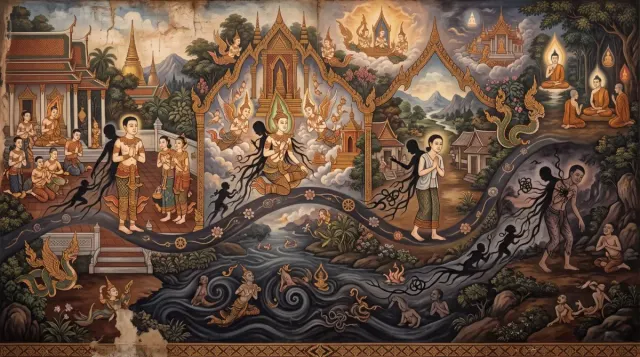
The Latent Tendencies Pairs, Realms Section: Changing Worlds Leaves Them Intact
Anusayā bhaṅgā natthiAt the end of the Latent Tendencies Pairs, the text asks: when someone passes away from one realm and is rebor…


Na bhagavā ceḷapaṭikaṃ akkamissati
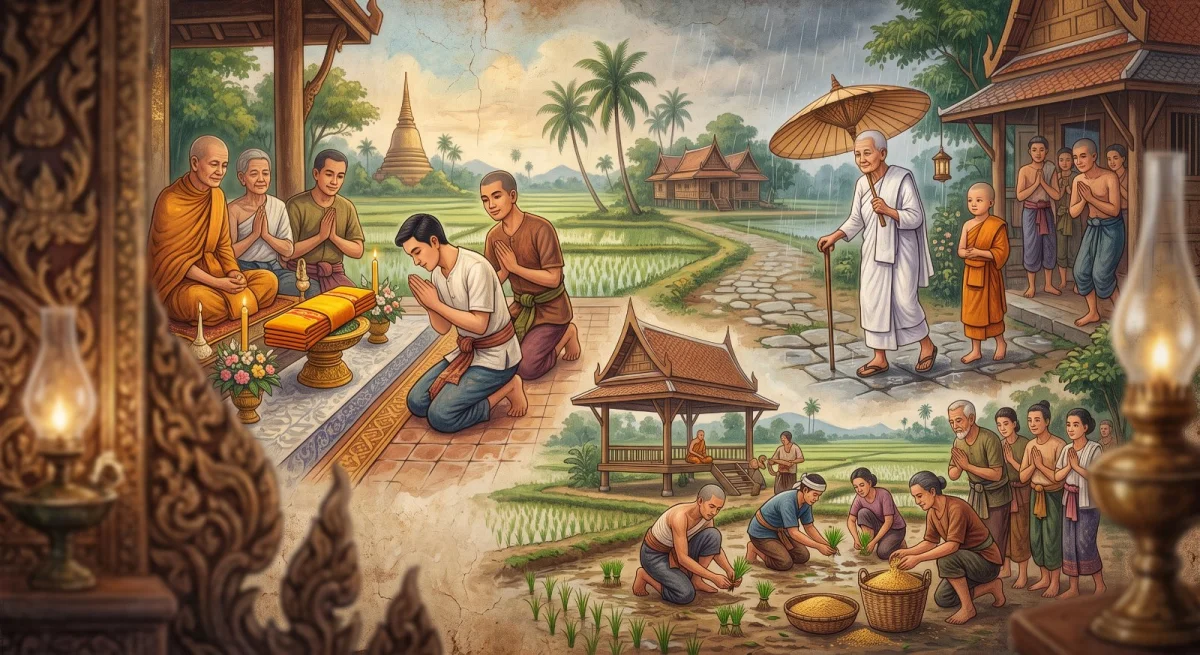
The Buddha would not step on the cloth Prince Bodhi spread for him, out of concern for later generations; monks carrying sunshades looked like high officials; a monk with a staff and hanging bowl was seized as a thief; and people criticised grains of rice scattered in the refectory.
The Khuddakavatthu Khandhaka of the Cullavagga, Vinaya Piṭaka, contains several stories that begin with what other people see. Prince Bodhi had just finished his Kokanada palace. He invited the Buddha for a meal and spread white cloth from the first step of the stairs, asking three times that the Buddha step on it. The Buddha stayed silent and glanced at Ānanda, who told the prince to roll up the cloth, because the Tathāgata has compassion for later generations.
The Buddha then laid down that monks should not step on cloth spread out, but when householders asked them to step on it for good fortune, he allowed it. The same passage includes Visākhā's gift of a water pot and broom, the rule on sunshades, the staff and carrying sling, and the grains of rice spilled in the refectory.
These are rules for monks, but the principle behind them belongs to everyone: our actions are always seen and interpreted by others, and being considerate of them is not pretence.
Prince Bodhi asked the Buddha three times to step on the cloth he had spread. The Buddha stayed silent, and Ānanda told the prince to roll it up, because the Blessed One would not step on it; the Tathāgata has compassion for later generations. The Buddha then went up into the palace, ate, and taught the prince the Dhamma.
When you must decline someone's kindness, decline only the part that is unsuitable, and accept the rest with gratitude.
Later a woman invited monks, spread cloth and asked them to step on it for good fortune. The monks refused, and she criticised them. The Buddha said householders wish for good fortune, and allowed monks asked to do so for good fortune to step on the cloth; he later also allowed stepping on a foot-wiping cloth.
Hold firmly to principles, but if keeping to the letter would needlessly hurt someone well-meaning, see whether the principle allows some flexibility.
Visākhā offered a water pot, a broom and a kind of foot scrubber. The Buddha accepted the water pot and broom but not the foot scrubber, and then allowed three simple foot scrapers: gravel, potsherd and sea-foam stone. The text doesn't state why he declined it.
When someone gives you several things, accept those you will really use, and say politely if something simpler would do instead.
The group of six walked about holding sunshades. Followers of the Ājīvikas saw them from afar and said to a lay follower that his monks were coming with sunshades like high officials. He even insisted they weren't monks, but when they came near he recognised them and criticised them. The Buddha forbade sunshades, allowed them for sick monks, and later allowed monks who weren't sick to use them within the monastery and its precincts.
Consider whether your dress or the things you use in public send an image at odds with your role, without being so strict that you forget health needs.
A monk put his bowl in a sling hung from a staff and walked past a village gate at dusk. People shouted that a thief was coming, his sword glinting, chased and seized him, then let him go when they recognised him. The Buddha forbade carrying a staff and sling, but a monk too sick to walk or carry his bowl without them could ask the Saṅgha for formal permission.
When travelling at night or where people don't know you, think how what you are carrying looks to strangers.
At a meal offered to the Saṅgha, grains of rice were scattered all over the refectory. People criticised the monks: when rice is given, how can ascetics not receive it respectfully? Each single grain is finished only through a hundred tasks.
Serve yourself only what you will eat, and finish it. If you spill, pick it up, and remember the farmers, carriers and cooks.
After that, the Buddha allowed monks to pick up and eat themselves whatever falls while it is being given, because the donors have already given it up.
Food that falls on a clean table, or things that are still usable, needn't be thrown away at once; judge sensibly by hygiene.
The story of Prince Bodhi's cloth teaches that sometimes we must decline something offered with good intentions, for the sake of the longer term, and can do so politely without making the giver lose face. The Buddha still went up to the palace, ate and taught the Dhamma as usual.
The stories of the sunshade and the staff remind us that others judge us from a single glance. If we know something is easily misunderstood, we should adjust, while still making allowances for the sick who really need it.
As for the rice, people said each grain is finished only through a hundred tasks — reason enough to finish what is on our plate.
Tap to read the actual passage on the page cited.
At the end of the Latent Tendencies Pairs, the text asks: when someone passes away from one realm and is rebor…

The Vinaya sets out what kind of monk may give full ordination, give dependence and take a novice as attendant…

One should make friends with equals, superiors and inferiors alike, because when misfortune comes such friends…

A trapper plants fodder to lure four herds of deer. One gorges, one flees to extremes, one is careful but stil…