
Niddesa on the Pasūra Sutta: An Anatomy of Arguing to Win
PasūrasuttaniddesoThe Niddesa sets out every stage of a person who enters a debate to win: the anxiety before it starts, the emb…


Yo pana bhikkhu jātarūparajataṃ uggaṇheyya
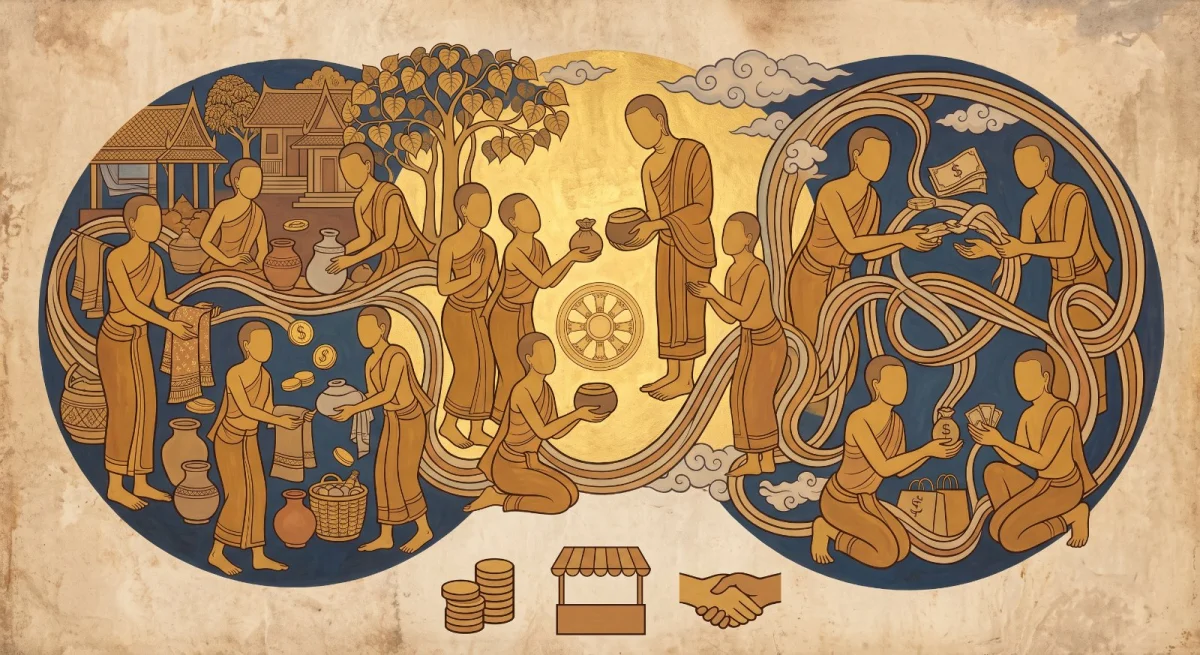
A portion of meat set aside for a monk was given to a crying child, so the householder offered to buy something else with one kahāpaṇa instead, and was asked for the coin itself. He walked away saying these monks accept money just as we do. This is the origin of three rules: accepting money, dealing in money, and bartering.
In the Vinaya Piṭaka, Mahāvibhaṅga Part 2, Nissaggiya chapter, Kosiyavagga rule 8, Venerable Upananda the Sakyan was a regular visitor to one family in Rājagaha and received their food daily. One evening meat came into the house and a portion was set aside for him, but the child of the family woke before dawn crying for meat. The father told his wife to give the monk's portion to the child, saying they would buy something else for him. That morning the man told Upananda honestly what had happened and asked what he should obtain with one kahāpaṇa. Upananda asked whether he had already relinquished that kahāpaṇa; when the man said he had, Upananda told him to hand over the coin itself. The man gave it and then walked away complaining that these monks accept money just as we do.
Rule 9 of the same chapter took place at Jeta's Grove. The group of six monks engaged in various kinds of dealing in money, and lay people complained that they behaved like householders who enjoy sensual pleasures. Rule 10 tells how Upananda, who was skilled at robe-making, made an outer robe from old cloth and dyed and finished it beautifully. A wanderer wearing an expensive cloth asked to exchange. Upananda said, you should know for yourself; the wanderer said he did, and they exchanged. Back at his own park the other wanderers asked how long that robe would last and said his own cloth had been better. Convinced, he returned and asked for his cloth back. Upananda replied that he had told him to know for himself and would not return it. The wanderer complained that even lay people return things to a lay person who regrets a deal, so how could one renunciant refuse another?
These rules apply to monks. Lay people use money, buy, sell and exchange as a matter of course. What can be taken from them is the reasoning behind them: all three stories end with an outsider's criticism, and in two of the three someone feels they were taken advantage of.
The householder said honestly that he had given the monk's portion to his child, and offered to obtain something else with one kahāpaṇa. Upananda first confirmed that the coin had been relinquished, and when the man agreed, told him to hand it over. The subtlety is that the giver's original intention was changed after he had already committed himself.
When someone offers help in one particular form, do not convert it into another form that suits you better without asking them first.
The first to complain was not an outsider but the donor himself, who said on the spot that these monks accept money just as we do. The monks who heard him reported it, the Buddha questioned Upananda, and laid down a nissaggiya pācittiya.
If someone who has just helped you walks away feeling bad, treat that as important information, not as them being oversensitive.
The text requires money that has become forfeit to be relinquished in the midst of the Saṅgha, not to an individual as other items may be, and it is not returned to the owner afterwards, unlike a robe or a bowl. That strictness shows the matter was treated differently from ordinary requisites.
Money matters in an organisation or a group should be handled openly where several people can see, not settled quietly between two.
If no one will take the matter in hand, the Saṅgha must appoint a monk to dispose of the money, and five qualities are specified: he does not act from favouritism, from hatred, from delusion or from fear, and he knows what counts as disposed of and what does not.
When appointing someone to look after a group's common fund, check these four biases before checking competence, and make the scope of the job explicit.
Rule 9 arose because the group of six engaged in several forms of monetary dealing. The lay criticism was that they acted like householders who enjoy sensual pleasures; not that they broke the law of the land, but that if they were no different from everyone else, what was the point of having gone forth?
If you have taken on a public role, ask whether what you are doing still leaves that role any meaning.
The wanderer exchanged an expensive cloth for an outer robe made of old cloth but beautifully dyed and finished. When his companions said his own cloth had been better, he came back to ask for it. He was refused with the words, I told you to know for yourself. He complained that even lay people return things to a lay person who regrets a deal, so how could one renunciant refuse another?
When you know the other party agreed without full information, leave the door open for them to withdraw. Winning through someone else's ignorance is not winning.
The analysis explains "of various kinds" as robes, alms food, lodging and medicine, and even a lump of powder, a toothwood or a thread from a cloth border. It explains entering into an exchange as speech that dictates: give this for this, bring this for this. The fault lies in the bargaining stance, not in the value of the goods.
A small bargaining tone over small things can turn a relationship into a transaction. Notice your tone of voice when asking those closest to you for help.
What the three stories share is a question of role. The householder offering one kahāpaṇa did not intend to give money; he intended to buy something as a gift. When the coin itself was requested, the relationship changed shape in his eyes at once. The same happens in ordinary life: someone who comes to us as a friend, teacher or adviser feels the shift the moment the conversation turns into a negotiation about money.
The robe exchange is a lesson about fairness in a deal. "You should know for yourself" pushes all responsibility onto the other party, and when he realises he has lost out there is no way back. Someone who agrees without knowing has not really agreed. Leaving the other person a reasonable window to withdraw is something lay people of the time already did, as the wanderer himself pointed out.
One more thing is worth knowing so the rule is not misunderstood: the text provides a workable procedure. Once money has been relinquished, if a monastery attendant or a lay follower comes by, he is told simply to take note of this; the monk must not say to bring this or that, and may only mention allowable items such as ghee, oil, honey or molasses. That is why monasteries today usually have a steward who handles funds, so that anyone wishing to give can do so through the monastery's own arrangements rather than handing money to a monk directly.
Tap to read the actual passage on the page cited.
The Niddesa sets out every stage of a person who enters a debate to win: the anxiety before it starts, the emb…

The Paṭisambhidāmagga describes wrong view as grasping things as "this is mine, this I am, this is my self", a…

Verses of five elders on gain, fame, praise and blame: praise is empty when your own mind is unsettled; fools …

The fifth Vibhaṅga gathers twenty-two things that govern their own domain — from the sense sensitivities and t…