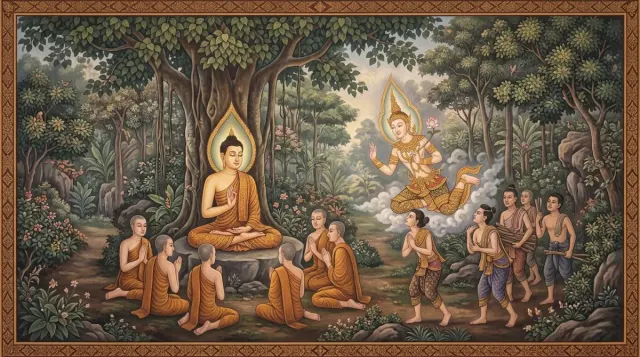
The Forest Collection: Forest Deities Warn Against Heedlessness
VanasaṃyuttaṃShort stories of forest deities who kindly admonish monks: one sits thinking unwholesome thoughts, one sleeps …


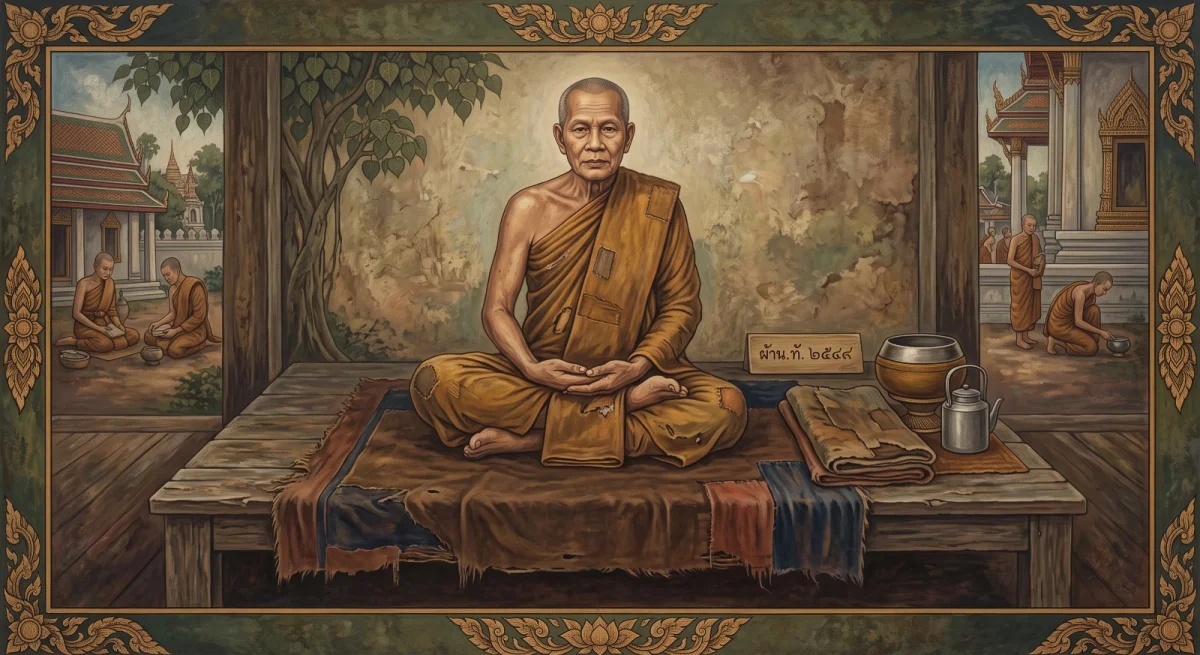
Navaṃ pana bhikkhunā santhataṃ kārāpetvā chabbassāni dhāretabbaṃ
The felt-rug rules of the Silk Chapter. Monks had rugs made of pure black wool like householders, dodged the ban by adding a little white wool, made new rugs every year while asking for wool incessantly, left rugs lying about, and carried wool so far that people mocked them. The Buddha set proportions, a six-year life, the reuse of old rug, and a distance limit, with an allowance for sick monks.
In the Vinaya Piṭaka, Mahāvibhaṅga part 2, the Nissaggiya section, Silk Chapter, several rules concern the felt rug (santhata), which the analysis explains as a rug made by spreading and pressing, not by weaving. Training rule 2 tells that at Vesālī the group of six had rugs made of pure black wool; people touring the monastery complained that they were like householders enjoying sensual pleasures. When this was forbidden, the group of six put a little white wool at the edge, so rule 3 sets the proportions.
Training rule 4 tells that monks had new rugs made every year and kept asking for wool. People compared this with their own rugs, made once and lasting five or six years, so the Buddha laid down that a rug must be kept for six rains, then allowed an exception for a sick monk granted by the Saṅgha. Rule 5 contains the story of Venerable Upasena Vaṅgantaputta and ends with the rule to mix a piece of old rug into the new one. Rule 6 concerns carrying wool on a long journey.
All this is monastic discipline. Lay readers needn't count the years of their cushions, but using things fully, not wanting what looks luxurious, and not dodging rules by keeping to the letter apply to everyone.
The group of six had felt rugs made of pure black wool. People touring the monastery saw them and complained that they were like householders enjoying sensual pleasures, so the Buddha made it a nissaggiya pācittiya offence. The non-offence clauses exempt making it into a canopy, floor covering, curtain, mattress cover or pillowcase.
Before buying something for yourself, ask whether you are choosing it for its use or because you want people to see you have it.
After the ban, the group of six put a little white wool at the edge of the rug and went on making pure black rugs as before. The Buddha then set that a new rug must use two parts of pure black wool, a third of white and a fourth of brown; the analysis explains these as weights.
If you notice you are keeping a rule only by its letter, stop and ask what it is meant to prevent, then act in line with that intent.
Monks had new rugs made every year, always asking, "Give us wool, we need wool." People complained that their own rugs, made once, soiled by children and gnawed by rats, still lasted five or six years. The rule says a monk who has a new rug made must keep it for six rains; making another before six rains, whether or not he has given away the old one, is a nissaggiya pācittiya offence.
Before replacing a phone, clothes or appliances, compare with how long the item should really last, not with the cycle of new models.
A monk fell ill at Kosambī, and his relatives sent a messenger inviting him to come and be nursed. He would not go, because he couldn't take his rug with him, was uncomfortable without it, and couldn't make a new one before six years. The Buddha allowed the Saṅgha to grant an agreement to a sick monk, and added "except with the agreement of the monks" to the rule.
When a household or workplace rule keeps a sick person from getting care, make a proper exception, rather than leaving them to choose between the rule and their health.
When the Buddha was going into seclusion for three months, the Saṅgha at Sāvatthī made its own agreement that anyone visiting him must confess a pācittiya offence. Venerable Upasena Vaṅgantaputta, unaware of it, came with his followers. When the Buddha told him of it, he said he would not lay down what the Buddha had not laid down nor abolish what he had. The Buddha said "Good, good," and allowed monks who dwell in the forest, live on almsfood and wear rag-robes to visit him whenever they wished.
In a group or organisation, beware of adding your own rules on top of existing ones until they are stricter than those who set the principle intended, and don't drop rules just because they are inconvenient.
Wishing to see the Buddha, monks abandoned their rugs and took up the ascetic practices. Walking round the lodgings, the Buddha saw rugs thrown away here and there, and laid down that a monk making a sitting rug should take a span of the Sugata's measure all round from an old rug, to spoil its colour. The analysis says this is for durability: cut a round or square piece and lay it in one part, or tease it out and mix it in. If no old rug can be found, using a little or none is no offence.
When making something new, look for ways to use the still-good parts of the old, such as turning old cloth into rags or reusing parts that still work.
A monk received wool on the road to Sāvatthī, wrapped it in his upper robe and carried it. People teased him: "How much did you buy it for, venerable sir? How much profit will you make?" Embarrassed, on reaching Sāvatthī he threw it down where he stood, and said he had carried it more than three leagues. The Buddha laid down that when there is no one to carry it, he may carry it himself for three leagues at most; having someone else carry it is exempt.
Some things we receive come with a heavy burden of weight, time and how others see us. Consider before accepting whether you can really look after it.
The picture of householders comparing their rugs with the monks' is vivid. Rugs at home that children wet and rats gnaw still last five or six years, yet those meant to set an example replaced theirs every year. Using things for their full life is both thrift and consideration for those who pay.
Adding a little white wool at the edge is an example of keeping the letter while dropping the intent. The Buddha didn't make the rule more complicated to catch people out; he made the proportion so clear it couldn't be dodged. If you find yourself looking for a loophole, ask what the rule is there for.
The allowance for sick monks, and Upasena refusing a Saṅgha-made agreement stricter than the Buddha's rule, remind us that good rules shouldn't be so rigid they harm the sick, and members of a group shouldn't add rules of their own that weigh more than necessary.
Tap to read the actual passage on the page cited.
Short stories of forest deities who kindly admonish monks: one sits thinking unwholesome thoughts, one sleeps …

A pigeon, a snake, a jackal, a bear and an ascetic each keep the uposatha for their own reason: so that attach…

Mahānāma the Sakyan asks how a wise lay follower should comfort another wise lay follower who is gravely ill. …

Five basic commitments that let you live among others without fear — grounded in putting yourself in the other…