
The Discourses on Future Dangers: Seeing What Lies Ahead, Striving Today
AnāgatabhayāniFuture dangers to see in advance — dangers in the forest, old age, illness, famine and a divided Saṅgha, which…



Bhikkhunīparipācitaṃ piṇḍapātaṃ
Two rules arising from the nun Thullanandā. First she calls the great disciples a householder had invited mere juniors and holds up Devadatta and his group as the great ones, then changes her words when the elders arrive and is thrown out of the house. Second, she gives robes to performers so they will praise her in public.
In the Vinaya Piṭaka, Mahāvibhaṅga part 2, the Pācittiya section, Ovāda chapter, rule 9 tells how the nun Thullanandā was a familiar of a certain family and received a regular meal there. One day the householder invited Sāriputta, Mahāmoggallāna, Ānanda, Rāhula and several other elders. She asked why he had invited juniors when there were great ones, naming Devadatta, Kokālika and their group as the great ones. Before she had finished, the elders arrived, and she said that he had indeed invited great ones. The householder threw her out of the house and stopped her regular meal.
The monks criticised Devadatta for knowingly eating almsfood that a nun had caused to be given, and this rule was laid down. Later an exemption was added for when the householder had already intended the offering.
In the Bhikkhunīvibhaṅga, Nagga chapter, rule 8, Thullanandā gave monastic robes to dancers, acrobats, jesters and drummers, asking them to praise her in public. They announced that she was learned, eloquent and confident, and urged people to give to her. This led to the rule forbidding nuns to give a monastic robe to a householder or a wanderer of another sect. Thullanandā appears as the origin of many rules; her story is that of one person, not a picture of nuns as a whole.
Thullanandā asked the householder why he had invited juniors when great ones were available. But when Sāriputta and the others arrived, she said he had rightly invited great ones. The householder said that a moment ago she had called them juniors and now called them great ones, and threw her out of the house, stopping the regular meal he used to give.
If what we say about someone changes depending on whether they're present, listeners will eventually notice. Speak of others in words you could say to their face.
Monks of few wishes criticised Devadatta for knowingly eating almsfood a nun had caused to be given. The Buddha questioned him and laid down that a monk who knowingly eats almsfood a nun has caused to be given commits a pācittiya. The analysis explains that he may know by himself, by being told by others, or by the nun telling him.
When you know a position, job or money came to you because someone lobbied for it without the giver's own intention, consider yourself responsible too, not only the one who lobbied.
The analysis defines it as a nun telling people who had not intended to give: he is a reciter, he is learned, he is versed in the discourses, he is an expert in the Vinaya, he is a Dhamma speaker, give to him, make merit for him. The praise here need not be false; it is praise used to steer gifts to the person the speaker chooses.
Before urging someone to donate to or support a person you know, state your relationship too, and let them decide for themselves.
A monk went back to visit his relatives, who gladly prepared a meal for him. The nun familiar with that family told them to give the venerable the meal. The monk, afraid of breaking the rule, refused it, was too late to go for alms, and went without food. The Buddha then added the exemption: if the lay people had prepared it beforehand, that is, if they are relatives, have given an invitation, or prepare it as usual, there is no offence.
A rule meant to prevent persuasion shouldn't become a reason to refuse kindness the giver had already intended. Look at whose intention it started from.
In the Bhikkhunīvibhaṅga, Thullanandā gave monastic robes to dancers, acrobats, jesters and drummers, telling them to praise her in public. They announced that she was learned, eloquent, confident and able to teach, and urged people to give to her. Nuns of few wishes criticised this, and the Buddha forbade it.
Praise you pay others to speak doesn't make you any better. If you want people to know your work, let the work speak, and say clearly when content is sponsored.
The rule says a nun who gives a monastic robe to a householder, a male wanderer or a female wanderer commits a pācittiya, but there is no offence in giving to her mother and father or lending it temporarily. The rule does not cut off gratitude or temporary help; it cuts off using the Saṅgha's things as payment for reputation.
Things obtained for shared work may be used to care for parents in need or lent to help someone, but shouldn't be traded for building your own image.
Both stories are the same thing seen from different sides: praise that does not come from seeing real worth, but is used to steer gifts towards whoever the speaker wants. Once she praises her own faction and belittles others; once she pays others to praise herself.
Today this is close to paid reviews, backing a candidate because they're one of our own, or urging people to donate to a friend's project without mentioning the relationship. The first rule also shows that the receiver shares responsibility: if you know something reached you because someone went and persuaded the giver, you shouldn't just accept it.
The exemption matters too. If the giver had already intended the gift, someone mentioning it does not spoil it. What is forbidden is changing the mind of someone who had not meant to give.
Tap to read the actual passage on the page cited.
Future dangers to see in advance — dangers in the forest, old age, illness, famine and a divided Saṅgha, which…
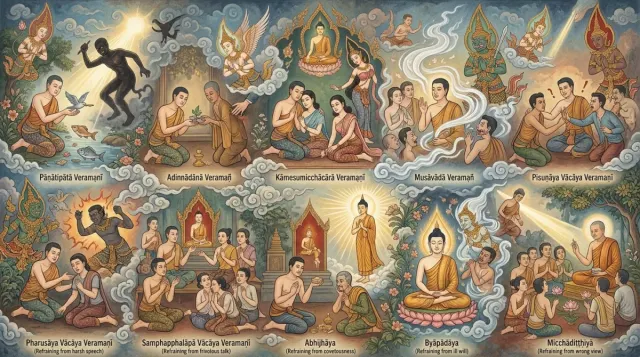
Ten paths of good conduct covering body, speech and mind — finer-grained than the five precepts, because it in…

Rāhula asks for a brief teaching to practise alone. The Buddha asks the same set of questions — permanent or i…

Key verses from Dhammapada chapters 24–25: craving grows like a māluvā creeper; a tree with its roots intact g…