
The Khemā Therī Discourse: Khemā and the Question That Cannot Be Measured
KhemātherīsuttaṃKing Pasenadi asks the nun Khemā whether the Tathāgata exists after death. She answers with the similes of cou…


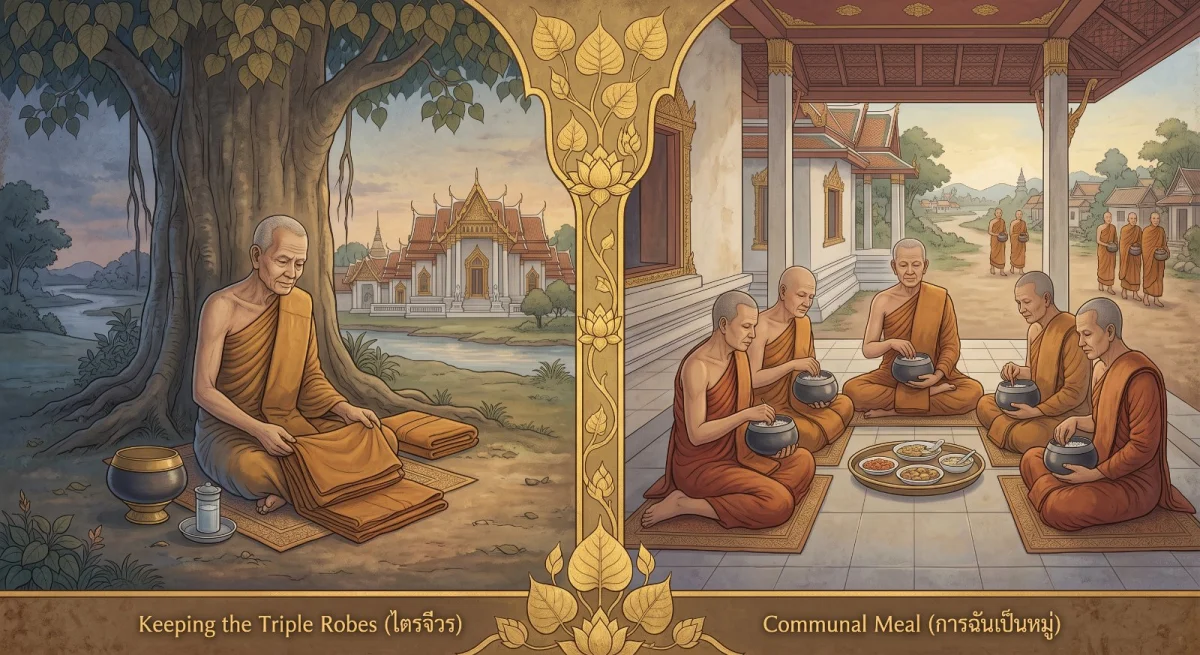
Ekarattampi ce bhikkhu ticīvarena vippavaseyya
Three monastic training rules: not to be apart from the three robes for even one night; permission to keep a robe in a village when a forest dwelling is dangerous, but for no more than six nights; and not to eat as a group, a rule that began when Devadatta led his followers begging food from families. Each has exceptions for illness, danger and travel, but the exceptions themselves have limits.
These three training rules are in the Vinaya Piṭaka (Mahāvibhaṅga) and are rules for monks. The first, a nissaggiya pācittiya in the Robe Chapter, began when several monks left their outer robes with other monks and set out wandering with only two robes. The stored robes grew mildewed; Venerable Ānanda found them, and the Buddha laid down that a monk should not be apart from his three robes even for one night. Later he allowed the Saṅgha to grant an authorization to a sick monk unable to carry his robes.
The second, in the Bowl Chapter, arose when thieves robbed monks still living in forest dwellings after the rains. The Buddha allowed them to keep one robe in the village, but when monks stayed apart from their robes for more than six nights, the robes were lost, burnt or eaten by rats, so he limited it to six nights.
The third, in the Food Chapter, arose when Devadatta, having lost gain and honour, went with his followers asking families for food. People criticised this, and the Buddha forbade eating as a group, then relaxed it case by case until there were seven occasions of exception. These are rules of monastic discipline and lay people need not keep them, but the thinking behind them applies to everyone.
Monks left their outer robes behind and went wandering with only the upper and lower robes. The stored robes grew mildewed and had to be taken out to air. Venerable Ānanda saw this and criticised it. The Buddha spoke of the faults of being hard to support, demanding and discontented, and praised fewness of wishes, contentment and not hoarding, then laid down that once a monk's robe is finished and the kaṭhina privilege has ended, being apart from the three robes for even one night is a nissaggiya pācittiya.
Know where the few essential things in your life are — important documents, regular medicine, work tools — and look after them yourself, rather than leaving them as a burden for others to clean up after.
A monk fell ill at Kosambī. His relatives sent word inviting him to come so they could nurse him, but he would not go, since he could not carry his three robes and did not want to break the rule. The Buddha then allowed the Saṅgha to grant an authorization to a sick monk: the monk asks the Saṅgha three times, and the Saṅgha announces it with a motion and one proclamation.
Rules shouldn't keep sick people from care. If you need an exception, ask for it openly through the proper channel, rather than deciding for yourself and quietly breaking the rule.
After the rains, thieves assumed the monks in forest dwellings had received offerings and went robbing. The Buddha allowed monks in forest dwellings known to be risky and dangerous to keep one of their three robes in the village. The analysis explains that risky means places where thieves are seen camping, eating or sleeping; dangerous means places where people are seen being killed, robbed or beaten by thieves.
Safety comes before form. If carrying valuables on you is risky, leave them somewhere safer.
After the allowance, some monks kept a robe in the village and stayed apart from it for more than six nights. The robes were lost, destroyed, burnt or chewed by rats, leaving the monks with only old cloth. The Buddha limited it: one may be apart from that robe for at most six nights, unless authorized.
Every exception should have a review date. If working hours are eased during an illness, for example, set a time to look at it again, so the exception doesn't turn into a habit.
Devadatta, having lost gain and honour, went with his followers asking families for food. People criticised it, saying, "Who doesn't like good food? Who doesn't enjoy something tasty?" The Buddha laid down that eating as a group is a pācittiya. The analysis explains that eating as a group means four or more monks accepting an invitation to one of the five kinds of staple food and eating it.
When popularity or income falls, don't make up for it by banding together to ask or by pressuring others to support you. Look instead at how you can rebuild trust by your own efforts.
When monks scrupulously refused invitations even where it was appropriate, the Buddha relaxed the rule one case at a time, until there were seven occasions of exception: illness, the robe-giving season, robe-making time, a long journey, travelling by boat, a great gathering when alms are not enough to go round, and a meal given by ascetics.
When an existing rule creates a new problem, fix it case by case by looking at the real cause — as he relaxed it for the sick, travellers or when food was short — not because someone wants an easier life.
A relative of King Bimbisāra who had gone forth among the Ājīvakas wished to give a meal to ascetics of all traditions. The monks declined, since it would be eating as a group. The Ājīvaka went to the Buddha and said, "Master Gotama is one gone forth, and I am one gone forth; one gone forth deserves the alms of one gone forth." The Buddha accepted the invitation, then allowed eating as a group on the occasion of a meal given by ascetics.
Differences in belief shouldn't make us refuse kindness. Accept goodwill from people of other religions or views with respect.
These three rules show that simplicity isn't only about owning few things but also about looking after the few things we have. A robe left with others carelessly can grow mildew; things kept far away for too long can be lost.
The rule on group meals warns against using a group to pressure those who give. When Devadatta's gains declined, he took people to ask from house to house, and the villagers saw it as unseemly. Lay people too should be careful when banding together to ask for help, or bringing friends to accept someone's generosity beyond what they meant to give.
Each rule has exceptions for illness, danger and travel, yet the exceptions have limits and procedures. A good rule is neither so rigid that it harms people nor so loose that it becomes a loophole.
Tap to read the actual passage on the page cited.
King Pasenadi asks the nun Khemā whether the Tathāgata exists after death. She answers with the similes of cou…
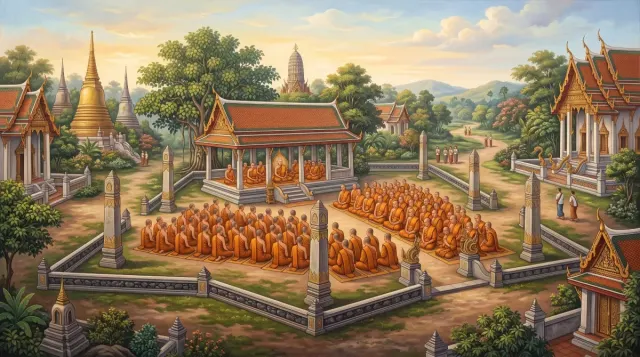
Monks were unsure how far a single residence extends, so the Buddha allowed the Saṅgha to establish a boundary…

Five qualities of a Buddhist who is a "jewel" rather than an "outcast" lay follower — faith, virtue, not chasi…

A street chief in Haṃsavatī gathered his whole neighbourhood — cooks, dyers, smiths, water-carriers, cake-sell…