
Pārāsariya's Verses: Guard the Senses, Do Your Task, Harm No One
PārāsariyattheragāthāSitting alone, the Elder Pārāsariya asks how one can do one's own task without harming anyone. The answer is t…


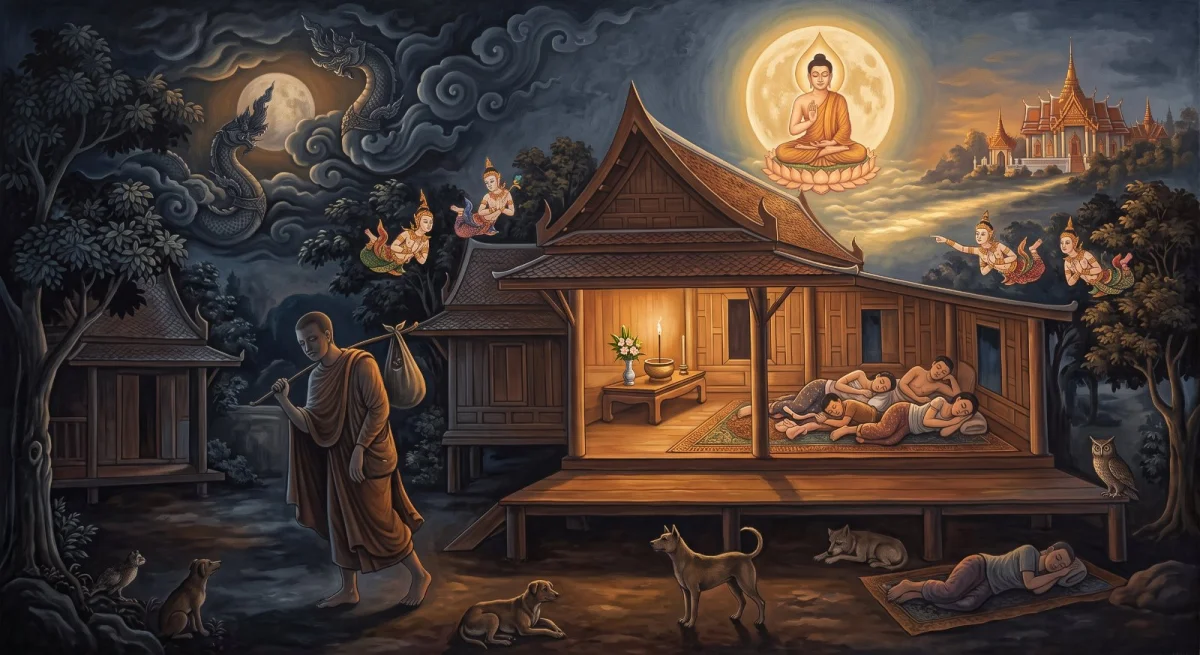
Yo pana bhikkhu santaṃ bhikkhuṃ anāpucchā vikāle gāmaṃ paviseyya
The group of six monks went into the village at the wrong time and sat in a public gathering talking about pointless things, so the Buddha forbade it. But when travelling monks were too afraid to enter a village at dusk and were robbed, he allowed entry after informing another monk; and when a monk was bitten by a snake, he allowed urgent business without informing anyone.
In the Vinaya Piṭaka, Mahāvibhaṅga Part 2, Pācittiya chapter, Ratanavagga rule 3, while the Buddha was staying at Jeta's Grove in Sāvatthī, the group of six monks entered the village at the wrong time and sat in a public gathering talking of pointless matters. The text lists them at length: talk of kings, of thieves, of generals, of battles, of food, of drink, of cloth, of relatives, of towns and countries, of liquor, down to talk of growth and decline. Lay people complained that they behaved like householders enjoying sensual pleasures, so the Buddha forbade entering a village at the wrong time.
Later several monks travelling to Sāvatthī reached a village in the evening. The villagers invited them in, but scrupling at the prohibition they did not enter, and robbers took their belongings. When they reported this, the Buddha allowed entering a village at the wrong time after taking leave. Afterwards a monk travelling alone met the same fate, so the rule was adjusted to taking leave of a monk who is present, meaning one who can be informed at that moment.
Then a monk was bitten by a snake, and another who went to fetch fire from the village dared not enter because he had not taken leave. So the Buddha made a further allowance: in such urgent business one may enter without taking leave. This rule therefore has an original formulation and three successive amendments before reaching the wording used to this day.
The story says the group of six entered the village at the wrong time and sat in a public gathering speaking of dozens of pointless subjects, from kings and thieves and battles to growth and decline. The lay criticism was that acting this way made them no different from householders enjoying sensual pleasures.
Notice the conversations you join late at night. If you come away feeling empty and going to bed later, that is the signal.
The analysis defines the wrong time precisely: from after midday until the next dawn. It explains entering a village as crossing the enclosure of a walled village, or crossing the precincts of one without a wall, so there is a line that tells you whether you have entered or not.
A workable agreement says when and where. Instead of "don't come home late", agree on a time and a place.
Monks who reached a village in the evening were invited in by the villagers but scrupled because of the prohibition and stayed out, and robbers took their belongings. This happened twice, once to a group of monks and once to a monk alone, and led to the rule being relaxed.
If a rule you have set forces people into danger in order to keep it, change the rule rather than asking them to endure it.
The text defines a monk who is present as one whom he is able to inform before entering. If there is nobody at all to tell, there is no offence. The requirement does not demand the impossible; it demands that you tell someone when telling is possible.
When you go out alone, a short message to any one person is enough. Do not wait for the perfect person to tell.
When one monk was bitten by a snake and another, going to fetch fire from the village, dared not enter because he had not taken leave, the Buddha allowed entering without taking leave in such urgent business, and this clause was added into the rule itself.
At home or in a team, agree in advance which situations may be acted on immediately without asking anyone's permission.
The exemptions cover several cases: entering because of such urgent business, entering after taking leave, entering when there is no monk to inform, going to another monastery, going to a refectory, walking along a road that passes through a village, and when there is danger. Each time the rule was revised, the text begins with an instruction to recite the rule anew, so that every revision was public to the whole community.
When you change a group's rules, announce the new version to everyone at once rather than granting quiet exceptions others do not know about.
The part that applies to everyone is this: when you go somewhere at an unusual hour, someone should know where you are. The reasoning is not surveillance but safety and the trust of the community, like telling the family you will be back late, or telling a travelling companion which way you are turning off. One short message means someone can look for you if something goes wrong.
The other side is what was being talked about. Pointless talk does not mean wicked talk; every item in the list is ordinary conversation, from politics and war to celebrities, food and travel. The point is that it consumes time without taking anyone anywhere. Now that the public gathering has moved onto a screen, scrolling through comment threads late at night has much the same effect.
The finest thing about this rule is how it was revised. When it proved too strict, so that those who kept it were robbed, the Buddha did not tell them to endure it; he changed the rule. When it still failed in an emergency, he changed it again. A good rule needs room for emergencies and for people's safety. It should never force anyone to choose between compliance and survival.
Tap to read the actual passage on the page cited.
Sitting alone, the Elder Pārāsariya asks how one can do one's own task without harming anyone. The answer is t…

Devas tell Venerable Mahāmoggallāna and the Buddha that they gained their mansions through small good deeds: o…

At Jīvaka's mango grove the Buddha tells the monks to develop concentration and to make an effort in seclusion…

One side holds that the Tathāgata's powers are shared by disciples. The Theravāda points out that disciples ar…