
Itivuttaka: Effort in Every Posture
Yataṃ care yataṃ tiṭṭheUnwholesome thoughts can arise while walking, standing, sitting or lying down. Entertain them and you are call…


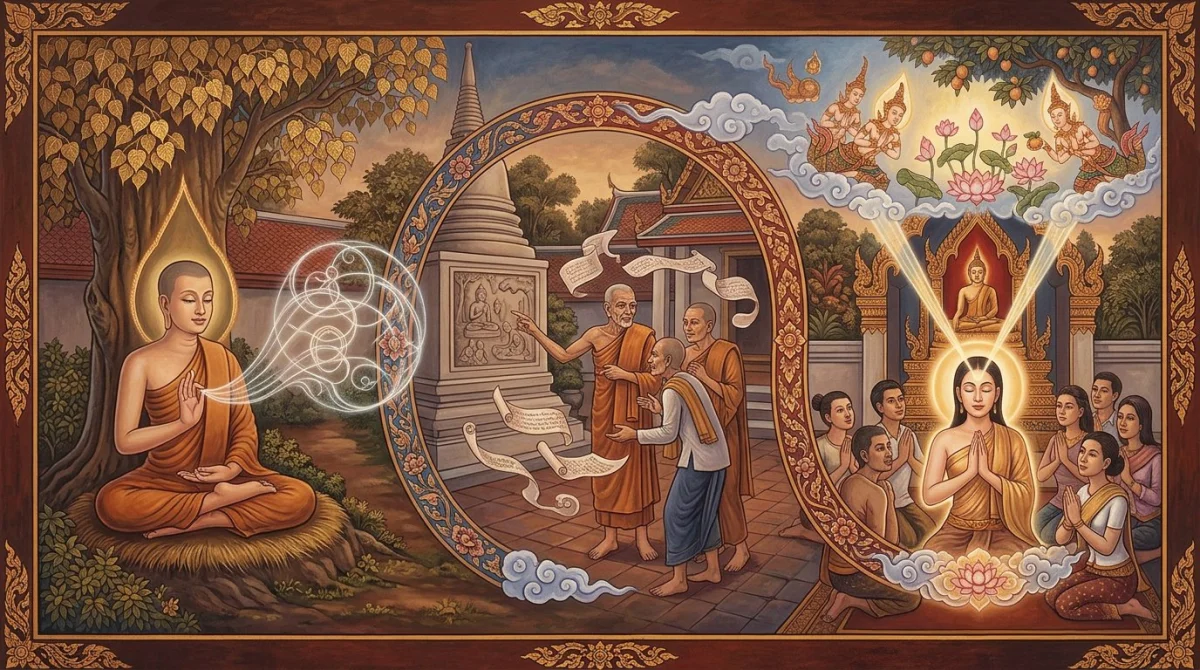
Saṃvaro kammantikathā
Three discussions opening chapter twelve ask whether restraint is kamma, whether all kamma bears result, and whether sound is a result. Together they show what the words kamma and vipāka can properly be applied to.
In the Saṃvaro Kammanti Kathā, the Kamma Kathā and the Saddo Vipākoti Kathā of the Kathāvatthu, volume 37, at the beginning of chapter twelve, three questions in a row examine how the words kamma and result are used.
In the first, the Paravādin holds that restraint is kamma. The Sakavādin (the Theravāda side) asks whether restraint of the eye faculty is then eye-kamma. There is no such term in the teaching; there is bodily, verbal and mental kamma only. The Paravādin therefore accepts the cases that fall under body and mind but denies those of eye, ear, nose and tongue, and his answer turns out to be inconsistent.
The second asks whether all kamma bears result. The Sakavādin points out that volition which is resultant-indeterminate, and volition which is functional-indeterminate, bear no result, so it cannot be said that all volition bears result. The third asks whether sound is a result. The Sakavādin points out that sound is not felt as pleasant or painful, has no object, no adverting and no intention, and so does not answer to the description of a result.
By tradition the Kathāvatthu was set out by the elder Moggalliputta Tissa at the third council. The commentary identifies the schools holding these views, but the school names are not in the text itself. This page is for overall understanding and follows the main lines of reasoning only.
The Paravādin accepts this fully, so the first discussion is a test of whether the short statement survives being asked again for each faculty in turn. This point is for overall understanding.
A short statement that sounds right can be broken into particular cases and asked again. That shows what you actually meant.
The Sakavādin works through the faculties one at a time: restraint of the eye faculty, the ear, the nose, the tongue, the body. The Paravādin says at each point that it cannot be said, because terms such as eye-kamma or tongue-kamma do not exist in the teaching.
If extending a rule to every case produces words nobody uses, the rule is broader than the reality.
The Paravādin accepts that restraint of the body faculty is bodily kamma and restraint of the mind faculty is mental kamma. But asked again whether restraint of the eye faculty is eye-kamma, he denies it. The Sakavādin shows that the answer accepts only the cases for which a name already exists.
When you accept some cases and reject others on the same reasoning, go back and find out what your real criterion is.
The Sakavādin repeats the entire set for non-restraint, from the eye faculty through to the mind faculty, with identical results. This doubling is the standard method of the Kathāvatthu: test a proposition in its positive and negative form alike.
Test your own view by flipping it to its opposite. If the opposite fails for the same reason, the problem is in the reasoning, not the example.
At the close of the first discussion the Paravādin quotes the Buddha: here a monk, having seen a form with the eye, grasps at its signs, or does not; having heard a sound with the ear, and so on to cognising a mental object with the mind. He takes this to show that restraint and non-restraint are kamma, and the discussion ends there in the canon's usual form; the refutation stands in the earlier portion.
The discourse is valuable in its own right: the decisive moment is the first instant of seeing or hearing, and whether you take hold of the detail that stirs up feeling.
The Kamma Kathā opens with the proposition that all kamma bears result. The Sakavādin immediately recasts it as a question about volition — does all volition bear result? — because in the teaching volition is precisely what kamma is. Once the word is changed, the weak point appears.
In a murky argument, replace the big word with the one that names the actual thing. The issue usually clarifies itself.
The Sakavādin points out that resultant-indeterminate volition and functional-indeterminate volition — of the sense sphere, the form sphere, the formless sphere and the unincluded — bear no result. Since some volition bears no result, it cannot be said that all volition does. At the end the Paravādin quotes the Buddha's words that he does not say that intentional deeds done and accumulated come to an end without being experienced — a statement specifically about deeds done with intention.
Not every thought that arises becomes a deed that returns to you. What matters is the intention you choose to act on.
The Saddo Vipākoti Kathā asks whether sound is a result. The Sakavādin points out that sound is not something felt as pleasant or painful, is not associated with contact, feeling, perception or volition, has no object, no adverting and no intention, unlike contact, which is a result and has all of these. At the end the Paravādin quotes the description of the Tathāgata as having a voice like Brahmā's, speaking with a melodious tone like the karavīka bird, because of kamma done in the past.
What arises because of kamma and what is itself the result are not the same. Your voice may have many causes; how it feels to hear it is another matter.
These discussions do not say that restraint of the senses is unimportant. On the contrary, restraint is virtue and a cause for wholesome states to grow. What is being examined is the use of a word: how far we may call it kamma in the sense of bodily, verbal and mental action.
The everyday benefit is precision. The word kamma is now used so broadly that it sometimes explains everything. Seeing that the canon itself examines the word this carefully makes us slower to conclude that whatever happens to someone is because of their kamma.
One conclusion of the Kamma Kathā is immediately useful: not every volition carries a result forward. Some states are the end of a line, not the start of one. Knowing this saves us from being anxious about every thought that crosses the mind.
Tap to read the actual passage on the page cited.
Unwholesome thoughts can arise while walking, standing, sitting or lying down. Entertain them and you are call…

The Buddha said this holy life is to be drunk like the finest, clearest part. The Paṭisambhidāmagga expands th…

Four things rarely obtained — human birth, staying alive, hearing the true Dhamma, and the arising of a Buddha…

Even carrying your mother on one shoulder and your father on the other for a hundred years, or making them rul…