
The Discourses on Growth: Noble Growth in Five Ways, for Laymen and Laywomen Alike
Ariyāya vaḍḍhiyā vaḍḍhatiA disciple who grows in faith, virtue, learning, generosity and wisdom is said to grow in a noble way and to t…


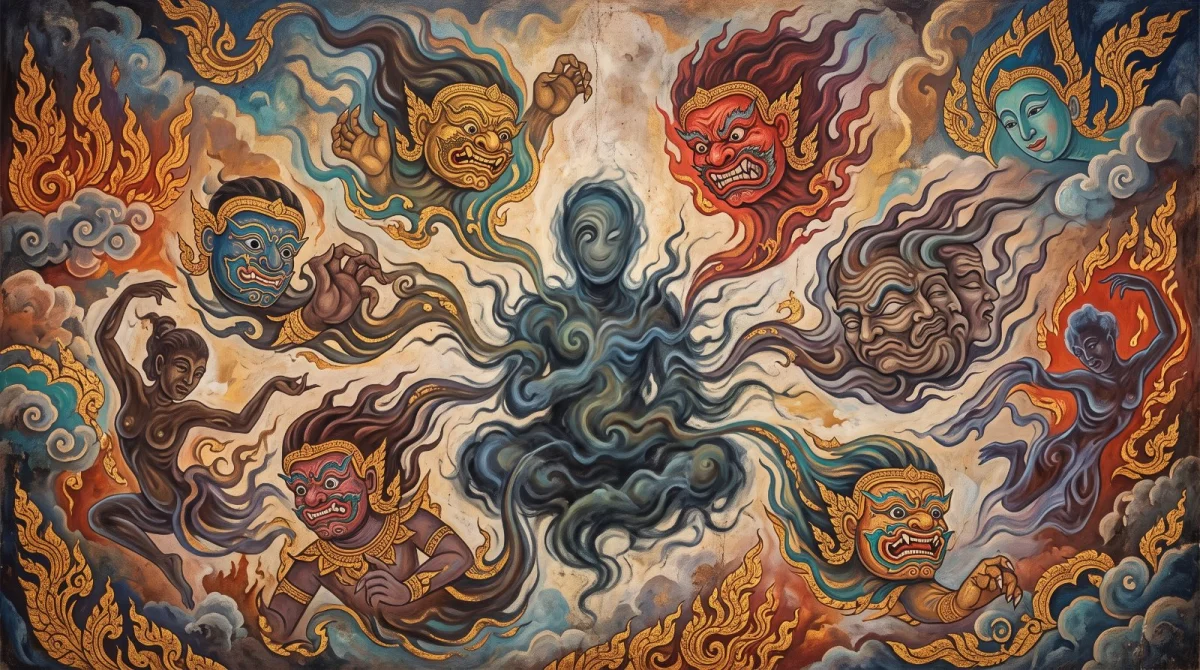
Nikkhepakaṇḍaṃ
The Nikkhepakaṇḍa arranges paired categories into clusters and defines the same set of defilements again and again under different names — roots, taints, fetters, knots, floods, yokes, hindrances, misapprehension, clingings and bases of defilement. Each name points to a different function of the same thing.
In the Dhammasaṅgaṇī of the Abhidhamma Piṭaka, the Nikkhepakaṇḍa is the third chapter, which takes the opening matrix and classifies it afresh, more concisely than the chapter on the arising of consciousness. Its middle stretch groups paired categories into clusters: the cluster of roots, of taints, of fetters, of knots, of floods and yokes, of hindrances, of misapprehension, of clingings, and of defilements.
Every cluster uses the same template: which states are X, which are not X, which are objects of X, which are associated with X — and then crossed pairs of these. Read in sequence, the lists overlap heavily. Greed appears as the taint of sensuality, the fetter of sensual lust, the knot of covetousness, the hindrance of sensual desire, clinging to sensuality, and the first base of defilement.
So what differs is not the defilement but the angle. Taints view it as something fermented that seeps out; fetters as what binds one to existence; knots as what ties one up; floods as what sweeps one away; hindrances as what blocks the good; clingings as what the hand holds; bases of defilement as what stains the mind.
The cluster of roots divides them into three wholesome — non-greed, non-hatred, non-delusion — three unwholesome — greed, hatred, delusion — and three indeterminate. It then distinguishes which states are roots, which have roots, which are associated with roots. The definition of non-delusion is unusually long, calling wisdom by many similes: wisdom like the earth, like a goad, like a sword, like a lamp.
When reviewing your own actions, don't stop at what you did. Ask which of the three roots it came from. That answer tells you where to make the repair.
There are four taints: of sensuality, of existence, of views, of ignorance. The taint of sensuality is defined as desire, lust, delight, fever and absorption in sensual pleasures. The taint of views is the set of positions about whether the world is eternal or not, finite or not, and whether a being exists after death.
Notice the craving that never flares up but seeps through the whole day — picking up the phone for no reason. That is what the word taint is describing.
The fetters here number ten: sensual lust, aversion, conceit, view, doubt, misapprehension of precepts and observances, lust for existence, envy, stinginess, ignorance. Notably this set includes envy and stinginess, which do not appear among the taints or the hindrances.
Envy and stinginess are often treated as minor, but the text ranks them among the things that bind. Notice how they close you off from other people.
There are four knots: the bodily knot of covetousness, of ill will, of misapprehending precepts and observances, and of insisting that only this is true. That last one — holding that this alone is the truth — is classed as a knot that ties one up, not as firmness about what is true.
In an argument, separate standing by what you have reasons for from standing by it simply because it is your opinion. The second is the knot the text means.
The cluster of hindrances counts six: sensual desire, ill will, sloth and torpor, restlessness and remorse, doubt, and ignorance — one more than the familiar set of five in the discourses. The definition of ill will traces its grounds in detail, from thinking this person has harmed, is harming or will harm me, or those I love, or has benefited someone I dislike, through to resentment arising on no grounds at all.
When you are irritated with someone, check the list and see which ground it fits. Often it turns out to be the last one: resentment with no cause.
There are four clingings: to sensuality, to views, to precepts and observances, and to a doctrine of self. Clinging to views is defined by the set of positions that denies the fruit of action and the existence of another world, denies what is owed to mother and father, and denies that there are those in the world who have practised well.
Ask yourself which single opinion would be hardest to set down today. That is where clinging is tightest.
The cluster of defilements gives a compact list of ten: greed, hatred, delusion, conceit, view, doubt, sloth, restlessness, shamelessness, fearlessness of wrongdoing. The definition of greed is very long, running from lust, longing and absorption to similes calling it that which drags one along, that which deceives, that which is a second companion, and a jungle and a thicket.
If you memorise only one set, memorise this one. These ten cover nearly everything that can go wrong in a single day.
Every cluster keeps these two apart. States that are objects of the taints are what the taints can fasten onto — all mundane aggregates, including wholesome ones. States associated with the taints are those that actually arise together with them. Every cluster ends the same way: the only states beyond being objects of defilement are the supramundane path and fruit, and the unconditioned element.
When you do something good and start feeling proud enough to want it seen, recall this point: your own goodness is something defilement can take hold of.
This chapter cures a common confusion. Reading the discourses, one meets set after set of defilements with different counts and starts to think there are hundreds of things to abandon. In fact it is one set, renamed according to the function under discussion. Seeing that makes reading the texts much lighter.
On the other side, each name gives a different angle for actual work with the mind. Seen as a taint, craving is something fermenting deep down and seeping out quietly. Seen as a hindrance, it is what stops the mind settling. Seen as clinging, it shows you what your hand is holding.
The point every cluster repeats is that the only states which are not objects of defilement at all are the supramundane path and its fruit, and the unconditioned element. Everything else can be an object of defilement, including wholesome states. That is a warning not to be complacent about your own goodness.
Tap to read the actual passage on the page cited.
A disciple who grows in faith, virtue, learning, generosity and wisdom is said to grow in a noble way and to t…

The Dhammasaṅgaṇī defines unguarded senses as seeing, hearing or sensing and then grasping at signs and detail…

The verses of Anuruddha, a Sakyan who was once woken with dance and song every morning and evening but gave it…

A libertine blocks the nun Subhā's path in Jīvaka's mango grove and tries to win her with flattery and riches.…