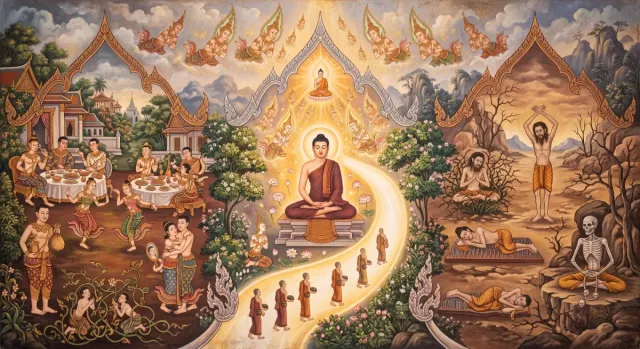
Three Ways of Practice: Slack, Scorching, and the Middle
Tisso imā bhikkhave paṭipadāA discourse near the end of the Book of Threes divides practice into three: the slack way of one who holds tha…



Vipākattikaṃ
The resultant triplet separates states that are results, states that produce results, and states that are neither. The text's examples show that bodily pleasure and pain can support both good and bad deeds, that even an arahant has bodily pain, and that the supports of bodily pleasure and pain include wholesome and unwholesome action, straining oneself, weather, food and lodging.
In the Paṭṭhāna of the Abhidhamma Piṭaka, volume 40, the resultant triplet (vipāka-tika) sorts states into three groups: resultant states (vipāka), states that produce results, that is, wholesome and unwholesome states (vipāka-dhamma), and states that are neither results nor producers of results. The text's examples of the third group include the functional states of an arahant, sense bases such as the eye, and Nibbāna.
In the Investigation Chapter the text gives vivid examples: contemplating resultant aggregates by the three characteristics or delighting in them; relying on bodily pleasure or bodily pain to do both good and bad; an arahant relying on bodily pleasure or pain to enter attainments; relying on faith to torment oneself; and weather, food and lodging as supports for bodily pleasure and pain.
In the Abhidhamma, result (vipāka) is a technical term for certain kinds of mind and mental factors that are results; it does not mean every misfortune in life. The text itself states that bodily pleasure and pain have many supports. So this page does not use this teaching to explain that anyone's illness or hardship is the result of past kamma. The modern examples are illustrations only.
Resultant states are mind and mental factors that are results. States that produce results are wholesome and unwholesome states, which will give results later. For states that are neither, the text gives examples such as an arahant's reviewing, sense bases like the eye, and Nibbāna, which are neither results nor producers of results. This point is for overall understanding.
When something happens, divide it in your mind into two parts: what has happened and cannot be changed, and what you are about to do next. Put your effort into the second.
Under the object condition the text says a person contemplates resultant aggregates as impermanent, suffering and not-self, or delights in and relishes them, and with that result as object, lust, view, doubt, restlessness and grief arise. What we receive can become the object of new causes, good or not.
When something good comes your way or something bad happens, what has happened cannot be changed, but your stance towards it is something new you can choose right now.
Under decisive support, the text says a person relying on bodily pleasure gives, undertakes precepts, and so on up to splitting the Saṅgha; relying on bodily pain, a person likewise gives, undertakes precepts, and so on up to splitting the Saṅgha. Bodily pleasure and pain also support faith, up to longing. What the body receives does not decide which way the mind goes.
When you ache or feel unwell, notice whether you are about to snap at those close to you. Telling them plainly that you are not well today is better than letting pain turn into hurtful words.
The text says an arahant, relying on bodily pleasure, brings about a functional attainment not yet arisen, enters one already arisen, and sees formations by the three characteristics; and relying on bodily pain, likewise brings about and enters a functional attainment. What follows is functional, meaning it does not produce further results.
Bodily pain does not mean your practice has failed. Use the time of pain to observe the sensation without adding the thought that you are not good enough.
Under states producing results as a condition for resultant states, the text says a person relying on faith torments and afflicts himself and undergoes suffering rooted in seeking; relying on longing, likewise torments himself. In this example, bodily pain is supported by one's own present actions.
Good intentions pushed too hard — skipping sleep for volunteer work or forcing the body beyond its strength — need limits. Good you can keep up for a long time is worth more than good that breaks you.
The text says wholesome and unwholesome states are a condition for kamma-results by way of decisive support; and in the next passage it says weather, food and lodging are a condition for bodily pleasure, bodily pain and the attainment of fruition, also by way of decisive support. Together with the example of tormenting oneself, the text sets out several supports for bodily pleasure and pain.
When you are unwell, look first at what can be fixed — weather, food, sleep, where you live — and see a doctor, instead of concluding at once that it is your kamma. And don't use past kamma to explain other people's suffering.
Under states producing results as a condition for states that are neither, the text says an arahant, emerging from the path, reviews the path, reviews wholesome deeds done before, reviews abandoned defilements, and sees aggregates by the three characteristics. These reviewing minds belong to the group that is neither result nor producer of results. This point is for overall understanding.
The aim of practice is not to keep piling up good results, but a mind that does what should be done without taking it as mine. Try doing one good thing today without telling anyone.
What this triplet makes clear is the difference between what happens to us and what we do next. Bodily pleasure and pain that have arisen belong to one group; the giving, keeping precepts, or harming others that follow belong to another, and it is this later group that will give results.
When you are ill or exhausted, take care of the body through the causes you can address first — rest, food, weather, where you live — and see a doctor when needed. The text itself names these as supports of bodily pleasure and pain. What the mind can do is choose how to respond to the pain.
The example of the arahant removes the misunderstanding that someone who practises well should never hurt. An arahant also has bodily pain; the difference is that the mind does not create new causes from that pain.
Tap to read the actual passage on the page cited.
A discourse near the end of the Book of Threes divides practice into three: the slack way of one who holds tha…
When people argued over whether a blessing is something seen, heard or touched, the ascetic Rakkhita answered …

The Buddha tells the monks to remember the householder Ugga as having eight wonderful qualities. When a monk a…

On a full-moon night, the Buddha asks whether an untrue person can recognise an untrue person or a true person…