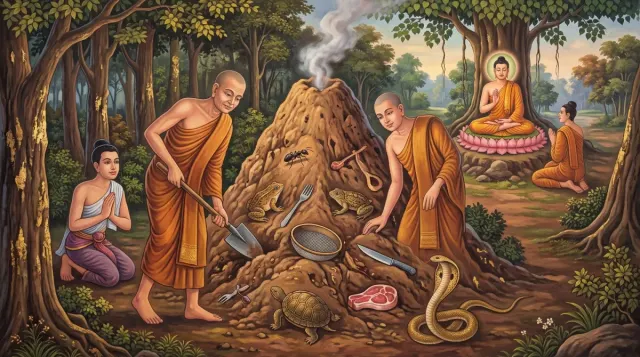
The Ant-Hill Discourse: The Riddle of the Ant-Hill
VammikasuttaṃA deva poses a riddle of an ant-hill that smokes by night and blazes by day, to be dug with a tool until a nāg…


Khemātheriyāpadānaṃ
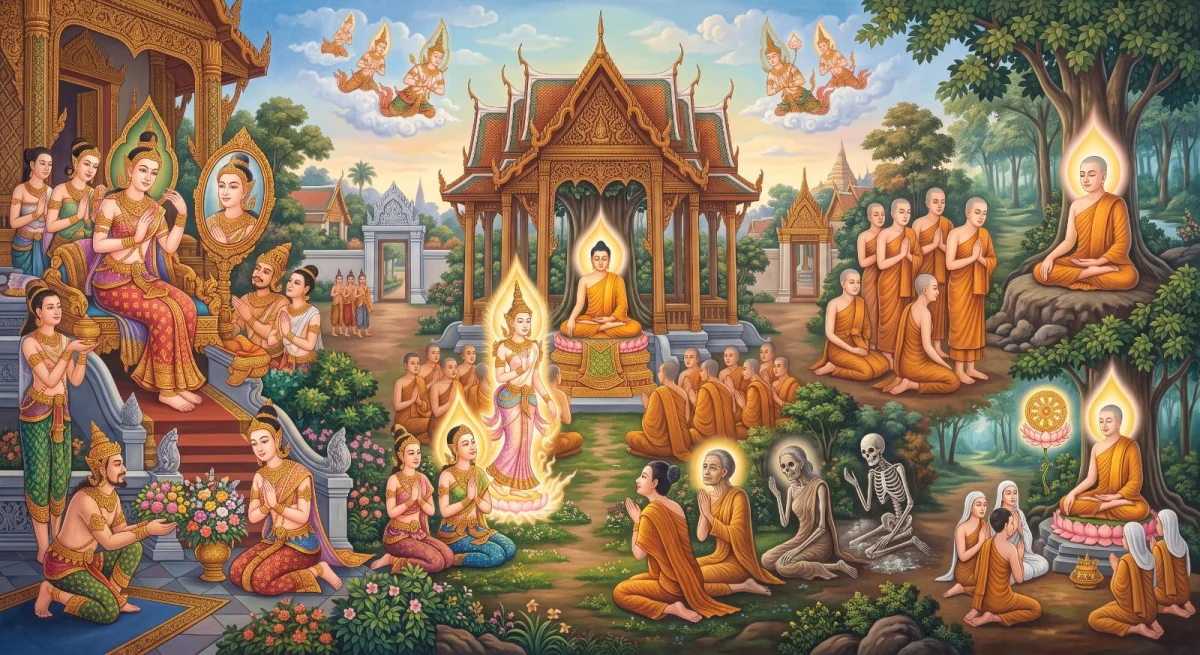
Queen Khemā, wife of King Bimbisāra, proud of her beauty, will not visit the Buddha for fear he will speak against physical form. Drawn to the Bamboo Grove by songs, she sees a young woman grow old before her eyes, hears the verse about the spider in its own web, goes forth, and becomes foremost among nuns of great wisdom.
In Khemā's Apadāna, in the Ekuposatha chapter of the Therī-apadāna in the Khuddaka Nikāya, the nun Khemā relates that in the time of the Buddha Padumuttara she was born into a wealthy merchant family in Haṃsavatī. Seeing the Buddha appoint a nun as foremost in great wisdom, she invited him and the Saṅgha for a meal for seven days and aspired to that position. In the time of the Buddha Vipassī she lived the holy life as a nun for ten thousand years, learned and a fine speaker of the Dhamma. In the time of the Buddha Kassapa she was the eldest daughter of King Kikī of Kāsi, one of seven princesses later reborn as leading nuns and the lay woman Visākhā.
The Apadāna is a text of the Khuddaka Nikāya collecting verses about the past merit of the Buddha and his disciples. Most scholars place it in a later stratum of the Tipiṭaka, while the Theravāda tradition counts it as the word of the Buddha.
In her final life she was a daughter of the king of Madda in Sāgala and became the queen of King Bimbisāra. The story ends with her attaining arahantship and answering subtle questions at Toraṇavatthu. The Pāli text says the questioner was the king who ruled Kosala (the Thai translation used here renders it as her royal husband), which agrees with the discourse in the Saṃyutta Nikāya where King Pasenadi of Kosala questions her.
She was dear to the king, delighted in caring for her beauty, and would not visit the greatly compassionate Buddha because she thought he spoke of the faults of physical form.
Notice which people or topics you avoid for fear of hearing a truth you don't want, and try opening up to one of them.
Wishing her well, King Bimbisāra had singers praise the Bamboo Grove: whoever has not seen the delightful Bamboo Grove has not seen the devas' Nandana Grove. She wished to see it, but asked to go when the Buddha had gone into town for alms. Later she praised the king's means as truly skilful.
To invite someone you love to try something good, start from what they already enjoy, such as inviting a nature lover to a retreat in a quiet place, without deceiving or forcing them.
In the grove she saw a handsome young monk meditating under a tree and thought that a householder should enjoy sensual pleasures at ease first and only practise this fine Dhamma later, when old.
If you catch yourself saying "I'll start when I retire", begin the smallest step today, such as five minutes of chanting or quiet sitting before bed.
Entering the Buddha's dwelling, she saw him seated with a beautiful young woman fanning him. Then the woman was overcome by old age: her face wrinkled, teeth broken, hair grey, leaning on a stick, trembling and falling. Khemā felt a hair-raising sense of urgency. The commentary explains that the woman was a form created by the Buddha.
Look at a photo of yourself or your parents from twenty years ago and compare it with today, as a reminder that beauty changes daily and it is worth investing in what does not fade with age.
The Buddha said: Khemā, see this body, afflicted, impure, oozing in and out, delighted in by fools. Develop the mind, unified and composed, on the unattractive; let mindfulness of the body be yours. As this is, so is that; as that is, so is this. Let go of desire for the body within and without, develop the signless, and abandon the underlying tendency to conceit.
When you start comparing your looks with others, remember that every body ages, sickens and changes alike. Both conceit and feelings of inferiority lighten.
The Buddha spoke the verse: those dyed with lust fall into the stream, like a spider in the web it has made itself; cutting this, they go forth without longing, giving up sensual pleasure. He then taught the Mahānidāna Sutta. Hearing it, she recalled what she had learned in the past and gained the Dhamma eye.
Ask yourself which of your troubles come from a "web" you spun yourself, such as an image you must maintain on social media, and loosen one thread.
She fell at his feet to confess her fault: because she delighted in form she suspected that he, who is of great benefit, did not wish her well, and so she did not come. The Buddha said: enough, Khemā. She then asked King Bimbisāra for permission to go forth, and the king, joining his palms, allowed it.
When you realise you misjudged someone, tell them directly why you misunderstood. Such an admission often repairs a relationship better than long explanations.
Seven months after going forth she saw a lamp flare up and go out, was moved, grew disenchanted with all formations, became skilled in dependent conditions and attained arahantship. Later she answered subtle questions at Toraṇavatthu; when the king asked the Buddha, he gave the same answers, and the Buddha appointed her foremost among nuns of great wisdom.
When you switch off a light or see a candle go out, use it as a brief reminder that whatever arises passes away.
Khemā's story concerns an attachment very familiar today: pride in one's appearance, to the point of avoiding people or truths that might shake one's self-image.
Contemplating the body as unattractive in the text is meant to loosen infatuation and conceit, not to make anyone hate their own body. Anyone whose body-image troubles affect eating or sleeping should consult a professional.
Another side is the courage to admit a mistaken suspicion. She makes no excuses, but says plainly that because she delighted in form, she imagined the one who wished her well did not.
Tap to read the actual passage on the page cited.
A deva poses a riddle of an ant-hill that smokes by night and blazes by day, to be dug with a tool until a nāg…
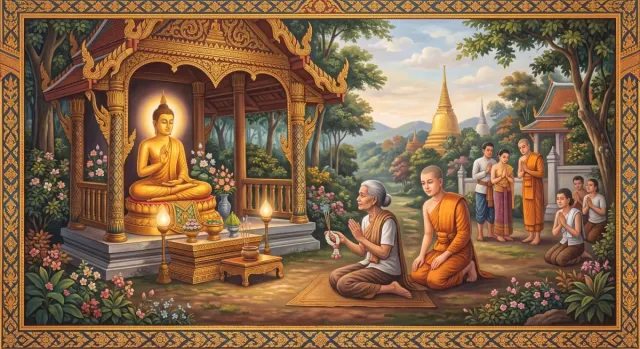
Ānanda asks how far the Buddha's voice can reach. Hearing the answer, he exclaims what a gain it is to have su…
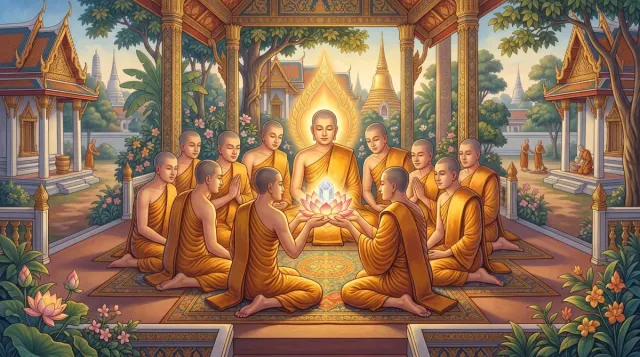
When Nigaṇṭha Nātaputta dies, his disciples split into two factions stabbing each other with words. The Buddha…

The Paṭisambhidāmagga sets out the patterns of kamma and its result in past, present and future: kamma whose r…