
The Intention Sutta: No Need to Force It, Results Follow Their Causes
Na cetanāya karaṇīyaṃA virtuous person need not wish, "may non-remorse arise in me", because it arises naturally. It then leads on …


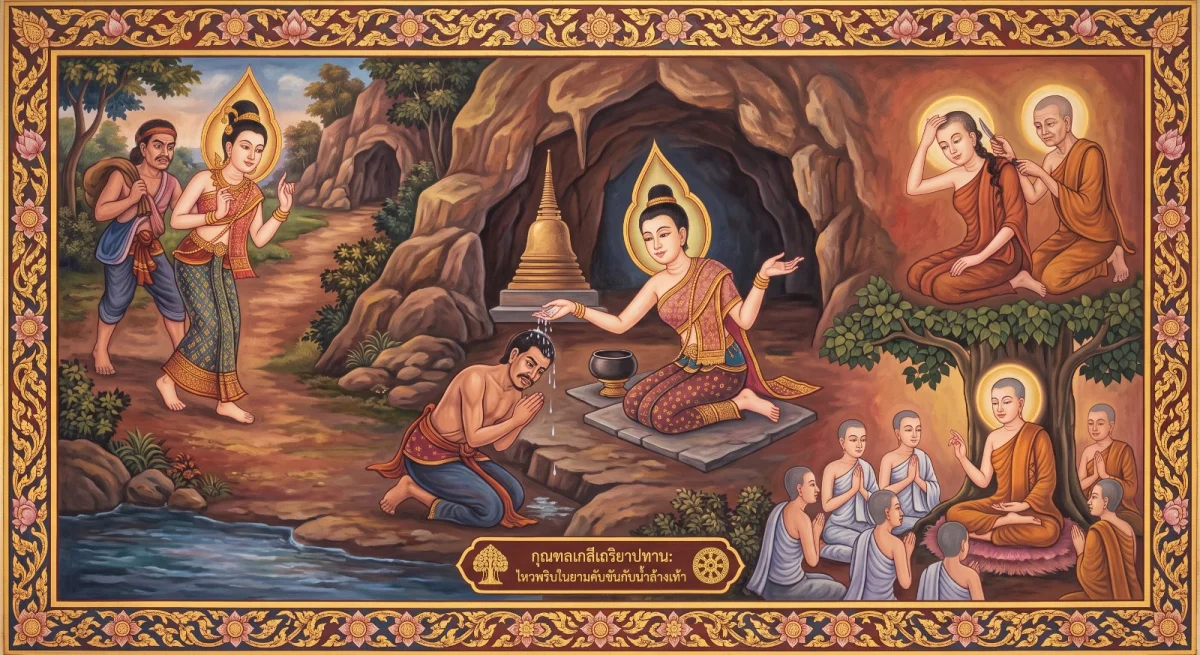
Kuṇḍalakesītheriyāpadānaṃ
Bhaddā Kuṇḍalakesā tells her life: falling in love with a thief about to be executed, surviving him through quick thinking, going forth among white-clad ascetics, searching for answers until she met the Buddha, and awakening on seeing a little water from washing her feet, becoming foremost in quick realisation.
In the Apadāna of Kuṇḍalakesī, in the Kuṇḍalakesa chapter of the Therī-apadāna in the Khuddaka Nikāya, the nun Bhaddā Kuṇḍalakesā relates that in the time of the Buddha Padumuttara she was born into a wealthy merchant family in Haṃsavatī. Seeing the Buddha appoint a nun as foremost in quick realisation (khippābhiññā), she made an offering and aspired to that position. In the time of the Buddha Kassapa she was the fourth daughter of King Kikī of Kāsi.
The Apadāna is a text of the Khuddaka Nikāya collecting verses about the past merit of disciples. Most scholars place it in a later stratum of the Tipiṭaka, while the Theravāda tradition counts it as the word of the Buddha.
Her final life includes an episode of surviving a man who meant to kill her. This page tells that part only briefly, to focus on the lessons of mindfulness and wisdom. The widely told story that she travelled debating until defeated by Sāriputta comes from the commentaries on the Dhammapada and the Therīgāthā, and does not appear in this Apadāna.
In the time of Padumuttara she heard the Buddha appoint a nun of good wisdom as foremost in quick realisation, made an offering, and bowed down aspiring to that position. The Buddha predicted she would be a disciple named Bhaddā Kuṇḍalakesā in the dispensation of Gotama.
When you see someone excelling at what you want to become, admire them sincerely and set out to learn, instead of envying them.
In the time of the Buddha Kassapa she was King Kikī's fourth daughter, named Bhikkhudāsī. Hearing the Dhamma she wished to go forth, but her father did not allow it, so the seven princesses lived the holy life in the palace and delighted in attending on the Buddha. This point is for overall understanding.
When family circumstances keep you from fully following your aspiration, do the part you can where you are for now.
In her final life she was born into a wealthy merchant family in Rājagaha. As a young woman she saw a thief being led to execution and fell in love. Her father, understanding his daughter, ransomed the thief for a thousand coins and gave her to him. She loved and cared for him well, but he took her up a mountain intending to kill her for her jewellery.
When you fall for someone quickly, take time to watch how they act in many situations, and listen to those around you who see warning signs.
She speaks the verse: not in every situation is a man the wise one; a woman too is wise, discerning and quick to think things through in this place and that.
In meetings or at home, give everyone's views equal weight, not choosing whom to hear by gender or rank.
Knowing she was to be killed, she kept her presence of mind, paid respect to him, offered him all her jewellery and asked to embrace him one last time, and so she survived while the robber fell from the mountain. She concludes that one who does not quickly understand what suddenly arises is struck down, while one who understands quickly is freed from enemies.
Train the mind to be steady enough to think in an emergency, for example by rehearsing fire-escape or emergency plans in advance, so you won't panic when something really happens.
She went forth among white-clad ascetics, had her hair plucked out with tweezers, and learned their doctrine. As she sat reflecting alone, a dog carried a severed human hand and dropped it near her. Seeing it swarming with worms she was deeply moved and asked her fellow ascetics; they said the Sakyan monks knew about such things. She went to ask the Buddha's disciples, who brought her to the Buddha.
When an existing answer does not settle your doubt, don't force yourself to keep believing it. Ask those who truly know, from other sources, with an open mind.
The Buddha taught that the aggregates, sense bases and elements are unattractive, impermanent, suffering and not self. She gained the Dhamma eye and asked to go forth. The Buddha said: come, Bhaddā, and so she received ordination.
When you cling hard to a feeling or thought, try seeing it as something that has arisen for a while, not the whole of who you are.
After ordination she saw a little water from washing her feet, understood its arising and passing away, and reflected that all formations are like that. Her mind was freed through not clinging, and the Buddha appointed her foremost among nuns in quick realisation.
Use ordinary routines like washing your hands or the dishes as moments to watch water flow and vanish, training yourself to see change in daily life.
Bhaddā's life is full of quick decisions, both wrong and right. Hasty love led her into danger, quick wits in a crisis saved her, and a doubt that would not rest led her to the answer.
The usable lesson is that good speed must come with mindfulness, not impulsiveness, and awakening need not come from a grand event, only a little foot-washing water seen by a ready mind.
If anyone is in a relationship where they are harmed or threatened, please seek help from someone you trust, or call the Thai Social Assistance Center hotline 1300; outside Thailand, contact a local helpline.
Tap to read the actual passage on the page cited.
A virtuous person need not wish, "may non-remorse arise in me", because it arises naturally. It then leads on …

The three formations here have very specific meanings: bodily formation is the breath, verbal formation is app…

Apadānas of those who offered water, dug a well, set water out by the monastery gate, spread a seat for a monk…

A family does not weep when a young man of the house dies, and each gives a different reason: his father says …