
Extra Robes and Extra Bowls: When a Spare Becomes a Stockpile
Yo pana bhikkhu atirekacīvaraṃ dhāreyyaThe group of six monks kept three sets of robes, one for going into the village, one for the monastery and one…


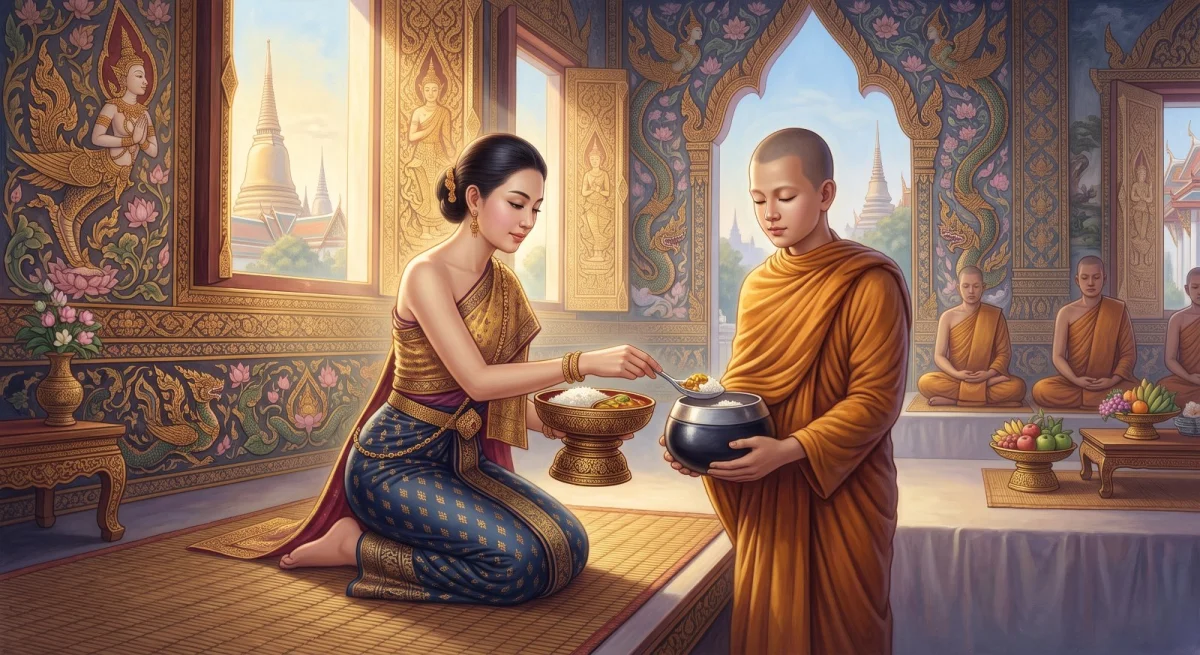
Mama bhāgaṃ gahetvāna
Apadānas of people who did not go out to find something to offer, but handed over what was already in their hands: a servant's own share of sweet cakes, milk rice prepared for a sacrifice, fruit just gathered, and a gatekeeper's piece of sugarcane.
In the Apadāna of the Khuddaka Nikāya, a great many stories do not begin with preparing an offering but with an accidental meeting. The speaker is walking along, holding something, and gives that. Moḍakadāyikā Therī opens her verses with mama bhāgaṃ gahetvāna — taking my own share.
This page reads the Sereyyaka Vagga (13), the Ekūposatha Vagga (2) of the Therī Apadāna, and the Ambaṭaphala Vagga (39), which consists entirely of fruit givers, with one more from the Ekavihāri Vagga (44).
What these share is that the thing offered was what the speaker was about to eat or had prepared for their own use. It was not a leftover, and it was not bought specially for the occasion.
Moḍakadāyikā Therī (Ekūposatha Vagga 2 of the Therī Apadāna) says she was a household water-carrying servant in the city of Bandhumatī. That day she took her own share of sweet cakes and set off for the landing, and on the road met an ascetic of peaceful, collected mind. With a confident mind she offered three of the cakes. The verse closes by saying that she reached the unshakeable state because of those three sweet cakes.
Share food you bought for yourself with someone who has not eaten. That giving costs something real, because your own portion genuinely shrinks.
Pāyāsadāyaka Thera (Sereyyaka Vagga 13) says he wanted to make a sacrificial offering, so he ladled milk rice into a bronze dish with his own hand and set out for the kapok wood. On the way he saw the Sambuddha Vipassī coming out of the great forest with the community of monks, so he set the dish down, paid homage, and asked him to accept the milk rice instead.
If on the way you find a better use for what you are carrying than the one you planned, changing course there is not inconstancy — it is putting the thing where it belongs.
Ambaṭaphaladāyaka Thera (Ambaṭaphala Vagga 39) says that the Sambuddha Sataraṃsī, who loved seclusion, had gone out on almsround. He was holding fruit, saw the Buddha, and with a confident and glad mind approached and offered the hog-plum. The verse never says who he was or where he was going — only that he had something in his hand and gave it.
When a chance to help arrives unprepared, look at what you happen to have on you, rather than regretting that you brought nothing.
Labujadāyaka Thera (Ambaṭaphala Vagga 39) says he was an orchard keeper in the city of Bandhumatī and saw the dustless Buddha travelling through the air, so he took a monkey-jack fruit and offered it. The Buddha received it while standing right there in the air, and the verse says that at that moment he felt an abundant joy and the highest happiness.
In the middle of your ordinary working day, look up now and then. The chance to help someone usually passes by during work hours, not in your free time.
Valliphaladāyaka Thera (Ambaṭaphala Vagga 39) says that at that time everyone went together into the forest, searching for fruit, and they found it. There in the forest he saw the self-awakened Sambuddha, and with a confident mind offered the valli fruit he had just gathered. The verse first sets the scene of a whole community out foraging, and only then says what he did with his own share.
Something just received — a bonus, a gift someone brought back — is a moment when the mind has not yet closed around it. Give part of it away before you put it away.
Ucchukhaṇḍika Thera (Ekavihāri Vagga 44) says he was a gatekeeper in the city of Bandhumatī and saw the dustless Buddha who had gone beyond all things, so with a confident and glad mind he took a piece of sugarcane and offered it to Vipassī. The whole apadāna is a few lines long, and what he gave was one piece of cane.
Work that keeps you in one place — minding a shop, sitting at a counter — still lets you give every day: share a snack, or a greeting, with the people going past.
Many people postpone giving because what they have does not seem good enough, and they want to wait until they have something better. This group of apadānas answers that with examples of people who gave what was in their hands right then.
The immediately usable point is sharing out of your own portion: half your lunch for a colleague who hasn't eaten, some of the fruit you bought for the security guard at the gate, the bus seat you already have. Giving like that costs something real, because your share really is smaller afterwards.
Pāyāsadāyaka Thera is also worth thinking about. He had prepared the milk rice for one purpose and changed his mind when he saw something better in front of him. Being willing to change a plan you have already made is itself a form of giving.
Tap to read the actual passage on the page cited.
The group of six monks kept three sets of robes, one for going into the village, one for the monastery and one…
The nun Caṇḍakālī quarrels with other nuns and, in anger, declares that she renounces the Buddha, the Dhamma a…

The Buddha names disciples who were foremost in different qualities, across monks, nuns, laymen and laywomen. …

The second debate of the Kathāvatthu. One side holds that an arahant can fall away; the other refutes it — wha…