
The Eight-Factored Uposatha: Following the Arahants for a Night and a Day
Aṭṭhaṅgasamannāgato uposathoThe eight-factored uposatha is not just a list of prohibitions but a resolve: "The arahants abstain like this …


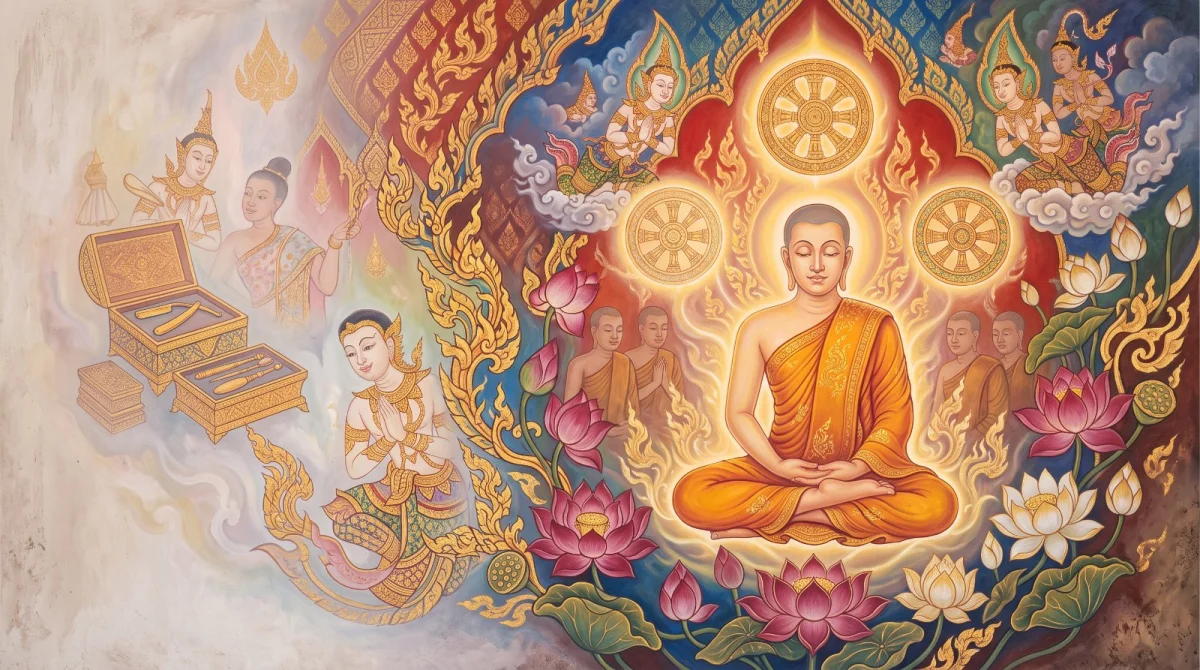
Upālittherāpadānaṃ
Upāli's past lives according to the Apadāna: a proud brahmin, a prince intoxicated with his birth who drove an elephant at a paccekabuddha, and finally the Sakyans' barber who became foremost in the Vinaya. Birth does not set the limits of awakening.
The Apadāna of the Khuddaka Nikāya contains two apadānas of Upāli. The first, a long one, is in the Buddha chapter; the second opens the Upāli chapter. The Apadāna is a collection of verses in which the Buddha and his disciples recount deeds of past lives. Most scholars regard it as a later text within the Tipiṭaka, while the Theravāda tradition counts it as part of the Khuddaka Nikāya.
In the first, Upāli tells how in the time of the Buddha Padumuttara he was a wealthy brahmin named Sujāta, so proud that he saw no one worthy of honour. Later he saw a monk appointed foremost in the Vinaya, aspired to that position, and built a monastery called Sobhana for the Saṅgha. He also tells of a life as Prince Candana, intoxicated with his birth, who drove an elephant at a paccekabuddha named Devala, and says that because of this deed he was born into a low station, as a barber who delighted the Sakyans.
The second tells how he was a hide-clad ascetic who praised the Buddha Padumuttara's knowledge with similes and was foretold that, though low by birth, he would be named Upāli, go forth, end the taints and be appointed foremost in the Vinaya. The verses' explanation of low birth reflects the class ideas of that era, but what they emphasise is that he went beyond that birth.
In the time of the Buddha Padumuttara he was the brahmin Sujāta of Haṃsavatī, master of the three Vedas and honoured by many, yet he honoured no one, seeing no one worthy. He admits he was then stiff with conceit.
When you feel no one around you is worth learning from, treat it as a warning that conceit is clouding your view. Find one good quality in someone around you every day.
Seeing a monk skilled in the texts appointed foremost in the Vinaya, Sujāta aspired to that same position. He used his wealth to buy the Sobhana park and build a monastery with huts, a sauna, bathrooms, beds and seats, medicines, attendants and a wall so no one would trouble the monks.
When you see someone excelling at what you want to become, turn envy into a training plan, and start by supporting the community that trains in it.
In another life he was Prince Candana, hardened by pride in birth, fame and wealth. Riding an elephant to the park, he met the paccekabuddha Devala and drove the elephant at him, but the elephant would not lift its foot, and the prince grew angrier still. Afterwards he found no happiness at all, feeling as if his head were on fire.
The burning feeling after hurting someone is a warning from the heart. Don't bury it with excuses; use it as the push to make amends.
His father the king, fearing ruin for the kingdom, had people gather and go to ask forgiveness, all with wet clothes and wet heads, bowing at his feet. The paccekabuddha said: as fire does not stay in water and seeds do not sprout on rock, so anger does not arise in a Buddha. Then he relieved their distress.
When you wrong someone, go and apologise in person with humility; and when someone apologises to you, practise being like water in which fire cannot stay.
He says that because he slighted the paccekabuddha he was born into a low station, as barber to the Sakyans, but adds that he went beyond that birth and entered the city free of fear. The second apadāna likewise foretells that, though low by birth, he would be named Upāli, go forth, end the taints and become foremost in the Vinaya.
Don't let labels of background, education or former occupation limit you or others. In a team, give people the chance to show their ability through what they actually do.
After telling his deeds he warns his listeners: do not let the moment pass you by, for those who let it pass grieve; strive for your own true good.
What good opportunity is waiting now, such as apologising, starting meditation or caring for your parents? Do it before the chance passes.
He says the Buddha crosses the world through patience, harmlessness and loving-kindness, unattached like the earth to gain and loss, honour and contempt. He is even-minded toward Devadatta, the archer, Aṅgulimāla, Rāhula and the elephant Dhanapāla, with neither aversion nor lust toward any, the same toward his would-be killer and his own son.
Notice how differently you treat people who like you and people who don't, and begin with equal courtesy toward both.
He compares the Buddha to a king who builds a city of Dhamma, with virtue as its wall, knowledge as its gateway, faith as its pillar, restraint as its gatekeeper and the foundations of mindfulness as its watchtowers, appointing Sāriputta, Kolita, Mahākassapa and Ānanda to their roles, while Upāli was entrusted with judging the Vinaya. He says: the Vinaya is my shelter, my place to stand and walk, my dwelling and my pasture.
Every community needs someone who looks after its rules carefully and fairly. If you are given that role, do it with real knowledge and respect, not to catch people out.
Upāli's story warns that pride in family, wealth or position blinds us to the worth of others and can lead us to harm people who have done nothing wrong.
On the other side, a barber became the one the monks came to with questions about discipline. Background does not limit how far someone can learn and become a support for others; what matters is commitment, care and steady training.
That the verses explain low birth as the result of past action should never be used to look down on anyone today. We don't know anyone's past, and the verses themselves end with awakening, not with birth.
Tap to read the actual passage on the page cited.
The eight-factored uposatha is not just a list of prohibitions but a resolve: "The arahants abstain like this …

The conduct expected of one appointed by the Saṅgha to settle a dispute: not asking the parties' names or fami…

Tormenting oneself to burn up past kamma does not end suffering. Fruitful striving means not overwhelming ones…

The sage Paṇḍarasa asks what monks will be like in future. The elder Pussa answers that many will be angry, pr…