
The Sayha Jātaka: Not Trading Rank and Wealth for Self-Degradation
Dhiratthu taṃ yasalābhaṃA king sends his minister Sayha to invite a friend who has gone forth to return and take high office, but he d…


Uruvelakassapattherāpadānaṃ
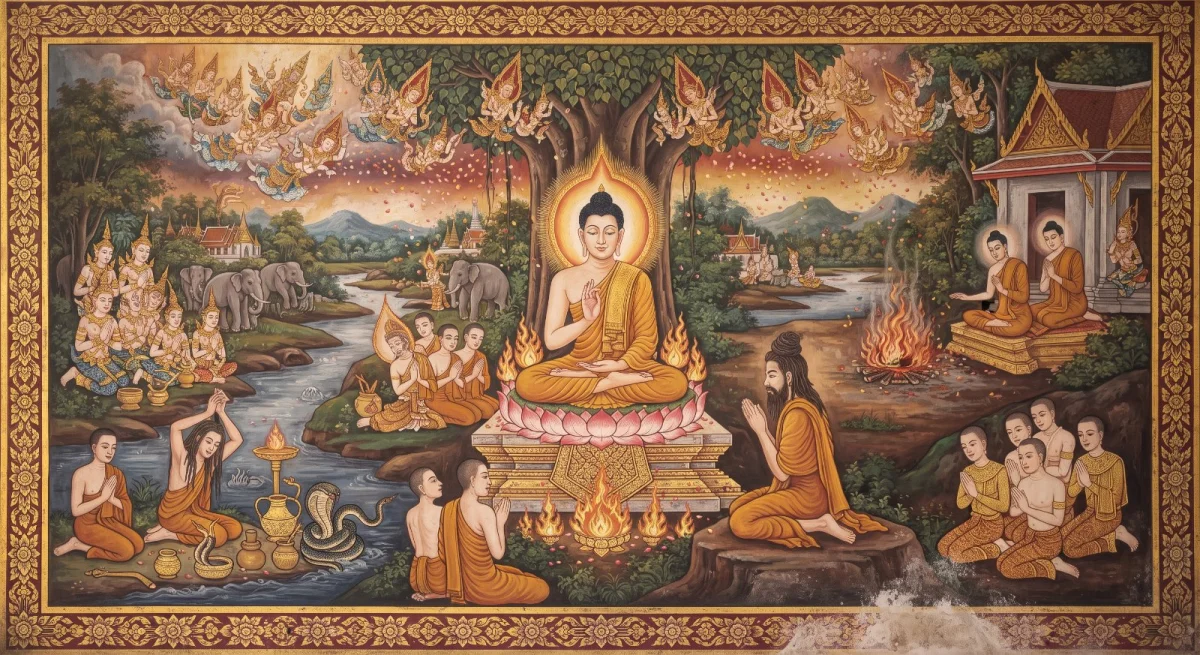
A brahmin who once asked for a boon — that he might always have a large following — who once held a wrong view that nearly ruined him, and who later, as a matted-hair ascetic with five hundred pupils, gave up what he had taught all his life because he saw the real thing.
In the Uruvelakassapatthera Apadāna of the Khuddaka Nikāya (the fifty-fourth vagga, Kaccāyana vagga), the elder Uruvela Kassapa relates that in the time of the Buddha Padumuttara he was a brahmin of Haṃsavatī. Having heard the Buddha place a disciple in a foremost position, he gave a great gift together with a thousand other brahmins and then asked: wherever I am born, may I have a large following.
The verses continue that in the time of the Buddha Phussa he and his two younger brothers were royal ministers in Bārāṇasī. When the king sent them to settle unrest on the frontier, all three first asked to be granted the Teacher to attend upon; then they carried out the task, having arms laid down, and on their return served the Teacher for life with cloth, food, lodgings and medicines rightfully obtained.
The verses also mention a life as the king of Videha, when the words of a naked ascetic led him into wrong view and he disregarded the counsel of his daughter Rucā, until Brahmā Nārada instructed him at length and he abandoned that bad view. The full story of this episode is in the Mahānāradakassapa Jātaka. In his final life he was born a brahmin's son in Bārāṇasī, and fearing death, illness and old age he went forth as a matted-hair ascetic with both his brothers.
After giving with a thousand other brahmins he said: through faith in you, may I who am born in this or that existence have a large following. It is a request for people to look after, not for people to wait on him.
If you want influence or a team, aim at your capacity to look after people, not at the number of people cheering for you.
When the king ordered the three brothers to settle unrest on the frontier, they replied that if he would grant them the Teacher to attend upon, they would accomplish his task. They then carried it out, with arms laid down.
Before taking on heavy work or a hard decision, arrange your inner support first — a mentor, time for practice, someone you can genuinely talk to.
The verses specify that the three offered costly cloth, fine food, delightful lodgings and beneficial medicines, all of it produced by them in accordance with the Dhamma, and that they attended on him with a mind of loving-kindness throughout.
Where the money came from matters as much as how much of it there is. Give from honestly earned wealth and your mind won't have to keep explaining itself afterwards.
The verses say that as king of Videha his disposition was ruined by wrong view through the words of a naked ascetic, and he disregarded the counsel of his daughter Rucā; only when Brahmā Nārada instructed him at length did he abandon that bad view and fulfil the ten courses of wholesome action.
Keep near you the people who dare to warn you, and when warned, hear them out before you argue. A wrong view has usually been flagged by someone beforehand.
In his final life he was born a brahmin's son in Bārāṇasī. The verses say that, afraid of death, illness and old age, he plunged into the great forest in search of the path to nibbāna and went forth among the matted-hair ascetics with both his brothers.
Fear that comes from seeing the truth of life can be used as fuel for practice, unlike fear that sends us looking for something to drown it out.
He explains that his clan name was Kassapa, but because he lived at the village of Uruvelā he came to be designated Uruvela Kassapa; the brother by the riverbank was called Nadī Kassapa, and the one at Gayā, Gayā Kassapa.
The title or nickname people use for you marks one stretch of the road. There is no need to carry it so heavily that change becomes frightening.
The verses say the youngest brother had two hundred pupils, the middle one three hundred, and he himself five hundred. When the Buddha came and guided him, he and his thousand followers were ordained and all attained arahantship together. The Buddha later placed him foremost among those with a large following.
The more people trust you, the harder it is to admit you were wrong — and doing so in front of your team is what builds trust most.
This page speaks to anyone with a position, staff, or people who trust them. The hardest thing for Uruvela Kassapa was not understanding the Dhamma but admitting, in front of five hundred pupils, that what he had taught all his life was not the highest.
The verses give a further warning: wrong view does not only afflict the foolish. He had been a king and was still led far astray. What saved him was that someone dared to correct him and that he eventually listened.
A last point concerns names. He explains that he was Kassapa by clan, but because he lived at Uruvelā he came to be called Uruvela Kassapa; the brother who lived by the river became Nadī Kassapa, and the one at Gayā became Gayā Kassapa. The name people call us by marks a location, not a self to be defended.
Tap to read the actual passage on the page cited.
A king sends his minister Sayha to invite a friend who has gone forth to return and take high office, but he d…
Sāriputta arranges the Dhamma in sets of one, two and three, each with ten functions, such as what is most hel…

A tree with just one leaf on each side, not four inches above the ground, already tastes like poison; how bitt…
Devadatta gains lavish support from Prince Ajātasattu and then wants to lead the Saṅgha. Refused, he nurses a …