
The Nanda Sutta: Raising Motivation from Lower to Higher
NandasuttaṃNanda wants to disrobe because he keeps thinking of a beautiful woman who asked him to come back soon. The Bud…


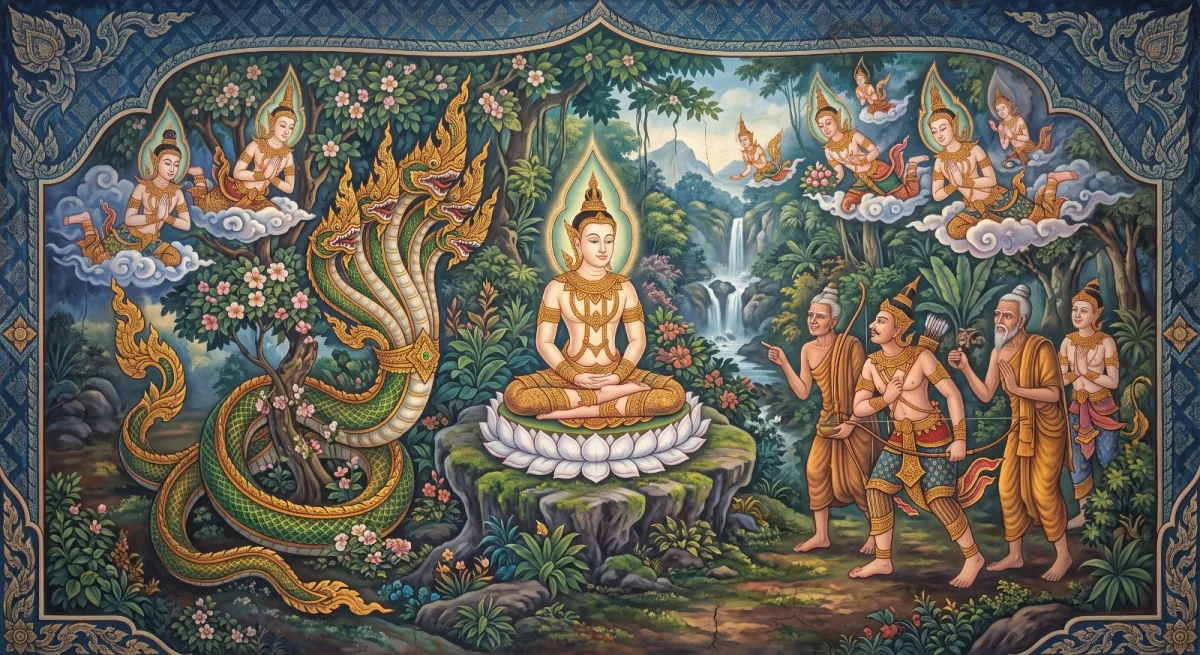
Bhūridattajātakaṃ
The powerful nāga prince Bhūridatta keeps the uposatha on an anthill and is betrayed by a brahmin he had hosted, who tells a snake charmer where to catch him. According to the commentary he refuses to use his power to retaliate because he is keeping his precepts. A story of virtue, restraint, and not being taken in by rites that claim killing brings purity.
The Bhūridatta Jātaka is the sixth story of the Mahānipāta Jātaka in the Khuddaka Nikāya. The Bodhisatta is Bhūridatta, son of the nāga king Dhataraṭṭha and Queen Samuddajā. The heading in the Thai translation and tradition associate it with the perfection of virtue (sīla-pāramī). The canonical text consists of verses in dialogue; the full narrative comes from the Jātaka commentary.
In the verses, Dhataraṭṭha asks for the daughter of the king of Bārāṇasī and orders the nāgas to spread their hoods and frighten the townspeople, but forbids them to harm anyone. Later Bhūridatta meets a brahmin and his son in the forest, hosts them in the nāga realm, and says he keeps the uposatha on an anthill because he aspires to the mansions of the devas. When the brahmin leaves, he meets a snake charmer named Ālambāyana who has a spell, and agrees to reveal Bhūridatta's whereabouts in exchange for a gem. His son Somadatta objects and parts from him, and the snake charmer captures Bhūridatta.
Later Bhūridatta's mother has a bad dream and his brothers set out to search. Sudassana, disguised as an ascetic, challenges the snake charmer before the king, and Bhūridatta is freed from him. Toward the end a long verse passage refutes Ariṭṭha, who praises sacrifice: feeding the fire or killing animals in sacrifice does not purify, and the division of classes said to be ordained by Brahmā is not true. According to the commentary, the speaker of these verses is Bhūridatta.
Details familiar to Thai people, such as Bhūridatta resolving that anyone may take his skin, flesh or bones but his precepts must not be broken, and letting the snake charmer put him in a basket for shows without looking at him in anger, though he had power enough to destroy him, come from the commentary.
Bhūridatta lives in a splendid nāga realm surrounded by nāga maidens; the brahmin even remarks that he surely has no need of Indra's mansion. Yet Bhūridatta still comes up to keep the uposatha on an anthill, aspiring to a more refined happiness.
Times when life is comfortable are a good time to start training in virtue, such as keeping precepts on observance days. Don't wait for problems first.
In the verses Bhūridatta says he is a mighty nāga who, if angered, could destroy a country; Dhataraṭṭha, even while ordering the nāgas to intimidate, forbids them to harm anyone. That Bhūridatta let himself be captured and displayed without retaliating, to keep his precepts, is the commentary's account.
When you're angry and know you could get back at someone, such as with evidence to shame them or power to make trouble for them, pause first, then choose a way to solve the problem that creates no further enmity.
The brahmin was hosted by Bhūridatta yet revealed where he was in exchange for a gem. Somadatta warns that if he wanted wealth, Bhūridatta would surely have given it, and that one who betrays a friend meets the results of what he has done.
When some gain tempts you to betray someone who once helped you, ask whether they would help if you simply asked. The honest way often gets what you need without betraying anyone.
When his father won't listen, Somadatta declares he will not live with or walk even one step alongside someone doing such a cruel deed, and goes his own way.
If someone at home or on your team is doing something wrong, saying clearly that you disagree and won't take part helps them and protects you at the same time.
When Bhūridatta disappears, his brothers console their mother that birth and death are the nature of beings. She replies that even knowing this, she is overwhelmed by grief. So the brothers don't stop at words of comfort; they set out searching in every direction.
When someone you love is suffering, "it's only natural" may not be enough. Ask what you can do, then really help.
The closing verses argue: if feeding things to the fire made merit, charcoal burners and cooks would make merit too; if those killed in sacrifice really went to heaven, the teachers should begin with their own kind. No animal begs to be killed; all struggle to live. And if classes were truly fixed, no one outside a class could do other work, but reality is not like that.
When someone claims a ritual or a payment will wash away bad kamma or change your fortune, ask as the verses do: if this were true, what results should we see, and who benefits?
The heart of the story is that virtue matters most when we have the power to do wrong easily. Bhūridatta wasn't powerless; he chose not to use his power to harm. People with position, a loud voice, or information about others in their hands can practise this every day.
A caution: patience in the Jātaka doesn't mean that in real life you must put up with being harmed. If you face violence, exploitation or danger, getting yourself to safety and seeking help from people close to you, organisations or the law does not go against the precepts. Not taking revenge and allowing harm to continue are different things.
Somadatta's role is also worth remembering: a son dares to tell his father he is doing wrong and refuses to take part, even within his own family.
Tap to read the actual passage on the page cited.
Nanda wants to disrobe because he keeps thinking of a beautiful woman who asked him to come back soon. The Bud…
The lay follower Dhammika asks how disciples, both those gone forth and those living at home, should practise.…

King Ajātasattu asks whether going forth yields any fruit visible in this life. The Buddha answers step by ste…

For one without sensual desire or craving, who has crossed over doubt, there is no further liberation to seek.…