
The Discourse to Bhaddiya: The Charge of Converting Magic
BhaddiyasuttaṃBhaddiya the Licchavi hears that the Buddha knows a magic that converts the disciples of other teachers. The B…


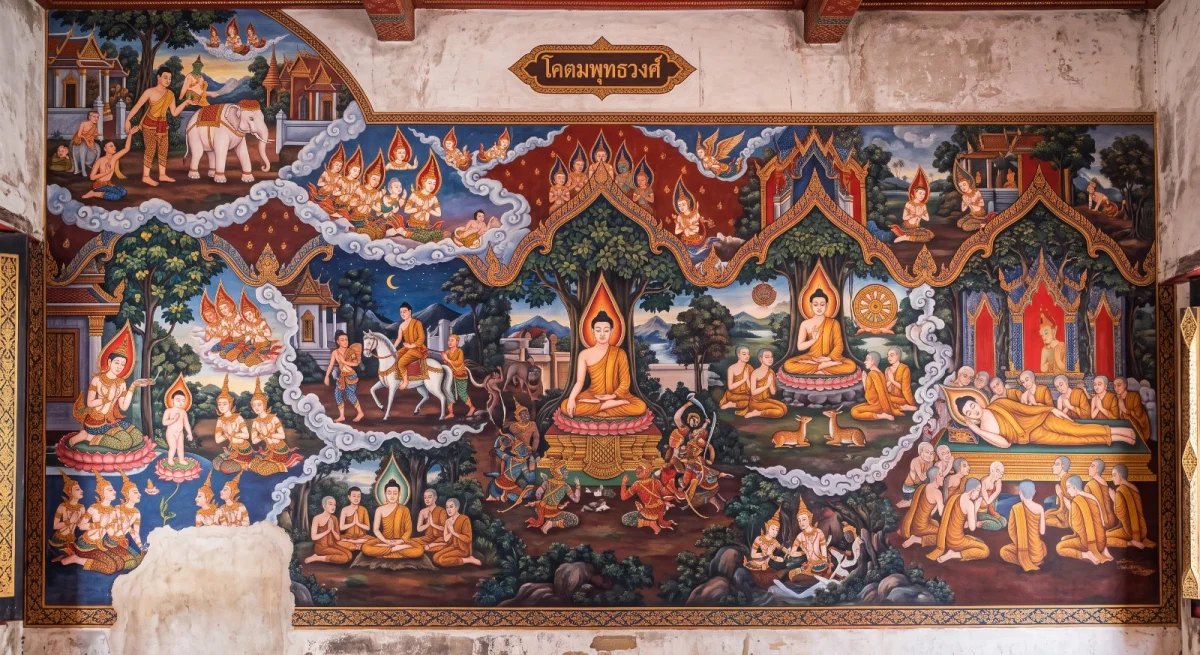
Gotamabuddhavaṃso
In the Buddhavaṃsa, the Buddha briefly tells his own life: his city, parents, going forth, the tree of awakening, chief disciples and attendant, and then the Miscellany sums up the Buddhas of the past and the future.
In the Buddhavaṃsa of the Khuddaka Nikāya, the Buddha tells of twenty-four Buddhas of the past, from the Buddha Dīpaṅkara, who gave the prediction to the ascetic Sumedha, to the Buddha Kassapa, and ends with the Chronicle of Gotama, the twenty-fifth, which is his own story. The Buddhavaṃsa opens with the Chapter of the Jewelled Walkway, in which the Buddha creates a jewelled walkway in the sky and Sāriputta asks about his original resolve.
The Chronicle of Gotama consists of short verses spoken in the first person. It gives the core facts in the same pattern used for the other Buddhas in the text: city, father and mother, years in household life, wife and son, going forth, years of striving, where the wheel of Dhamma was set rolling, chief disciples, attendant, tree of awakening and lifespan.
After it comes the Miscellany on the Buddhas (Buddhapakiṇṇakakaṇḍa), which sums up in which aeon each Buddha arose, and the Account of the Distribution of the Relics. Some names in the verses are spelled differently in different editions. Further details of the Buddha's life familiar to Thai Buddhists come mostly from the commentaries and later texts.
"Now I am the Buddha named Gotama, who brings increase to the Sakyans. Having striven, I attained supreme awakening." At Brahmā's request he set the wheel of Dhamma rolling. The first breakthrough to the Dhamma was for eighteen crores of beings; the second, in the assembly of humans and devas, and the third, when he instructed his son Rāhula, were beyond counting.
The highest achievement in this account begins with the words "having striven", not luck. When a long-term goal discourages you, come back to asking whether you've done your own part today.
He had a single assembly of disciples, with 1,250 monks, shining in the midst of the Saṅgha, and proclaimed the four noble truths out of compassion for beings. He says the teaching of the Sakyan sage is widespread, well purified and of benefit to many, and that many hundreds of monks free of the taints always surround him.
A good community is measured by the quality of its people, not by how many big events it holds. In a group or team you look after, care more about the growth of those already there than about adding members.
His city was Kapilavatthu, his father King Suddhodana, and the mother who bore him was Queen Māyā. He lived the household life for twenty-nine years, had three excellent palaces, his wife was Yasodharā and his son Rāhula. The names of the palaces and of his wife differ in some editions of the verses.
When you feel "if I had this, it would be enough", remember that one who had everything the world admires still chose to seek a deeper answer to suffering.
Having seen four signs, he went forth on horseback, practised difficult striving for six years, and set the wheel of Dhamma rolling at Isipatana near Bārāṇasī. The verse doesn't say what the four signs were. The familiar list of an old man, a sick man, a dead man and a renunciant comes from the commentaries' explanation, and matches the story of the Buddha Vipassī in the Mahāpadāna Sutta.
The ageing, illness and death we see around us can be signs to review our lives. When visiting someone ill or attending a funeral, ask yourself whether you're spending your time on what really matters.
His chief disciples were the monks Kolita and Upatissa (Mahāmoggallāna and Sāriputta); his attendant, always near him, was Ānanda. His chief female disciples were the nuns Khemā and Uppalavaṇṇā. His chief male lay supporters were Citta and Hatthaka of Āḷavī, and his chief female lay supporters Nandamātā and Uttarā.
Even the Buddha had helpers who were monastics and lay people, men and women. Good work in our lives also depends on many kinds of people. This week, thank one person who quietly helps you.
He attained supreme awakening at the foot of the assattha tree, the Bodhi tree, and his radiance always extends a fathom around him. He says his lifespan now is short, a hundred years, yet in that time he has helped many people cross over saṁsāra.
A hundred years is called short, yet much good can be done in it. Don't wait until you have more time to begin what matters.
He set up the torch of Dhamma for the awakening of later generations. He says that before long he and his community of disciples will attain final nibbāna right here, like a fire going out when its fuel is spent. His body with its thirty-two marks and bright radiance will all vanish. The chronicle ends: "Are not all conditioned things empty?" The same words close the accounts of the other Buddhas in the Buddhavaṃsa.
What remains after we're gone isn't our looks or position but what we pass on to others, such as knowledge, ways of thinking, or good we've done. Consider what kind of torch you'd like to leave.
The Miscellany on the Buddhas says that in an aeon immeasurably long ago there were four Buddhas in a single aeon: Taṇhaṅkara, Medhaṅkara, Saraṇaṅkara and Dīpaṅkara. It then lists the Buddhas of later aeons down to this fortunate aeon, which has Kakusandha, Konāgamana, Kassapa, Gotama now, and Metteyya, who is yet to come. All five are wise and compassionate towards the world.
Seeing that there have been many Buddhas, all teaching the same path, helps us see the Dhamma as a truth discovered, not one person's private opinion.
The Buddhavaṃsa answers the question of who the Buddha is without making him a creator of the world. He is one who strove until awakening, taught the Dhamma, and attained final nibbāna in keeping with the nature of conditioned things, like the Buddhas before him.
What makes a Buddha in the Buddhavaṃsa is firm resolve and perfections developed over a very long time, not birth or supernormal power. Ordinary people needn't aim to become Buddhas, but can use the same principles: sustained effort, and benefiting others along the way.
Numbers such as crores of beings, aeons and the extent of radiance should be read as the text tells them. The point to take into life is that even the greatest are subject to impermanence, and what can truly be passed on is the Dhamma.
Tap to read the actual passage on the page cited.
Bhaddiya the Licchavi hears that the Buddha knows a magic that converts the disciples of other teachers. The B…

Four wheels that carry a life forward — a suitable place, good company, setting yourself rightly, and merit al…

An ascetic is uneasy at the nāga king who visits him daily, so he uses the tactic of asking for the gem at his…
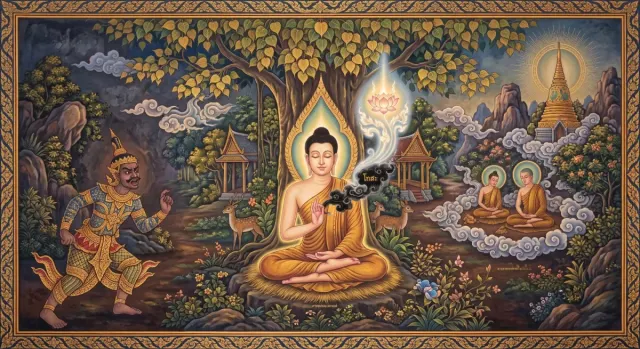
An ascetic admits that anger really did arise in his mind, but he checked it at once, as heavy rain settles du…