
The Four Foundations to Be Established
Cattāro adhiṭṭhānāFour things to set firmly in the mind — wisdom, truth, relinquishment and peace. The whole practice condensed …


Cittasaṃyuttaṃ
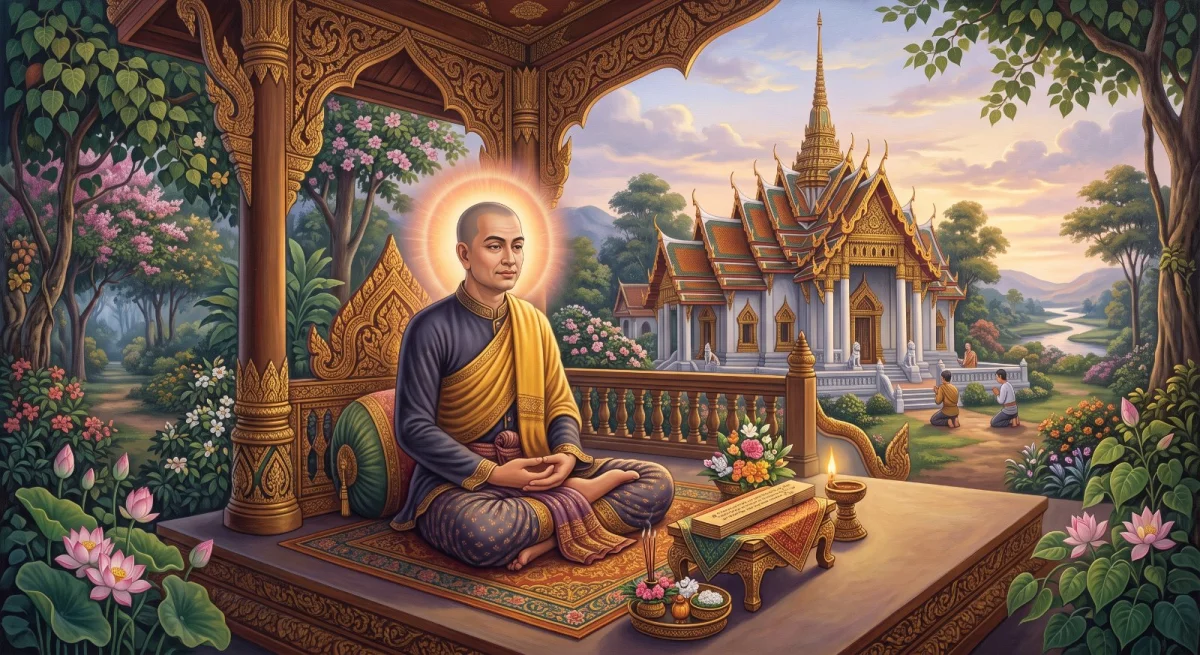
Citta of Macchikāsaṇḍa explains that the eye is not bound to forms; desire is the rope that binds. He tells Nigaṇṭha Nāṭaputta he knows jhāna for himself rather than by faith, and on his deathbed declines to wish for kingship, then teaches his relatives to be firm in the Triple Gem and to share.
The Citta Saṃyutta of the Saṃyutta Nikāya contains ten discourses in which the householder Citta asks or answers questions. He lived at Macchikāsaṇḍa, supported the monks at Ambāṭaka Grove, and discussed the Dhamma confidently with senior monks, newly ordained monks and ascetics of other sects alike.
When the elder monks debated whether fetters and the things that can be fettered differ, he explained with the simile of a black ox and a white ox yoked by a single rope. When Nigaṇṭha Nāṭaputta asked whether he believed the Buddha that there is concentration without thought and examination, he said he did not believe it, because he knew it himself. When he met an old friend who had been a naked ascetic for thirty years and gained nothing, he said that in his thirty years as a lay follower he could enter all four jhānas.
In the Gilāna Sutta, when he was gravely ill, deities urged him to aspire to become a wheel-turning monarch. He replied that even that is impermanent, and used his final time to teach his friends and relatives to have firm confidence in the Buddha, Dhamma and Saṅgha, and to share what the household had with the virtuous.
A black ox and a white ox are yoked by one rope. It would be wrong to say the black ox is bound to the white or the white to the black; the rope is what binds them. Likewise the eye is not the fetter of forms nor forms of the eye; the desire and lust arising in dependence on both is the fetter. So too with ear, nose, tongue, body and mind. The elder monks praise his wisdom for penetrating the Buddha's deep teaching.
When you blame your phone, snacks or other people for hooking you, look for the "rope", the wanting in your own mind, and loosen it there.
He asks the presiding elder about the diversity of elements, and on another occasion why the various views in the world arise. The elder remains silent three times. Isidatta, the most junior monk, asks permission to answer instead. Citta rejoices in the answer, and on learning that this monk is the friend he had heard of but never met, invites him to stay, offering to provide the four requisites.
In meetings, value a correct answer whether it comes from someone younger or lower in rank.
Venerable Kāmabhū quotes a verse about a faultless chariot with a white canopy and a single axle, rolling on without suffering, and asks its meaning. Citta first asks whether the Buddha spoke it, then asks him to wait a moment while he reflects. He explains: faultless means virtue, the white canopy is liberation, the single axle is mindfulness, the chariot is this body, and the one without suffering who has cut the stream and has no bonds is the arahant who has abandoned lust, hatred, delusion and craving.
When asked something important, saying "let me think for a moment" isn't weakness; it makes for a better answer.
Nigaṇṭha Nāṭaputta asks whether he believes the ascetic Gotama that there is concentration without thought and examination. Citta says he does not take this on faith in the Buddha, and asks in return which is more excellent, knowledge or faith. When the Nigaṇṭha answers knowledge, Citta says he can enter the first to fourth jhānas at will; knowing and seeing this himself, he need not believe any ascetic or brahmin on the matter.
Use faith as a starting push, then try things out until you know the results yourself. For example, practise mindful breathing for two weeks and see how your mind changes.
Nigaṇṭha Nāṭaputta first announces to his followers that Citta is honest and without guile, but after hearing his answer about jhāna announces that he is dishonest and boastful. Citta points out that if the first statement is true the second is false, and if the second is true the first is false. He then puts ten further questions to him before rising and leaving.
When someone keeps shifting what they say in order to attack you, state the facts briefly in a normal tone, without replying with insults.
His old friend Acela Kassapa says that in thirty years as an ascetic he has gained no superior state, only nakedness, a shaven head and brushing off dust. Asked in return, Citta says that even as a householder he can enter the four jhānas, and that no fetter remains that would bring him back to this world. Kassapa asks to ordain; Citta takes him to the elders and offers his support, and Kassapa later becomes an arahant.
Don't measure practice by outward form or years spent. See whether the defilements are actually decreasing, and when a friend becomes interested in the Dhamma, help connect them with a good teacher.
As he lies gravely ill, deities of the park, forest and trees urge him to aspire to become a wheel-turning monarch, since a virtuous man like him would have his wish fulfilled. He replies that even that is impermanent and unstable and must be left behind. His relatives, hearing this, think he is rambling, and he explains that he was answering the deities.
When setting life goals, also ask yourself: if I get this and must eventually give it up, is it still worth the rest of my life?
When his friends and relatives ask for advice, he tells them to train so that they have unwavering confidence in the Buddha, the Dhamma and the Saṅgha, with their familiar qualities, and so that whatever the family has to give is shared with the virtuous and good. Having encouraged them in confidence in the Triple Gem and in generosity, he passes away.
What you want to leave your family needn't wait for your last day. Share your spiritual anchor and your habit of sharing with your children and grandchildren from today.
Citta shows that someone with a family, wealth and work to do can understand the Dhamma deeply and really practise it, without waiting to ordain or retire.
What is worth learning from him is not only his knowledge but his manner. He asks when he doesn't know, asks for time to think before answering, is glad when a junior monk can answer, and speaks frankly with those who disagree without looking down on them.
The conversation with the Nigaṇṭha doesn't say faith is unimportant. At the end he himself teaches his relatives to have firm confidence. But it shows that faith should lead on to knowing and seeing for oneself.
Tap to read the actual passage on the page cited.
Four things to set firmly in the mind — wisdom, truth, relinquishment and peace. The whole practice condensed …
Ānanda hands out cakes to the poor at the Buddha's word, but three times gives one female wanderer two cakes t…

The Buddha picks up a few siṃsapā leaves and says that what he knows but has not taught is as many as the leav…

The Mahāniddesa's explanation of the Attadaṇḍa Sutta: the rod that brings fear is wielded through body, speech…