
The Exposition of Offerings: Pure Giving
DakkhiṇāvibhaṅgasuttaṃMahāpajāpatī wishes to give the Buddha cloth she wove herself, but he suggests giving it to the Saṅgha — then …


Paṭiccasamuppādo
The twelve links by which suffering is produced — see any one link clearly and the chain can be cut right there.
Dependent origination explains in detail how suffering comes about, as a chain of twelve links. The principle is simple: when this is, that is; when this ceases, that ceases. Nobody decrees it; conditions simply pass the process along.
It has a reputation for being hard, but you don't need the whole circle at once. The stretch easiest to catch in daily life is contact → feeling → craving, which happens to us hundreds of times a day.
Not knowing the Noble Truths, not seeing that things follow conditions, and so assuming a fixed "me" who is forever gaining and losing.
Accept that you always have blind spots, and listen occasionally to information that contradicts what you already believe. That alone reduces ignorance at everyday scale.
Not seeing truly, the mind builds along habitual lines, wholesome and unwholesome alike, and those constructions become actions that accumulate as kamma.
Watch your automatic habits, such as reaching for the phone the moment there's a gap. Seeing the habit is the first step to changing it.
The knowing that continues on from those constructions, carrying the stream of life forward and taking in fresh experience without pause.
Choose what you let the mind know each day, because what we watch and listen to repeatedly becomes the raw material of tomorrow's thinking.
With knowing there is a body and a mind working together as one life: "name" for the mental side, "form" for the physical.
Treat body and mind as a pair. When the mind is off, first check whether you slept enough and what you ate. Many problems of the mind are solved at the body.
With body and mind come the six doors of experience: eye, ear, nose, tongue, body and mind — the gates through which the world reaches us.
The doors most wide open today are the eye and the ear. Close them for part of the day — no screens while eating, for instance — and notice how much the mind settles.
The meeting of sense base, object and knowing: eye meets form, ear meets sound. Every episode of experience starts here.
Choose your surroundings well. It is hard to stop the mind from proliferating, but easy to choose what you put yourself in contact with.
Every contact produces a tone — pleasant, unpleasant or neutral — instantly and without being ordered.
Train yourself to catch "what am I feeling right now" before you act on it. This is the link closest to the point where the chain can be cut.
Pleasant, and we want more; unpleasant, and we want it gone. Right here the chain turns from ordinary experience into suffering.
When you want to buy something, wait twenty-four hours before deciding. If it still matters afterwards, consider it. Most of the time the wanting has gone first.
Craving that is fed becomes grasping — to pleasures, to our own views, to rules and observances, and to the idea of self.
In an argument, notice whether you are defending what is correct or defending your image as the one who is correct. They are very different things.
Grasping leads to action that shapes a new state of being, laying the ground for what follows.
Think of the roles you slip into out of habit — the wronged one, the capable one who can't admit a mistake. Any role worn often enough eventually becomes your life.
What has been shaped duly appears: birth in the sense of a new existence, and equally the birth of a "self" in each matter we take up as ours.
Every time something makes you feel "this is my business", know that a self has just been born again. Catching it keeps small matters from swelling into large ones.
What is born must decay and end, bringing sorrow, lamentation and despair. This is where the chain that began in not-knowing arrives.
And because it is a chain, the Buddha pointed out that cutting the earlier links causes all the later ones to cease as well.
Use this truth to sort your priorities. Ask whether the thing you're stressed about will still matter in five years. The answer usually lets you put down whatever doesn't.
The place where the chain can actually be cut in ordinary life sits between feeling and craving — the moment when something has been felt but not yet wanted.
A simple practice: when wanting arises, hold still and simply watch whether it grows stronger or slowly fades. Very often it fades on its own without being acted on. That is seeing a link break with your own eyes.
Tap to read the actual passage on the page cited.
Mahāpajāpatī wishes to give the Buddha cloth she wove herself, but he suggests giving it to the Saṅgha — then …
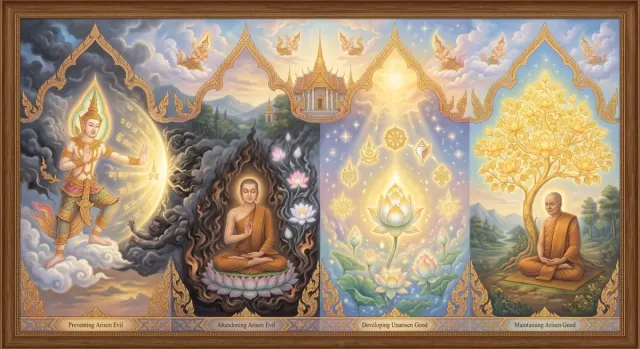
Effort in four directions — prevent, abandon, develop and maintain. It covers both guarding what you have and …

A deity urges the young monk Samiddhi to enjoy sensual pleasures first and not give up what is right in front …
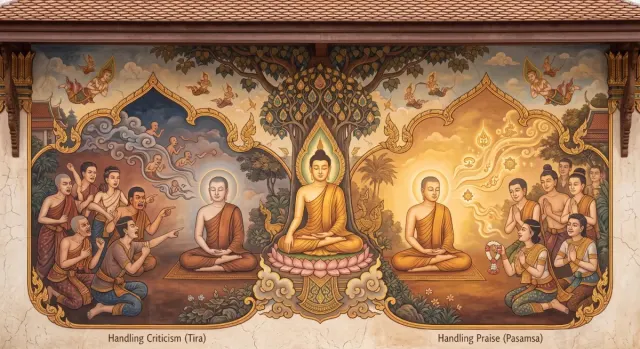
A teacher disparages the Triple Gem while his pupil praises it. The Buddha teaches the monks not to be angry w…