
Debate on Hearing Sound in Attainment: Does One in Jhāna Hear Sounds?
Samāpanno saddaṃ suṇātītikathāThree debates at the end of chapter 18 asking whether there is an intermediate jhāna between jhānas, whether o…


Saṅghabhedakkhandhakaṃ
Devadatta gains lavish support from Prince Ajātasattu and then wants to lead the Saṅgha. Refused, he nurses a grudge, plots against the Buddha, proposes extra-strict practices to win followers, and splits the Saṅgha. The story teaches about ambition, envy, admitting wrongdoing, and not letting gain or loss overpower the mind.
In the Saṅghabheda Khandhaka of the Cūḷavagga in the Vinaya Piṭaka is the story of Devadatta, a Sakyan prince who went forth together with Bhaddiya, Anuruddha, Ānanda and Upāli. In his first rains he attained worldly psychic powers. The chapter records his story to explain what splitting the Saṅgha is, how serious it is, and how the Saṅgha should respond.
Devadatta wondered whom he could win over to bring him great gain, and impressed Prince Ajātasattu with a display of psychic power. The prince attended on him morning and evening. The wish arose in Devadatta to lead the Saṅgha, and with that thought his powers were lost. He later asked the Buddha to hand over the Saṅgha and was refused. He bore a grudge, urged the prince to seize the throne, sent men to kill the Buddha, rolled a rock from Vulture Peak so that a splinter drew blood from the Buddha's foot, and had the elephant Nāḷāgiri let loose. All these plots failed. He then proposed five rules and separated to hold his own Saṅgha acts, leading about five hundred new monks to Gayāsīsa.
This page keeps the violent events brief and focuses on lessons for everyone. The simile that gain and honour arose for Devadatta's own destruction, as a plantain dies after bearing fruit, is also in this chapter but is not expanded here. Later accounts of Devadatta's end found in the commentary are not included.
Monks reported that Prince Ajātasattu attended on Devadatta morning and evening with five hundred carriages and five hundred dishes of food. The Buddha told them not to envy Devadatta's gain, honour and praise. As long as he received them, only decline in wholesome qualities could be expected, just as smearing bear's bile on the nose of a fierce dog only makes it fiercer.
When you see someone rapidly gain followers, sponsors or promotion, don't rush to envy them. First ask whether what they've gained is making them a better or worse person.
Before an assembly that included the king, Devadatta said the Buddha was now old and asked him to hand over the Saṅgha for Devadatta to lead. The Buddha refused three times, saying he would not hand it over even to Sāriputta and Moggallāna, and rebuked him sharply. Devadatta felt humiliated in public while the chief disciples were praised, and left angry and resentful. The Vinaya records this as his first grudge against the Buddha.
When you're turned down for a position or opportunity, give yourself time before reacting, then ask what reasons behind the refusal are worth hearing. Unresolved resentment can grow into hatred.
The Saṅgha made a public announcement that Devadatta's conduct was formerly one way and now another, and that what he did should not be taken as the Buddha's, the Dhamma's or the Saṅgha's. Sāriputta said he had once praised Devadatta as having great power. The Buddha said he had praised truthfully then, and should now announce truthfully too. Those without wisdom said the monks were jealous of Devadatta's gain; the wise saw this was no small matter.
People who were once good can change, and people who once erred can improve. Praise or warn according to what is true now, and separate one person's actions from the whole group or organisation.
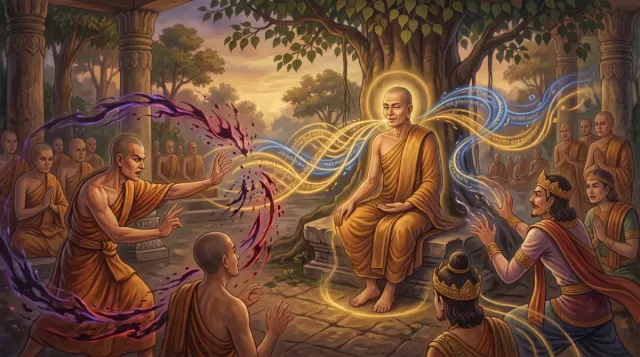
A man sent to kill the Buddha came near and froze in fear. The Buddha said, "Come, don't be afraid." He put down his weapons, bowed at the Buddha's feet and asked him to accept his confession for the sake of future restraint. The Buddha said that since he saw his wrong as wrong and made amends according to the Dhamma, it was accepted, for this is growth in the noble discipline. The Buddha then taught him until he gained the eye of Dhamma, and the further groups of men sent after him also changed their hearts. Later, when Nāḷāgiri was let loose, the Buddha pervaded the elephant with loving-kindness until it lowered its trunk and returned to its stall.
When you do wrong, say clearly what you did, apologise and say how you will change. When someone apologises to you sincerely, give them the chance to start again.
Devadatta and his companions asked the Buddha for five rules: that monks live in the forest, eat only almsfood, wear only rag robes and live at the foot of trees for life, and never eat fish or meat, with penalties for breaking them. He knew the Buddha would not allow them and planned to use this to win people over. Kokālika agreed it would work, since people are impressed by austerity. The Buddha said whoever wished could keep these practices, but he would not impose them on all, and he allowed fish and meat that are pure in three respects: not seen, heard or suspected.
Be wary of people who use being stricter than others to pull people into their camp or make others look lax. Choosing a strict practice can be a personal matter, but it shouldn't be forced on others or used to put them down.
The Buddha warned Devadatta that splitting the Saṅgha is grave, while reuniting a divided Saṅgha brings great merit. But Devadatta told Ānanda that from that day he would hold the Uposatha and Saṅgha acts separately. The Buddha exclaimed: good is easy for the good and hard for the bad; evil is easy for the bad but hard for the noble. On Uposatha day Devadatta had voting tickets handed out, and about five hundred Vajjian monks, newly ordained and knowing little of the Dhamma and Vinaya, took them.
What comes easily shows what the mind is used to. If gossip or taking sides starts feeling easier and easier, stop and reflect. And if you are new to a group, understand the issue before choosing a side.
Sāriputta and Moggallāna went to Gayāsīsa. Devadatta thought they had come to join him, invited Sāriputta to teach in his place and lay down to rest, imitating what the Buddha used to do, and fell asleep. The two chief disciples taught until the monks gained the eye of Dhamma and led them back to Veḷuvana. The Buddha told a simile: great elephants wash lotus roots clean before eating them and stay strong, while young elephants imitating them eat the roots with mud and come to death or deadly pain; so too Devadatta, imitating him, would die wretchedly. He also praised Sāriputta as having the eight qualities of one fit to be an envoy, such as listening, remembering, understanding, explaining and not stirring up quarrels.
Learn from capable people, but learn what lies beneath too. If you copy only their manner, position or way of speaking without the knowledge and character behind it, it will collapse in a real situation.
The Buddha said Devadatta was overpowered by eight bad qualities: gain, loss, fame, disrepute, honour, dishonour, evil wishes and bad friendship. A monk should live having overcome these, for if he does not, taints that bring vexation and fever arise. Elsewhere he named three bad qualities: evil wishes, bad friendship, and stopping halfway after attaining some minor distinction.
Notice how much your mind is shaken both when you gain and when you lose. Choose friends who pull you back when you go astray, and don't stop growing just because you're slightly better than those around you.
Wanting to advance is not wrong in itself. The trouble begins when the desire for position, reputation and recognition outweighs doing what is right. Devadatta did not start by plotting harm; he started by asking, "How can I gain a lot?" and each step took him further.
The moments to watch in real life are when we are turned down, when we see others praised, and when we feel slightly superior to those around us. The bright side of this story is that even the men sent to do harm could change, once they admitted their wrong honestly.
Tap to read the actual passage on the page cited.
Three debates at the end of chapter 18 asking whether there is an intermediate jhāna between jhānas, whether o…

A leper feels relief scorching his sores over a fire, but once cured, no one would want to go back to the fire…

Verses in which the Buddha answers Ānanda on how one becomes an omniscient Buddha: his aspiration under countl…
Two debates in chapter 21 ask whether the Tathāgata's teaching has been made new, and whether the Buddha or hi…