
The Discourse to Sunakkhatta: The Wound That Has Not Closed
SunakkhattasuttaṃSome people believe they have arrived when they have not. The Buddha compares this to a man wounded by a poiso…


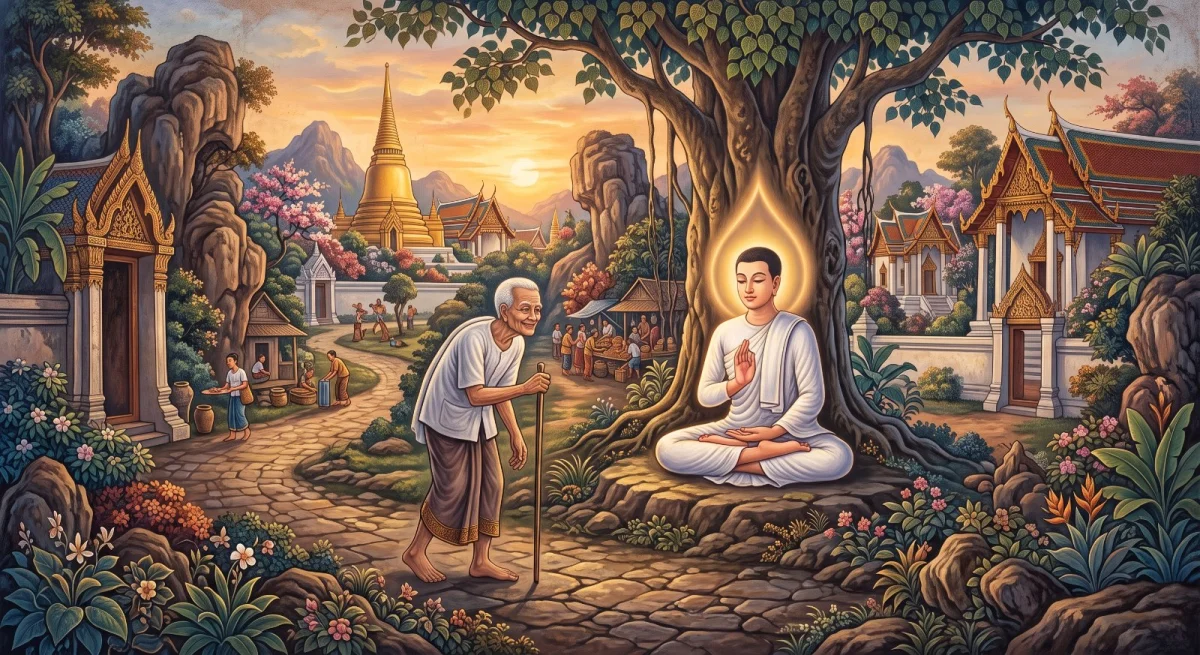
Attavaggo
Key verses from Dhammapada chapters 11–13: why laugh when the world is ever burning; the body is a decorated image; the verse of the house-builder; establish yourself in what is proper before teaching others; oneself is one's own refuge; and seeing the world as a bubble.
In the Dhammapada of the Khuddaka Nikāya, chapters 11 to 13 are the Jarāvagga (old age), Attavagga (the self) and Lokavagga (the world).
The Jarāvagga invites us to see the body as it is, ageing, decaying and a nest of disease, and contains the verses in which the Buddha speaks of finding "the house-builder". The Attavagga stresses responsibility for oneself: establishing oneself in what is proper before teaching others, and purity and impurity being one's own affair. The Lokavagga invites us to look at the world without getting stuck in it.
The background stories of the verses, such as the people who prompted them, come from the Dhammapada Commentary. This page says so each time one is mentioned.
What laughter, what joy, when the world is always burning? Shrouded in darkness, why don't you seek a lamp? The Dhammapada Commentary says these words were addressed to a group of Visākhā's friends who had drunk liquor at a festival and came to the monastery intoxicated.
This verse doesn't forbid laughter; it warns against letting fun cover up the truth of life. When you notice you're seeking entertainment to escape something you should face, ask what the "lamp" is in this situation.
See this decorated image, a mass of sores, propped up, ailing, the object of many people's thoughts, yet with nothing lasting or stable. This form is worn out, a nest of disease, fragile; it will break up, for life ends in death. The Dhammapada Commentary says this was spoken when Sirimā, a beautiful woman many desired, died, and no one would take her body even for free.
When worries about appearance, such as wrinkles or weight, become stressful, look after your health sensibly, then remind yourself that the body changes by nature and your worth doesn't lie in how you look.
Even splendid royal chariots wear out, and the body too grows old, but the Dhamma of the good does not age. The next verse says that a person of little learning grows old like an ox: his flesh grows, but his wisdom does not.
Each year as your age goes up, ask whether, besides age and weight, your knowledge, patience and broad-mindedness have grown too.
Through many births I wandered in saṁsāra, seeking the house-builder but not finding him; painful is birth again and again. House-builder, you are seen! You will not build the house again. All your rafters are broken, the ridge-pole is shattered; the mind has reached the unconditioned and attained the end of craving. The Dhammapada Commentary explains that the builder is craving, the house is this individual existence, and that the verses were an inspired utterance at the awakening.
When you see yourself building the same situation again and again, such as the same kind of debt or conflict, look for the "builder": the craving behind it. If you don't see the builder, a new house will be built.
One should first establish oneself in what is proper, and only then teach others; so the wise are not tainted. If one does oneself what one teaches others, then, well tamed oneself, one may tame others, for the self, they say, is hard to tame.
Before warning your child about phone use, or your team about arriving at meetings on time, check first whether you do it yourself.
Oneself is one's own refuge; who else could be a refuge? With oneself well tamed, one gains a refuge hard to find. Evil done by oneself, born of oneself, crushes the foolish as a diamond grinds a gem born of stone.
Relying on yourself doesn't mean never asking for help. Advice from others is like a map, but the one who has to walk and train the habits each day is you.
By oneself is evil done and by oneself is one defiled; by oneself is evil left undone and by oneself is one purified. Purity and impurity are personal; no one can purify another. The next verse teaches not to neglect one's own good for the sake of others' good, however great. The Dhammapada Commentary explains that one's own good here means pressing on with Dhamma practice, not selfishness.
Rituals, amulets or having others make merit for you cannot purify the mind on your behalf. What you can do is choose your own actions today.
One who looks upon the world as a bubble, as a mirage, is not seen by the King of Death. Come, look at this world, decked out like a royal chariot, in which fools sink but the wise have no attachment.
When online trends or comparisons with others stress you out, think of a bubble that forms and bursts. What's hot today usually fades within a few days.
These three chapters start from a truth no one escapes, that the body ages and breaks up, and lead to the question: if so, what can we rely on? The answer is a well-trained self.
Reflecting on old age isn't meant to depress, but to set priorities right. When you know time is limited, small things that once upset you for days look smaller, and important things you've put off become clearer.
"Oneself is one's own refuge" helps when you feel your life depends entirely on others. But if you're facing distress too heavy to handle alone, asking for help from people close to you or from a professional is also part of looking after yourself.
Tap to read the actual passage on the page cited.
Some people believe they have arrived when they have not. The Buddha compares this to a man wounded by a poiso…

When a house is on fire, only what is carried out can still be used. Life, burning with ageing and death, is t…

Sakka offers the ascetic Akitti whatever boon he wishes, but Akitti asks for neither wealth nor heaven. Instea…

The past lives of Venerable Kumārakassapa in the Apadāna: a brahmin who decorated a pavilion with many-coloure…