
The Entering Collection: The Faith-Follower and the Dhamma-Follower
OkkantasaṃyuttaṃOne who has not yet realised the Dhamma but has unwavering confidence that these things are impermanent is cal…


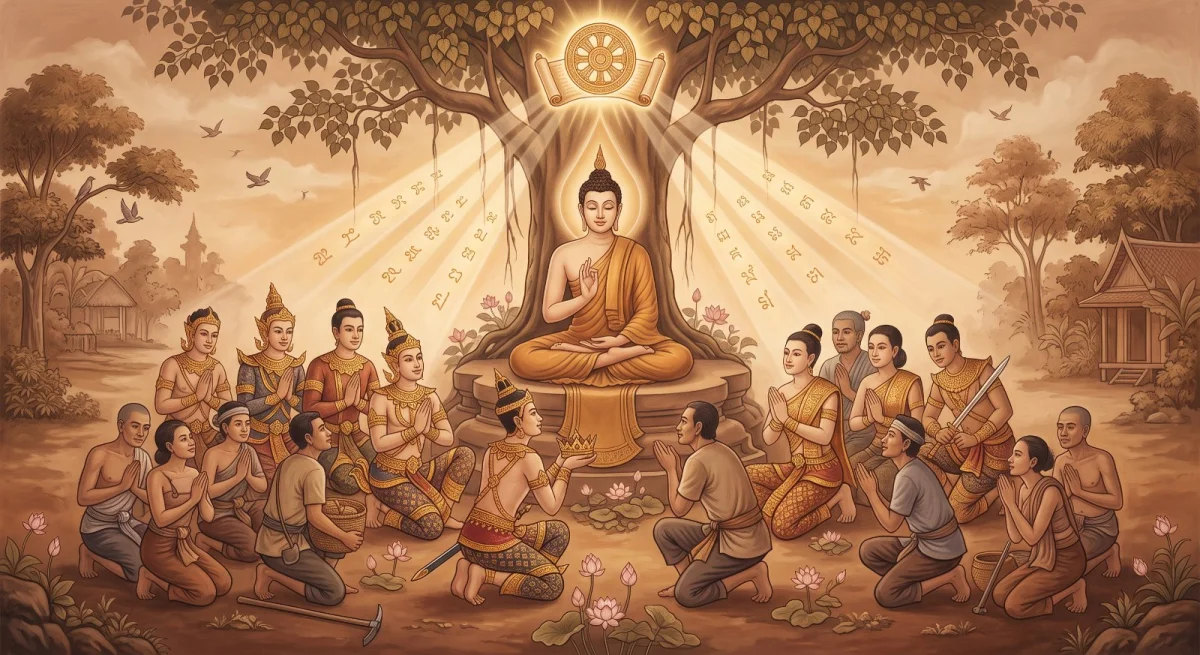
Aggaññasuttaṃ
Two novices from brahmin families are abused by brahmins for abandoning the highest caste. The Buddha says good and evil are found in every caste and the Dhamma alone is best, then tells a story of the origin of the world and society, showing how good things vanished through conceit and greed and how rulers arose by the agreement of the people.
In the Aggañña Sutta of the Dīgha Nikāya, Pāṭikavagga, Vāseṭṭha and Bhāradvāja are novices hoping to become monks, staying at the Eastern Monastery, the mansion of Visākhā Migāramātā, at Sāvatthī. The Buddha asks whether the brahmins abuse them. They say they are reviled with the claim that brahmins alone are the best caste, sons born from Brahmā's mouth, yet the two have abandoned that caste to join shaven-headed ascetics.
The Buddha points out that brahmins are born from brahmin women's wombs like anyone else, that in every caste there are people who do evil and people who do good, and that the Dhamma alone is best among people, in this life and the next. He then tells of the evolution of the world: from luminous beings, to the savoury earth, to self-growing rice, to the division of fields, theft, the appointment of a ruler, and the rise of khattiyas, brahmins, vessas, suddas and ascetics.
The origin story reflects the cosmology of its time. Its practical point is that at each stage good things disappeared through people's own conceit and greed, that social positions arose from agreement and function rather than from Brahmā, and that whatever their caste, those who act badly go to a bad destination, those who act well go to a good one, and those restrained in body, speech and mind who develop the factors of awakening can all attain final Nibbāna.
The brahmins claim to be sons born from Brahmā's mouth, but the Buddha says brahmin women are plainly seen menstruating, becoming pregnant, giving birth and nursing. Those brahmins are born from the womb like everyone else, so such a claim misrepresents Brahmā and is a lie.
When someone claims to be above others because of lineage or family, come back to the basic fact that everyone is born, ages, falls ill and dies alike.
Among khattiyas, brahmins, vessas and suddas, some kill, steal, commit sexual misconduct, lie, speak divisively, harshly or idly, are covetous, ill-willed and of wrong view: dark qualities with dark results, criticised by the wise. And in every caste some refrain from these: bright qualities with bright results, praised by the wise.
Before labelling any group good or bad, think of the good and not-so-good people you actually know within that group.
Whoever becomes an arahant with taints ended, from whatever caste, is declared foremost by the Dhamma. As an example, the Sakyans pay homage to King Pasenadi of Kosala, yet King Pasenadi pays homage to the Buddha, out of respect for the Dhamma, because the Dhamma alone is best among people, in this life and the next.
When choosing whom to respect or elect as a leader, look at virtue and ability before rank, title or wealth.
Those who go forth differ in birth, name, clan and family. When asked who they are, they should answer, "We are ascetics, sons of the Sakyan." One whose faith in the Tathāgata is settled, rooted and unshakeable by anyone may rightly say he is the Blessed One's son, born of the Dhamma, created by the Dhamma, an heir of the Dhamma.
A secure identity need not come from ancestry; it comes from the values you choose to hold and actually live by.
In the origin story, as beings eat the savoury earth for a long time, their complexions come to differ. The good-looking despise the ill-looking, saying, "We are better-looking than you." Because of conceit over appearance, the savoury earth disappears. The same happens again with the ground-fungus and the creeper, and people gather to lament the good things they once had.
Mocking someone's looks or skin colour is not a harmless joke; it erodes the goodwill a group once shared.
While rice still grows by itself and regrows at once, one being grows lazy, thinking it tiresome to gather it morning and evening, and gathers enough for both meals at once. Others copy him, gathering for two days, four days, eight days. Once they start storing it up, the rice gets husks and powder, the cut stalks no longer regrow, and rice grows only in clumps.
When goods run short, hoarding beyond need makes others suffer. Buy only what you really need, and the common supply will stretch for everyone.
So people divide the rice and set boundaries. One greedy being guards his own share and takes another's that was not given. He is caught and warned, and promises, but does it again, up to a third time; this time, besides warning him, some beat him with fists, clods and sticks. The discourse says that from then on theft, censure, lying and the use of sticks appeared.
In group work or with shared resources, watch out for the attitude "Don't touch mine, but the common stuff is fair game", because this is where mistrust begins.
The senior beings meet and agree to appoint the handsomest and most impressive among them to rightly reprove those who deserve reproof, censure those who deserve censure and banish those who deserve banishment, giving him a share of rice in return. Thus arose the word Mahāsammata, "appointed by the people"; khattiya, "lord of the fields"; and rājā, "one who delights others by the Dhamma".
Leaders at every level are entrusted by others to do their duty fairly, not empowered because they are superior. If you lead others, ask whether you delight people by what is right.
Today there is no ancient Indian caste system in Thai society, but judging people by surname, school, skin colour, hometown or wealth is still widespread. This discourse gives a simple principle: measure people by their actions of body, speech and mind, not by where they come from.
The origin story also mirrors everyday behaviour: people who look down on others because of appearance, people who hoard more than they need until the common supply runs out, and people who guard their own share while secretly taking others'. The discourse shows how these make the good things everyone once shared gradually disappear.
Tap to read the actual passage on the page cited.
One who has not yet realised the Dhamma but has unwavering confidence that these things are impermanent is cal…
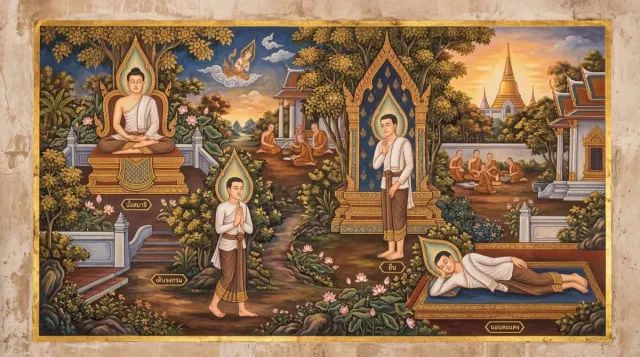
Unwholesome thoughts can arise while walking, standing, sitting or lying down. Entertain them and you are call…
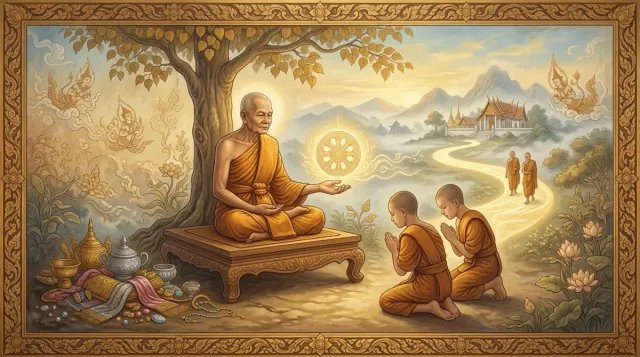
The Buddha wanted his disciples to inherit the Dhamma, not gain and honour — and Sāriputta lists sixteen defil…

Waste tipped over the wall onto a passer-by's head, waste dumped into a neighbour's rice field, and relieving …