
The Minor Matters Chapter: Not Dressing Up to Show Off, but Caring for the Body When Needed
KhuddakavatthukkhandhakaṃThe group of six monks rubbed their bodies against trees, wore jewellery, grew their hair long, looked in mirr…



Ambaṭṭhasuttaṃ
A young brahmin versed in the three Vedas visits the Buddha and insults the Sakyans as inferior to brahmins. The Buddha takes apart his pride of birth with reasoning, and declares that one accomplished in knowledge and conduct is best of all.
In the Ambaṭṭha Sutta of the Dīgha Nikāya, Sīlakkhandha Vagga, the brahmin Pokkharasāti sends his pupil Ambaṭṭha, who has mastered the three Vedas, to find out whether the Buddha's reputation is true. Ambaṭṭha walks about and stands while talking to the seated Buddha, and when admonished, grows angry and three times insults the Sakyans as mere householders who do not honour brahmins.
The Buddha asks about his clan and recounts that the ancestor of the Kaṇhāyana clan was the son of a slave woman in the household of King Okkāka, forefather of the Sakyans. But when the other young brahmins begin to belittle Ambaṭṭha harshly, the Buddha stops them, saying that this Kaṇha became a great sage.
He then quotes the verse of Brahmā Sanaṅkumāra: among people who rely on clan, the khattiya is best, but one accomplished in knowledge and conduct is best among gods and humans. He explains that in knowledge and conduct there is no talk of birth, clan or conceit. In the end Pokkharasāti, angry that his pupil gave offence, hurries to apologise to the Buddha, hears the Dhamma and gains the eye of Dhamma.
Ambaṭṭha walks about and stands while speaking to the seated Buddha, claiming that brahmins sit to talk with seated brahmins, but with shaven ascetics one may talk like this. The Buddha tells him to attend to the purpose he came for, and says that Ambaṭṭha, though untrained, imagines himself trained.
A degree or book knowledge is no substitute for courtesy towards strangers. Notice how you speak to people you think of as "beneath" you.
Ambaṭṭha recounts going to the Sakyans' assembly hall, where they sat on high seats, poking each other and laughing, and no one offered him a seat. The Buddha says that even a little quail chatters as it pleases in its own nest; Kapilavatthu is the Sakyans' own home, and Ambaṭṭha should not take offence at such a trifle.
When you visit an unfamiliar place and are received poorly or laughed at a little, don't carry it as a wound or generalise it to the whole group.
After Ambaṭṭha insults the Sakyans three times, the Buddha asks his clan and recounts that the Kaṇhāyana line began with a son of the slave woman Disā. Ambaṭṭha stays silent, but finally admits he has heard it so. When the other young brahmins then belittle him as a slave's son, the Buddha stops them, saying not to disparage Ambaṭṭha too harshly, for that Kaṇha became a great sage.
When you see someone who looked down on others being put in their place, don't join in piling on. The Buddha himself stopped others from belittling him further.
Using the brahmins' own customs, the Buddha shows that if birth were the measure, khattiyas would still rank above brahmins. He then quotes the verse of Brahmā Sanaṅkumāra: "The khattiya is best among people who rely on clan; one accomplished in knowledge and conduct is best among gods and humans," and says that he too says the same.
When someone claims their group is superior, shift the question from "Who were they born as?" to "What do they know and what do they do?"
The Buddha says that claims based on birth, clan or conceit, such as "You are worthy of me" or "You are not worthy of me", belong to matters of giving and taking in marriage, but have no place in supreme knowledge and conduct. Those still bound by claims of birth, clan or conceit are far from it, and it is realised by abandoning them.
When hiring or admitting people to a group, look at ability and conduct, not surname or background.
When Ambaṭṭha asks, the Buddha describes the training of one who goes forth out of faith: virtue, restraint of the senses, mindfulness and clear comprehension, contentment, the jhānas, and on to the various knowledges. A monk who practises thus is called accomplished in knowledge and conduct; there is no knowledge and conduct higher than this.
If you truly want to become a better person, start with what can be trained every day, your conduct, care of the mind and understanding, not what you were born with.
The Buddha says that some ascetics or brahmins, failing to attain knowledge and conduct, go to the forest to live on fallen fruit, or on roots and tubers, or set up a fire shrine, or build a four-doored house at a crossroads to honour whoever comes. All four ways only make them attendants of one accomplished in knowledge and conduct. He says Ambaṭṭha and his teacher do not even follow these ways, and that reciting the hymns of the ancient sages does not make one a sage, since those sages did not live in the luxury they live in.
Being able to recite the teachings of great people does not make us like them. Ask how close your way of life is to the teachings you can recite.
This story does not teach using birth to put others down in return. When the Buddha raises lineage and brahmin customs, he is using the other side's own standards to show that claims based on birth have no firm footing. The real point is the line that excellence is measured by knowledge and conduct.
Today pride may not come as caste, but as surname, the school one graduated from, the neighbourhood one lives in, or job title. The discourse invites us to notice: whenever we start thinking "people like that aren't good enough for us", we are moving away from true excellence.
Another point: much learning does not mean one has been trained. Ambaṭṭha knew many texts, but had not yet learned courtesy or how to control his anger.
Tap to read the actual passage on the page cited.
The group of six monks rubbed their bodies against trees, wore jewellery, grew their hair long, looked in mirr…

Taking "me" apart into six elements — earth, water, fire, air, space and consciousness. The analysis the Buddh…

An elephant trainer's son remarks that animals are easy to read but humans are a tangle. The Buddha describes …
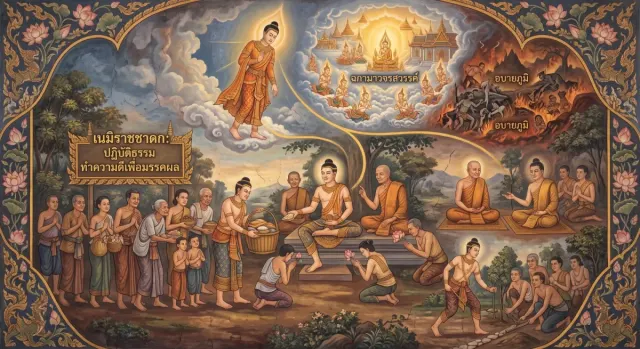
King Nemi wonders whether giving or the holy life bears greater fruit. The divine charioteer Mātali shows him …