
The Three Characteristics
TilakkhaṇaṃThree marks shared by everything — impermanent, unable to hold its shape, and not a self. Visible in the small…


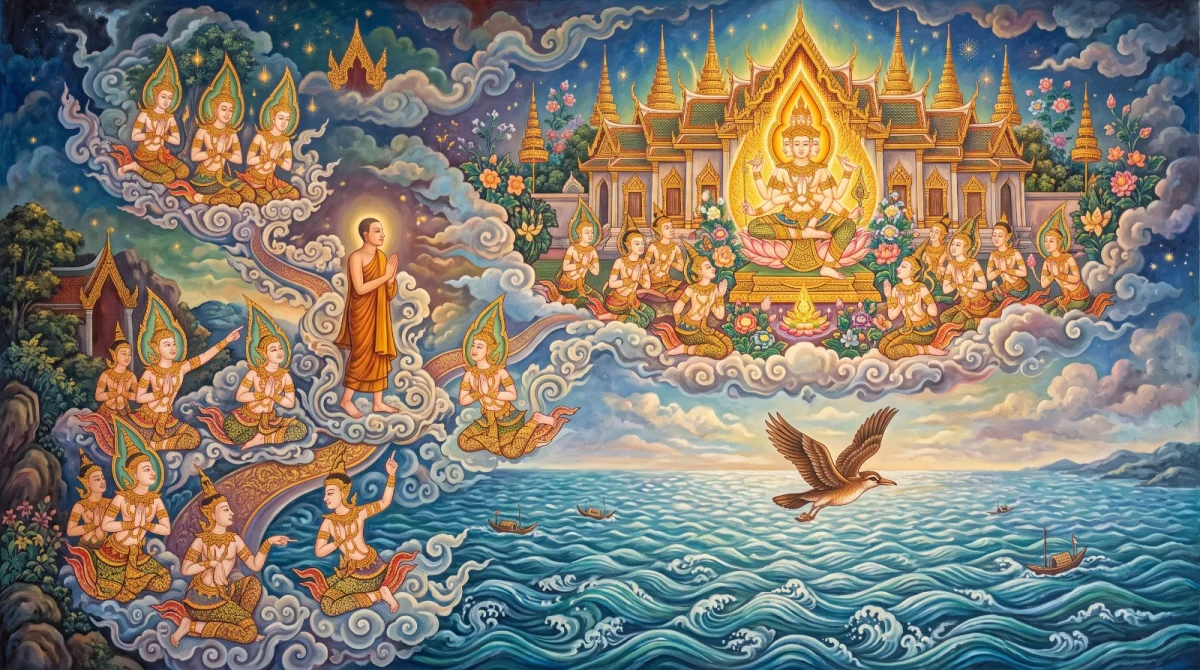
Tīradassiṃ sakuṇaṃ
A monk wonders where the four great elements cease without remainder and asks the gods realm by realm up to the Great Brahmā. No one knows. The Great Brahmā is too embarrassed to admit it before his retinue and sends him back to the Buddha, who compares him to a shore-sighting bird returning to the ship and teaches him to rephrase the question correctly.
In the Kevaddha Sutta of the Dīgha Nikāya (Sīlakkhandha Vagga), the householder Kevaddha at Nālandā asks the Buddha to have a monk perform a psychic wonder so that the townspeople will have even more faith. The Buddha refuses and describes three kinds of wonder: the wonder of psychic power, the wonder of mind-reading and the wonder of instruction. He sees danger in the first two, since a sceptic could dismiss them as mere magic charms, and presents teaching people to train themselves as the wonder of instruction.
At the end of the discourse the Buddha tells of a monk who wondered where earth, water, fire and air cease without remainder. He entered a concentration in which the path to the heavens appeared, and questioned the gods of the Four Great Kings and upward, realm by realm. Each said they did not know but those above surely did, until he reached the Great Brahmā.
The Great Brahmā dodged the question three times by describing his own greatness, then took the monk aside, admitted he did not know, and said the monk had made a mistake in bypassing the Blessed One to look for an answer outside. The monk returned to ask the Buddha, who told the simile of the shore-sighting bird, corrected the question, and gave the answer in verse.
A monk wonders where the four great elements, namely the earth, water, fire and air elements, cease without remainder. He enters a concentration in which the path to the heavens appears, and sets out to find the answer.
Doubt is a good starting point, but before searching for answers, first ask who is likely to truly know about the matter.
The gods of the Four Great Kings say they do not know, but the Four Great Kings surely do. The Four Great Kings say they do not know, but the gods of the Thirty-Three surely do. So it goes, realm by realm, up to the gods of Brahmā's host, who say they do not know but the Great Brahmā surely does, and that he appears when a light arises.
When you keep getting passed from one person to the next, stop and consider whether you are asking the right person, or asking the right question.
When the monk asks, the Great Brahmā replies: I am Brahmā, the Great Brahmā, the supreme one unsurpassed, the maker, the father of all beings. The monk says he did not ask that; he asked where the elements cease. The Great Brahmā gives the same reply, three times in all.
Be wary of answers full of titles and achievements that don't address what was asked. You can politely repeat the question to bring it back to the point.
The Great Brahmā takes the monk by the arm, leads him aside and says that the gods of Brahmā's host believe there is nothing Brahmā does not know or see, so he could not say in front of them that he didn't know. He says the monk made a mistake in bypassing the Blessed One to look for an answer outside, and tells him to go back, ask the Blessed One, and remember his answer.
If you are a leader or someone others expect to know, practise saying openly "I don't know this; try asking this person", without waiting to say it in private.
The Buddha says that ocean-going merchants take a shore-sighting bird on board. When they can't see land they release it. It flies in every direction; if it sees land it keeps going, and if not it returns to the ship. Likewise the monk searched all the way to the Brahmā world without finding an answer, and had to come back to the Buddha.
Trying many sources is not wrong, but if you keep circling without finding anything, return to the reliable principles you already have.
The Buddha says the question should not be asked that way, but rather: where do earth, water, fire and air find no footing? Where do long and short, fine and coarse, beautiful and ugly find no footing? Where do name and form cease without remainder?
When you can't find an answer for a long time, write the question another way. Often the problem lies in the question rather than a lack of information.
The answer is: consciousness that makes no showing, infinite, radiant all round; here earth, water, fire and air find no footing, forms find no footing, and name and form cease without remainder; with the cessation of consciousness, name and form cease here without remainder. The Thai Royal Edition renders consciousness here as the nature that knows clearly, and the commentary explains it as referring to Nibbāna. This point is for overall understanding.
Don't rush to settle the meaning of a profound passage in one reading. Read slowly, compare translations and ask those who know, rather than clinging to your first interpretation.
This story carries two lessons that always apply. First, high position does not mean knowing everything, and people with status sometimes dare not say "I don't know" in front of others. So we shouldn't believe something just because of the speaker's rank, nor be afraid to say we don't know ourselves.
Second, a badly framed question can send us searching far and wide for nothing. Going back to reframe the question so it matches what we really want to know often helps more than asking more people.
The verse answer at the end is profound; general readers can study it for overall understanding.
Tap to read the actual passage on the page cited.
Three marks shared by everything — impermanent, unable to hold its shape, and not a self. Visible in the small…

The section on single persons sorts noble individuals by two criteria: whether they touch the eight liberation…
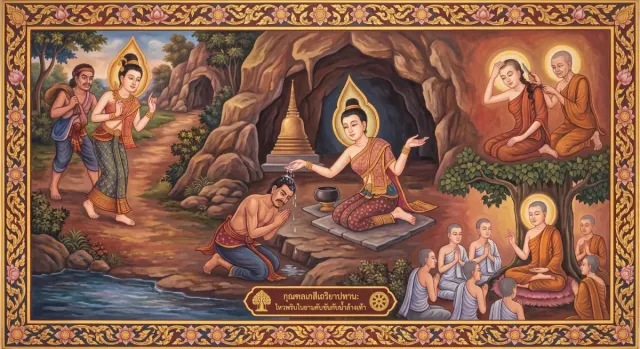
Bhaddā Kuṇḍalakesā tells her life: falling in love with a thief about to be executed, surviving him through qu…

Ānanda asks how a community of monks can live comfortably. The Buddha answers in stages, beginning with keepin…