
The Fortress Discourse: A Frontier Fortress for the Mind
NagarasuttaṃJust as a frontier fortress with seven defences and four kinds of provisions cannot be harmed by enemies, a no…


Pañcime gahapatayo ānisaṃsā sīlavato sīlasampadāya
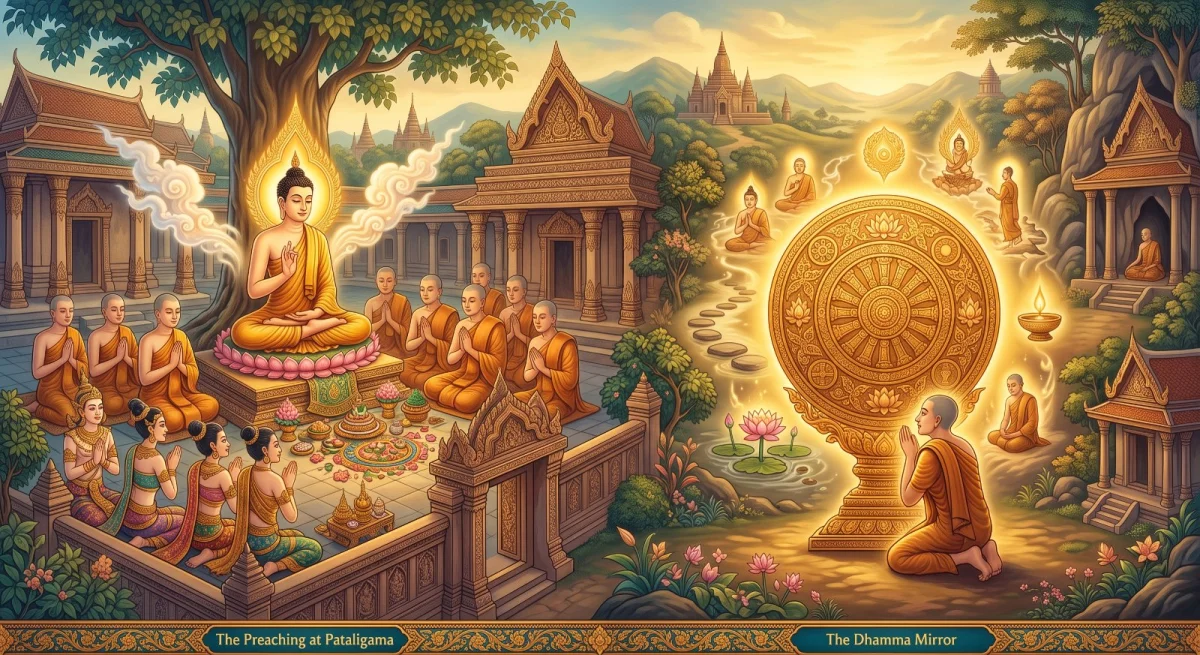
On his last journey to Vesālī, the Buddha teaches the lay followers of Pāṭaligāma the five dangers of immorality and the five benefits of virtue, and at Nādikā gives the "mirror of the Dhamma" so each person can look at themselves.
In the Mahāparinibbāna Sutta of the Dīgha Nikāya, Mahā Vagga, on the journey from Rājagaha to Vesālī the Buddha reaches Pāṭaligāma. The lay followers prepare their rest house, spreading mats, setting out a water jar and lighting a lamp, and invite him. Late into the night he teaches these householders that immorality has five dangers and a virtuous person has five benefits.
Later, at Koṭigāma, he tells the monks that it is through not understanding the four noble truths that they have wandered so long. At Nādikā, Ānanda asks about the destinations of many monks, nuns and lay followers who have died. The Buddha answers, then says it is no wonder that humans die, and it would be wearisome if he were asked each time. So he teaches the mirror of the Dhamma, by which a noble disciple can see for themselves.
Throughout the journey, the discourse records, he taught the monks again and again that virtue, concentration and wisdom develop one after another until the mind is freed from the taints.
The immoral person suffers great loss of wealth because of heedlessness; the virtuous person gains a great store of wealth because of heedfulness.
Track your spending for a month and see what went on alcohol, gambling or careless spending. That is the price of heedlessness.
A bad reputation spreads about the immoral person; a good reputation spreads about the virtuous one.
A reputation is built from small things repeated daily, such as being on time, returning what you borrow and doing what you said, more than from any big show.
Whatever assembly the immoral person enters, whether of nobles, brahmins, householders or ascetics, they enter timid and embarrassed. The virtuous person enters confident and at ease.
Notice when you don't want to meet someone's eye in a meeting; there is often something you haven't handled straightforwardly. Putting it right is the way back to confidence.
The immoral person dies confused; the virtuous person dies unconfused.
A life with no lingering regrets is the best preparation for death. You can start today by apologising for or making good what has been left undone.
The discourse says the immoral person, after death, is reborn in a state of loss, a bad destination, the underworld, hell; the virtuous person is reborn in a good destination, a heavenly world.
Even if you're unsure about future lives, the first four points already show their results in this life. So virtue is worthwhile both for those who believe and for those still in doubt.
At each place he stayed, he taught the monks again: such is virtue, such is concentration, such is wisdom. Concentration developed with virtue is of great fruit; wisdom developed with concentration is of great fruit; the mind developed with wisdom is freed from the taints.
If your mind is restless in meditation over something you did wrong, look at your virtue first. A mind with nothing to hide settles much more easily.
A noble disciple with unwavering confidence in the Buddha, the Dhamma and the Saṅgha, and with virtues unbroken, untorn, unblemished and unspotted, conducive to concentration, can declare of themselves if they wish that they are a stream-enterer, no longer liable to fall.
Before bed, take a quick look in the Dhamma mirror: is my confidence in what is good still steady today, and which precept is starting to get blemished? Don't wait for others to judge you.
The dangers and benefits of virtue in this discourse are things anyone can see in this life, without waiting for the next. The heedless lose money to vice, cheats lose their good name, and those who have done wrong feel uneasy walking into a meeting.
The mirror of the Dhamma is a tool for every day. Instead of asking others whether we're good enough, look for yourself: is your confidence in what is good steady, and is your virtue still unbroken and unblemished?
Virtue is not a measure of who is better than whom. It is the ground that makes the mind calm enough to go on training in concentration and wisdom.
Tap to read the actual passage on the page cited.
Just as a frontier fortress with seven defences and four kinds of provisions cannot be harmed by enemies, a no…

The Compendium Chapter works through the difficult cases of probation (parivāsa) and penance (mānatta): severa…

The Paṭisambhidāmagga sets out the patterns of kamma and its result in past, present and future: kamma whose r…

A small thing the mind refuses to release can bind as tightly as the rotten creeper that holds a quail, while …